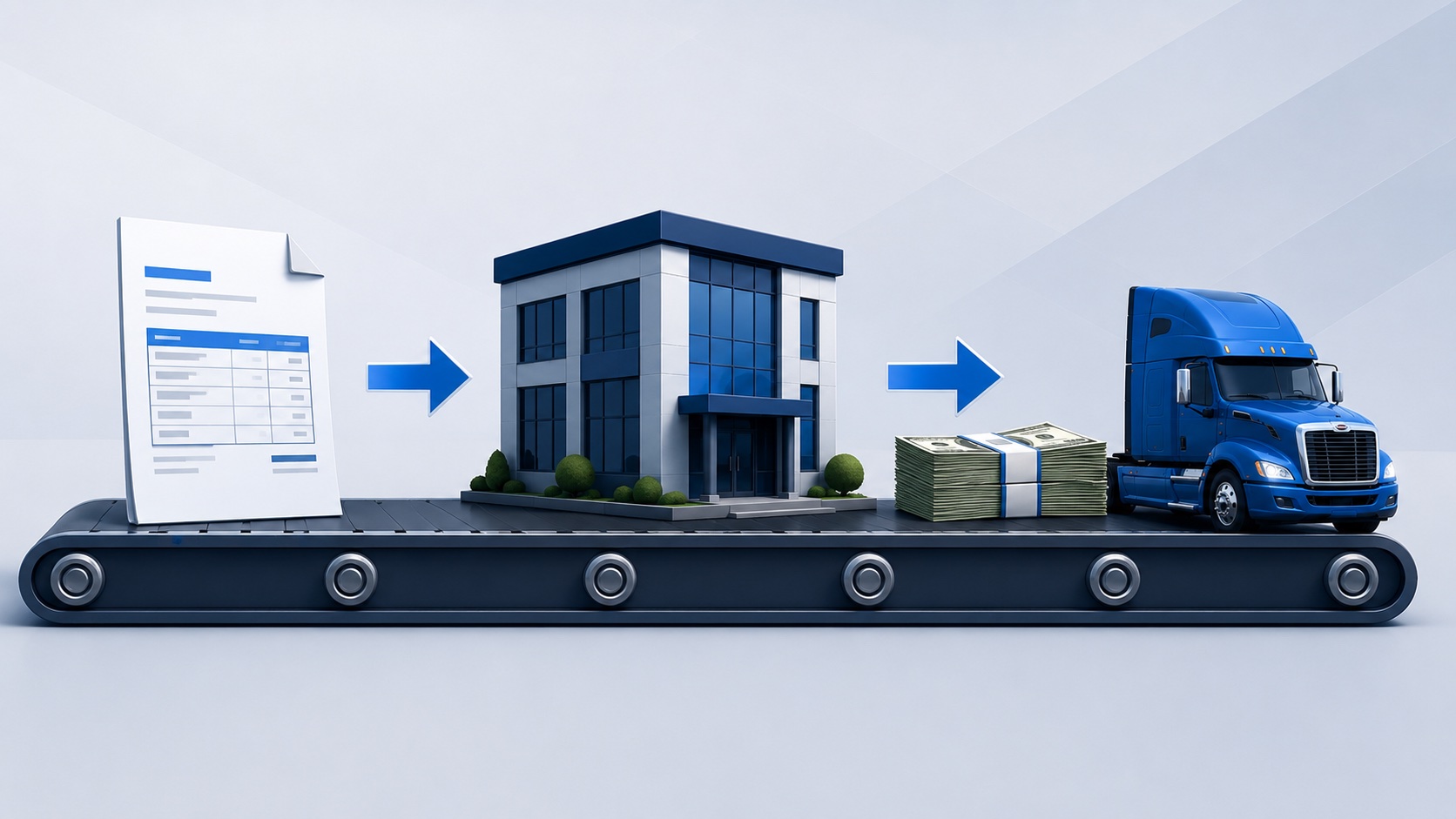
Factoring in trucking is when you sell an unpaid freight invoice to a third-party company, called a factor, in exchange for immediate cash, typically 85–97% of the invoice value paid the same day you submit it. Brokers pay in 30 to 90 days. Factors pay today. Those two facts have never lined up on their own, and that gap is the entire reason the freight factoring industry exists.
For carriers running tight margins, the wait for broker payment creates a cash flow problem that compounds fast. Diesel doesn't wait. Insurance doesn't wait. The truck that just threw a turbo doesn't wait. Factoring closes that gap. But the cost difference between factoring companies can be significant, and the contract terms even more so. Understanding how factoring works, what it actually costs, and which type fits your operation is one of the most consequential financial decisions you'll make as a carrier.
Freight factoring is a financial arrangement where a trucking company sells its accounts receivable, the unpaid invoices from brokers or shippers, to a factoring company at a discount. The factor pays the carrier most of the invoice value upfront, then collects the full amount from the broker when the invoice comes due. The factor keeps a small percentage as its fee.
That's the textbook definition. Here's the trucker version: you sell the IOU, you get paid now, and the factoring company does the waiting. Before you sign anything, though, it pays to know exactly how the money moves:
1. You deliver the load and generate an invoice. Nothing changes about how you haul freight. You pick up, deliver, and get your paperwork: BOL, rate confirmation, proof of delivery.
2. You submit the invoice to your factoring company. Instead of sending it to the broker and waiting, you upload it to your factor. Most companies have apps or portals that make this a 5-minute process.
3. The factor advances 85–97% of the invoice value. This is the advance rate. If your advance rate is 95% on a $2,000 invoice, you receive $1,900 within hours, sometimes minutes. The remaining 5% ($100) goes into a reserve held by the factor.
4. The factor collects payment from the broker. Your factor now owns the invoice. The broker pays the factor directly, usually within 30–60 days.
5. The factor releases your reserve, minus the factoring fee. Once the broker pays, the factor deducts its fee (typically 1.5–5% of the invoice value) from the reserve and sends you the remainder.
The result: you get the vast majority of your money the same day you deliver, instead of waiting a month or more. The factor earns its fee for fronting the cash and handling collections. The broker's payment timeline doesn't change at all: they still pay on their normal terms. The difference is that the factor, not you, is the one waiting.
One critical detail that surprises many carriers: factoring approval is based on the broker's credit, not yours. The factor is evaluating whether the broker will pay the invoice, so it's the broker's payment history and financial stability that matter. Your personal credit score, your time in business, and your fleet size are largely irrelevant to the approval decision.
Bad personal credit doesn't keep carriers from factoring. Bad brokers do.
So what does that sequence look like with real dollars moving? Follow one invoice through.
Factoring company (factor): A financial company that purchases unpaid freight invoices from carriers at a discount and collects payment from the broker or shipper. The factor is not a lender; it's buying an asset (your invoice), not issuing a loan.
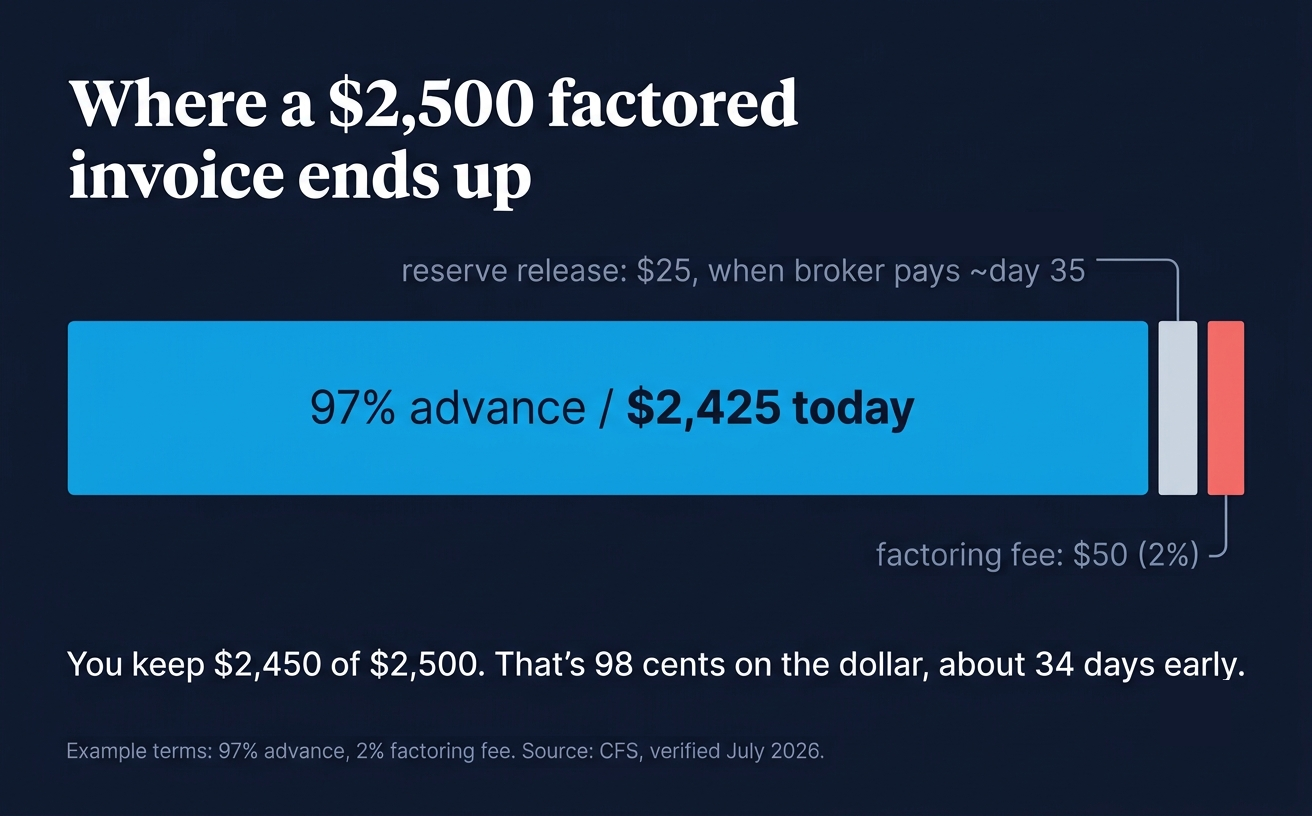
The fastest way to understand factoring is to follow real dollars through it. One $2,500 load, factored at a 97% advance rate with a 2% factoring fee, typical mid-range terms for a small carrier.
Day 1. You deliver, upload your paperwork (BOL, rate confirmation, proof of delivery), and the factor verifies the load. By the afternoon, $2,425 (the 97% advance) is in your account. The factor holds the remaining $75 as a reserve.
Day 35. The broker pays the factor the full $2,500 on its normal terms. The factor takes its fee out of the reserve ($50, which is 2% of $2,500) and releases what's left to you: $25.
The ledger: you received $2,450 of a $2,500 invoice. The factor kept $50 for fronting the cash and handling collection.
You kept 98 cents on the dollar and skipped a 34-day wait. That is the entire product.
One piece of paperwork makes all of this enforceable: the Notice of Assignment (NOA), a formal letter your factor sends each of your brokers stating that your invoices have been assigned and payment must go to the factor. Every factor requires it before funding, and it is what makes the assignment stick legally. Carriers sometimes worry an NOA signals financial trouble; in practice, factoring is so common in trucking that broker accounting teams process NOAs as routine paperwork. For the step-by-step version with document requirements and timelines, see our full guide to how freight factoring works.
The NOA redirects all broker payments to your factor. Once delivered, your brokers pay the factoring company, not your bank account. And you cannot undo it yourself: only a release letter from your factor, usually withheld until your balance is settled, points payments back to you. Plan the unwind before you need it.
Not all factoring arrangements work the same way. There are four distinct types, and the one you choose affects your rates, your risk exposure, and how much flexibility you have. Here's how they break down:
1. Recourse factoring. The most common type and usually the cheapest. With recourse factoring, if the broker doesn't pay the invoice within a set window (typically 60–90 days), you're responsible for buying it back. You carry the credit risk. In exchange, rates are lower: typically 1.5–3% of invoice value. Best for carriers who haul for established brokers with strong payment histories.
2. Non-recourse factoring. The factor assumes the credit risk if the broker fails to pay. If a broker goes bankrupt or becomes insolvent, the factor absorbs the loss, not you. Rates are higher to compensate, typically 2.5–5%. Best for carriers who work with smaller or less established brokers. But read the fine print carefully: what counts as "non-recourse" varies dramatically between companies.
3. Spot factoring. You factor individual invoices on a one-off basis with no ongoing contract or commitment. No minimum volume, no long-term agreement. The trade-off is cost: spot factoring rates run 4–8% per invoice because the factor can't amortize its costs across a steady stream of invoices. Best for carriers who only need cash flow help occasionally or want to test factoring before committing. Small-invoice niches price differently too; hotshot factoring is the worked example.
4. Contract factoring. An ongoing relationship where you agree to factor invoices regularly, often with a minimum monthly volume. In return, you get the lowest rates, typically 1.5–4%, and often better advance rates and faster funding. Contract terms range from 30 days (Bobtail Capital) to 24 months (some traditional factors). Best for carriers who factor consistently and want the lowest possible cost per invoice.
A reality check on that non-recourse fine print. One carrier we profiled had a broker go silent on $2,900 across three delivered loads: no bankruptcy filing, just dodged calls for months. He wasn't factoring at the time, but his story is exactly why the definitions matter, because a ghosting broker is the most common failure, and it is the one most "non-recourse" contracts do not cover (his full story).
Most carriers start with either spot factoring to test the process or contract factoring to lock in better rates. The choice between recourse and non-recourse is the more consequential decision, and it's the one where carriers most often get burned by assumptions. We break down exactly what each type covers (and doesn't cover) in our recourse vs. non-recourse factoring guide.
Whichever type fits your operation, the next question is the same: what does all of this actually cost?
Most "non-recourse" factoring contracts only protect you if the broker files for bankruptcy, not if they dispute the invoice, short-pay, or simply refuse to pay. If a broker claims the load was damaged or the rate was wrong, you're still on the hook under most non-recourse agreements. Don't assume "non-recourse" means zero risk. Read the contract definition of a "credit event" before you sign.
Factoring rates typically range from 1.5% to 5% of each invoice's value, but the headline rate is often not what you'll actually pay. The total cost of factoring includes the base rate plus any additional fees the company charges. Those fees vary widely.
Here's the math on $10,000 a month in factored invoices:
The spread between the low and high end is $350 a month, $4,200 a year, money that comes straight out of your margin before anything else moves.
But the base rate doesn't tell the full story. Many factoring companies charge additional fees that inflate the true cost:
Here's a real example from CFS rate research that shows why all-in cost matters more than the headline rate. A carrier factoring a $1,200 invoice:
The company with the lower headline rate cost 25% more on the actual invoice. This is exactly why CFS recommends asking for the all-in cost on a specific invoice amount, not just the rate percentage.
The percentage is marketing. The all-in number is the price.
Want yours? Our freight factoring calculator runs the all-in math on your own volume and invoice size in about a minute.
For a complete breakdown of how factoring rates work, what affects your rate, and how to negotiate, see our freight factoring rates guide.
What determines your rate? Several factors:
Which leaves the only question that actually matters: is it worth it for your operation?
Ask every factoring company for their all-in cost on a $10,000 invoice before comparing. Request an itemized breakdown that includes the factoring fee, ACH/wire fees, invoice processing fees, and any other charges. The base rate alone doesn't tell you what you'll actually pay. The company with the lowest rate sometimes costs more.
Factoring solves a specific problem: you've earned the money, but you can't access it for 30–90 days. Whether factoring is worth the cost depends on how badly that delay hurts your operation.
Factoring makes strong sense when:
Factoring may not be the right fit when:
If factoring fits your operation, here's what to evaluate when choosing a company:
Do I need a factoring company near me? No. Factoring is a fully remote service: invoices upload through an app or portal, and money moves by ACH. Where the company is headquartered has zero effect on service quality. Compare rates, contract terms, and funding speed, never geography.
How do factoring companies make money? The factoring fee is the business model: buy your $1,000 invoice, collect $1,000 from the broker, keep the 1.5–5% fee for fronting the cash and running collections. Some companies also earn on add-ons like ACH fees, wire fees, and fuel card interchange, which is exactly why the all-in cost matters more than the advertised rate.
What happens if the broker disputes the invoice? A documented dispute usually suspends payment and, under most contracts (recourse and most "non-recourse" alike), puts the invoice back on you until it's resolved. Clean paperwork is your best protection: signed BOL, proof of delivery, and the rate confirmation, submitted with every load.
Can I factor only some of my invoices? Depends on the contract. Spot factoring lets you pick invoice by invoice at higher rates (typically 4–8%), while many full-service contracts include a blanket assignment clause requiring every invoice to go through the factor. If selectivity matters to your operation, ask before signing and get the scope in writing. The crossover math is in our spot vs contract factoring breakdown.
CFS has ranked and reviewed the top 7 freight factoring companies with full rate data, contract terms, advance rates, and real carrier feedback. If you're ready to compare options, start with our best freight factoring companies for trucking rankings.
No. Factoring is the sale of an invoice you already earned, not borrowed money. There is no debt on your books, no monthly loan payment, and approval depends on your broker's credit rather than yours.
Most trucking factoring rates fall between 1% and 5% per invoice, with typical single-truck rates in the 2% to 4% range. The advertised rate is not the whole story; run any quote through our factoring calculator to see your true cost after fees.
Not with most modern factoring companies. Many, including our top-ranked picks, let you choose which invoices to factor with no monthly minimums. Some traditional factors still require whole-ledger factoring, which is worth checking before you sign.
Yes. Factoring approval is based on your customers' credit, not your company's age, which makes it one of the few funding tools available on day one of a new authority. If the authority itself is still ahead of you, start with our guide to becoming an owner-operator. See our guide to factoring for new authorities.
It depends on your agreement. With recourse factoring, you buy the invoice back. With true non-recourse factoring, the factor absorbs the loss if the broker defaults. That difference is the single most important line in your contract. If you are in that situation right now, our broker non-payment playbook covers the recovery steps.
Factoring is not a loan; you're selling an invoice you've already earned, not borrowing against future revenue. There's no debt added to your balance sheet, no interest charges, and your personal credit score is not a factor in approval. If a factoring company runs your personal credit as part of the application, that's unusual and worth questioning.
"I'm just a one-man operation. I need my money now... quick pay or even factoring for me is a no-brainer."
New articles for owner-operators, delivered twice a month.