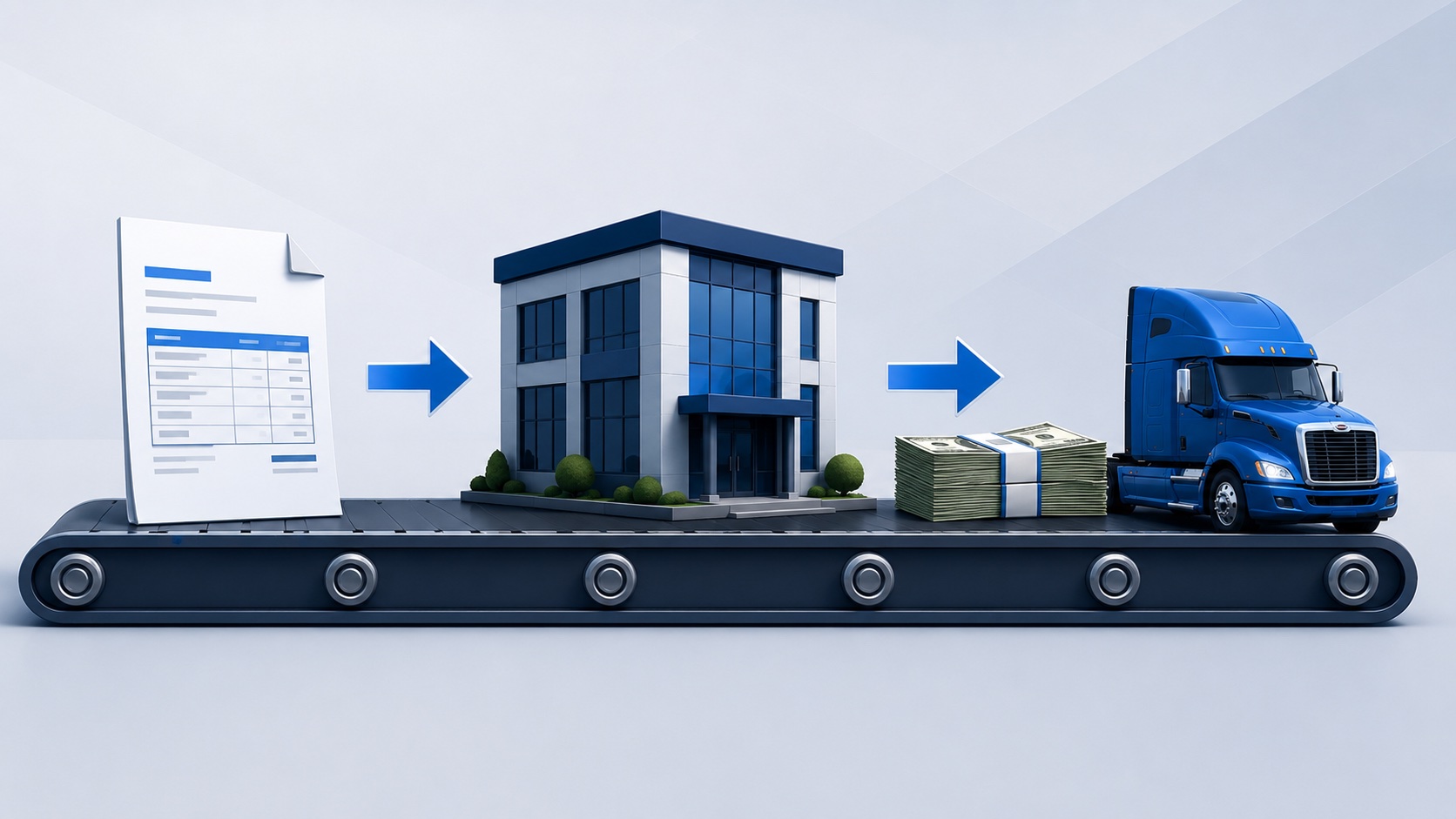
Net 30 means the full invoice amount is due within 30 days. Simple, until you ask the question that actually determines when you get paid: 30 days from what? From delivery? From the invoice date? From when the broker's accounting inbox received your complete packet? In trucking the answer is usually the last one, and the difference between those start lines is regularly a week or two of extra waiting that carriers blame on the broker and, sometimes, caused themselves.
Net 30 is the default heartbeat of freight payments, the reason the factoring industry exists, and the single biggest cash-flow fact a new carrier has to plan around. This guide covers what the term really commits a broker to, what the wait costs you on a real load, why "net 30" so often lands as day 38, and the honest comparison of the four ways carriers bridge the gap.
Net 30 sounds harmless when you're booking the load: haul it now, get paid in 30 days. Then the fuel bill lands in week one, the truck payment in week two, and you start to understand why payment terms quietly run the whole business.
"Net" in payment terms means the full amount, no discount; the number is the day count. Net 30: the entire invoice is due within 30 days. Net 15, net 45, and net 60 work the same way with different clocks. In freight, net 30 is the overwhelming convention for broker-to-carrier payment, common enough that most rate confirmations assume it silently.
The three details that decide when money really moves:
When the clock starts. Rarely at delivery. Most broker terms run from receipt of a complete, correct invoice packet: your invoice, the signed BOL or POD, the rate confirmation, plus any receipts (lumper, detention backup). Deliver Monday and invoice Friday, and you gave away four days. Send a packet missing a signature page, and the clock may not have started at all; it starts when the corrected packet lands. The single highest-leverage habit in this whole article: invoice same-day, complete, every load.
What "due" means in practice. Due within 30 days means the broker cuts payment by day 30, and then it travels: a mailed check or a standard ACH adds days. Day 30 compliance frequently produces day 33 to 38 money. Brokers who consistently drift past terms show up in freight credit data as "days to pay," which is a number worth checking before you book (a broker averaging 45 days-to-pay on net 30 terms is telling you their real terms).
Where the terms live. The rate confirmation and the broker-carrier agreement. Some brokers run net 45 or 60 standard; some agreements bury longer windows or offset rights in the fine print. There is no statute making 30 the legal maximum, so the paper you signed is the whole ballgame. Read the payment-terms line on every rate con from a new broker; it takes ten seconds and it is the cheapest due diligence in freight.
Days to pay: the broker's actual average payment speed as tracked by freight credit bureaus, as opposed to the terms they quote. A broker with net 30 terms and 31 days-to-pay is a broker who honors their word; a broker with net 30 terms and 47 days-to-pay has real terms of net 47 and a nicer brochure. Days-to-pay data is visible through load boards and factoring portals, and the trend matters as much as the level: a broker drifting slower quarter over quarter is showing you their cash position.
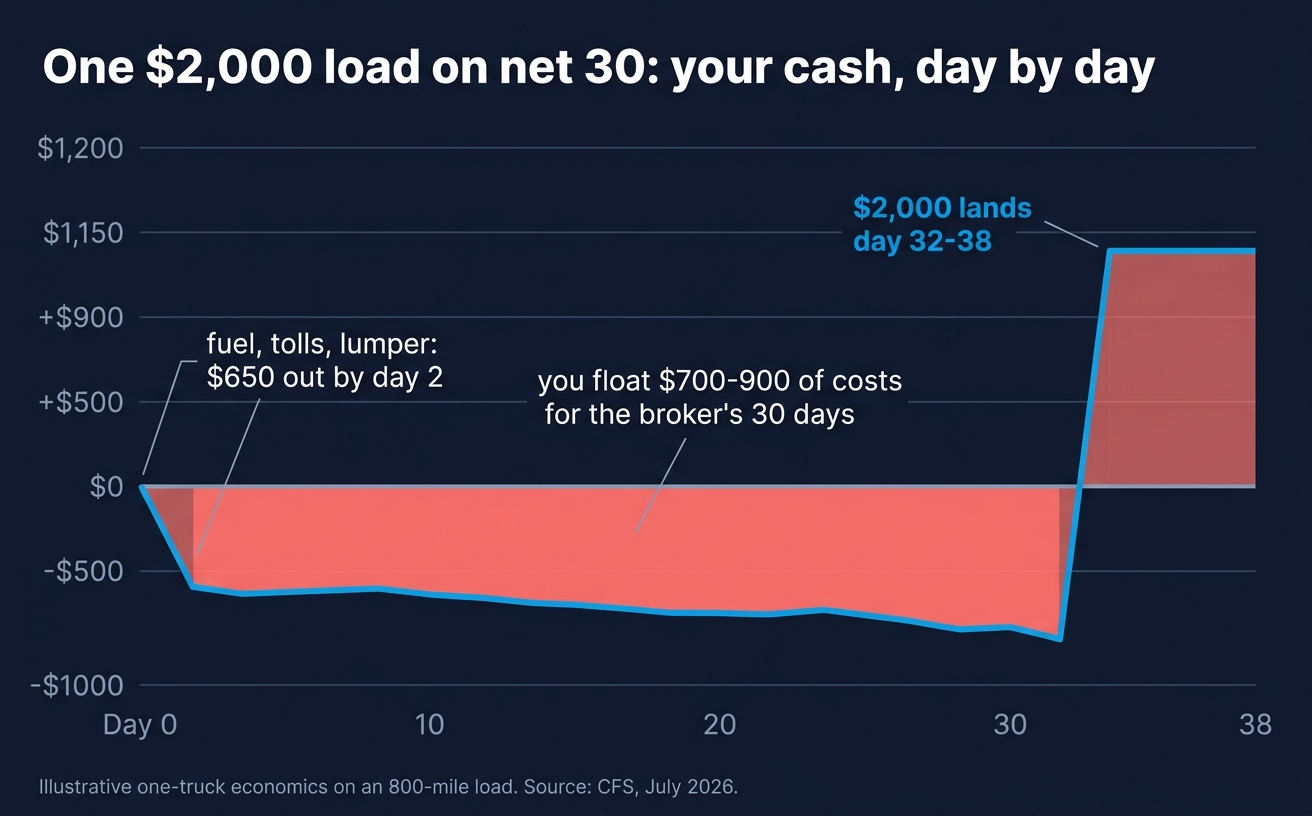
Here is the net-30 squeeze on a single, ordinary load: $2,000 from Atlanta to Dallas.
Days 1–2 (you spend): roughly $550 in fuel for ~800 loaded miles at current diesel prices, plus tolls and maybe a $75 lumper you cover at the dock. Call it $650 out of pocket before the freight is even off the trailer, all of it real money that left your account this week.
Day 2 (you earn, on paper): load delivers, POD signed. You are now owed $2,000. You submit your invoice packet the same day (because you read Section 1), and the clock starts.
Days 2–32 (you float): the truck payment, insurance installment, and your own pay do not pause for the broker's terms. Allocated per-load, fixed costs on a one-truck operation add a few hundred more against this load's revenue. By the time the $2,000 arrives, you have typically carried $700 to $900 of this load's costs for two to four weeks.
Day 32–38 (you get paid): the broker cuts payment on terms; transit adds a few days.
One load like this is an annoyance. The business problem is that you run ten to fifteen of these simultaneously: at three loads a week on net 30, you permanently float roughly a month of revenue, $20,000 to $25,000 for a typical solo operator, as an interest-free loan to your brokers. That float is the invisible startup cost nobody budgets (what starting really costs covers the reserve math).
And that is when terms are honored. Rohit Handa, an owner-operator we profiled, hauled three loads in late November on net 30 and was still chasing $2,900 in mid-January; the broker's net 30 turned into three months of "checks already sent" (the full playbook for that situation). Net 30 is a promise, and promises have a credit score.
The clock starts when your complete packet lands, which makes slow or sloppy invoicing a self-inflicted pay cut. A carrier who delivers Monday and invoices Thursday with a missing lumper receipt has added a week to net 30 and will experience it as "this broker pays slow." Submit the same day you deliver, from the truck if your tools allow it, with every document the rate con requires. It is the only part of the payment timeline you fully control, and it is worth several days on every single load.
Net 30 dominates, but the freight payment menu is wider, and knowing it changes how you book.
Net 15: some brokers offer it standard, others as a relationship perk to proven carriers. Half the float of net 30, at no fee. When two loads pay similarly, the net-15 broker is paying you meaningfully more per week of capital tied up.
Net 45 / net 60: common with shipper-direct freight and some large brokers' standard agreements. Not inherently a scam, but a $2,500 net-60 load and a $2,400 net-15 load are much closer in real value than they look, and only one of them doubles your float.
Quick pay: the broker pays in 1 to 7 days for a fee, typically 1.5 to 3 percent of the load. It converts terms into a price, per broker, per load. Coverage is the catch: it only exists where your broker offers it, terms vary broker to broker, and the rest of your ledger still rides net 30. The full cost comparison against factoring is in Freight Factoring vs. Quick Pay.
Factoring: sell the invoice to a factor and get most of it same-day, minus a fee in a similar percentage band, but across every broker on your ledger under one structure, with broker credit checks and collections included. The mechanics live in How Does Freight Factoring Work.
Can you negotiate terms? With small and mid-size brokers, sometimes, especially once you are a repeat carrier they want to keep: asking for net 15 or a fee-free quick pay lane on a dedicated relationship is normal business. Large brokers' terms are usually preset and firm; your negotiation there is the rate itself. The realistic frame: terms are one more axis of the rate, and a carrier comparing loads on price alone is comparing incomplete numbers. Price per mile matters; price per mile per week of waiting is the truer comparison.
Put payment terms on your load-selection scorecard next to rate per mile. A quick mental conversion: a 2 percent quick-pay fee to collect 30 days early is roughly a 24 percent annualized cost of money, steep but sometimes worth it; a broker offering net 15 standard is giving you the same acceleration free. Over a year, a carrier who systematically favors fast-paying brokers at equal rates runs on a fraction of the float, which is the same thing as needing a smaller reserve to run the same business.
Every carrier bridges the gap somehow. The four tools, honestly compared:
1. Cash reserves. The zero-fee option: enough operating cash to float a month of expenses without stress. This is how Rohit runs (deliberately holding reserves so he can "wait 30, 60, 90 days" without factoring), and it is the cheapest possible answer if you have the capital. The catch is that the reserve has to exist first, which is exactly the wall most new authorities hit; a month of float for a solo operation is five figures.
2. Invoicing discipline. Free, universal, underused. Same-day complete packets, submitted electronically, with the broker's required documents every time. Worth several days per load against the same terms, and it compounds with every other tool (factors also fund faster on clean paperwork).
3. Quick pay. Right tool when a couple of your regular brokers offer cheap programs and your remaining float is manageable. Wrong tool as a whole-business strategy, because coverage is spotty and per-broker.
4. Factoring. Right tool when you need the whole ledger accelerated: new authorities without reserves, growth phases where every dollar is working, or a broker mix you want credit-checked professionally. It has a real cost (the fee) and real fine print (contract terms, recourse structure), both covered candidly in our rates guide and contract red flags.
The honest sequencing for most carriers: discipline always; reserves as the destination; quick pay and factoring as the bridge sized to your gap. A new authority typically starts factoring-heavy out of necessity, builds reserves deliberately (pay the reserve first, like a bill), and earns their way toward optionality, choosing to factor for the broker-vetting and back-office value rather than needing it for survival. Carriers who never build the reserve stay on the bridge forever and pay for it monthly; carriers who treat the fee as the cost of growing fast while reserves accumulate are using the tool the way it works best.
Never book significant volume with a new broker on the strength of "net 30" alone. Terms describe when a solvent, honest broker will pay; they do nothing about a failing or slow-rolling one, and a rate confirmation is not collateral. Before hauling for anyone new, check their freight credit score and days-to-pay (87 and above is the low-risk threshold on the standard 0-100 freight scales). Net 30 from a 92-score broker is money in transit. Net 30 from a 58-score broker is a hope with paperwork.
Is net 30 required by law?
No. There is no federal statute setting broker-to-carrier payment deadlines; net 30 is convention and contract. Whatever the rate confirmation and broker-carrier agreement say governs, which is why reading the terms line before hauling matters more than industry norms. (Contrast: brokers do carry a federally required $75,000 bond that backstops non-payment, which is a different protection covered in what to do when a broker doesn't pay.)
Does net 30 mean I get paid on day 30?
It means payment is due by day 30, usually counted from complete invoice receipt, and then payment transit adds time. Practical arrival for an honored net 30 is often days 32 to 38. If a broker consistently lands beyond that, their days-to-pay data will say so, and so should your booking decisions.
Can I charge a late fee when a broker blows past terms?
Only if your paperwork provides for it, and collecting is another matter: brokers pay late fees about as eagerly as they pay disputed detention. A late-fee clause has some deterrent value, but the working remedies for real lateness are the escalation ladder (demand letter, bond claim, FMCSA complaint), not invoice surcharges. Prevention through broker vetting beats both.
Why would any carrier accept net 60?
Usually because the freight is good and consistent: shipper-direct contracts and large-broker dedicated lanes sometimes come with long terms attached to otherwise excellent business. The move is to price the float into the rate consciously (a net-60 lane needs to out-earn a net-15 alternative by enough to pay for doubling your float) or to plan on accelerating those specific invoices via factoring and treat the fee as part of the lane's cost.
Is factoring just for carriers who can't handle net 30?
No, and the framing runs backwards. Factoring converts terms into same-day cash for a fee, and whether that trade is worth it depends on what your capital is doing otherwise: a new authority uses it to survive the float; a growing fleet uses it so cash compounds into more trucks instead of sitting in brokers' payables; a reserve-rich solo operator may skip it entirely. The decision framework, with real carrier examples on both sides, is in Is Freight Factoring Worth It.
Dollar figures in this article (fuel costs on the sample load, float estimates) are illustrative at mid-2026 prices and typical solo-operator cost structures; your lane, equipment, and fuel economy move every number. The mechanics, when the clock starts, how terms interact with days-to-pay, what the float does to your working capital, are the durable part. Run your own loads through the same arithmetic once and you will never look at a rate confirmation's terms line the same way.
"Net 30 is a promise, and promises have a credit score."
New articles for owner-operators, delivered twice a month.