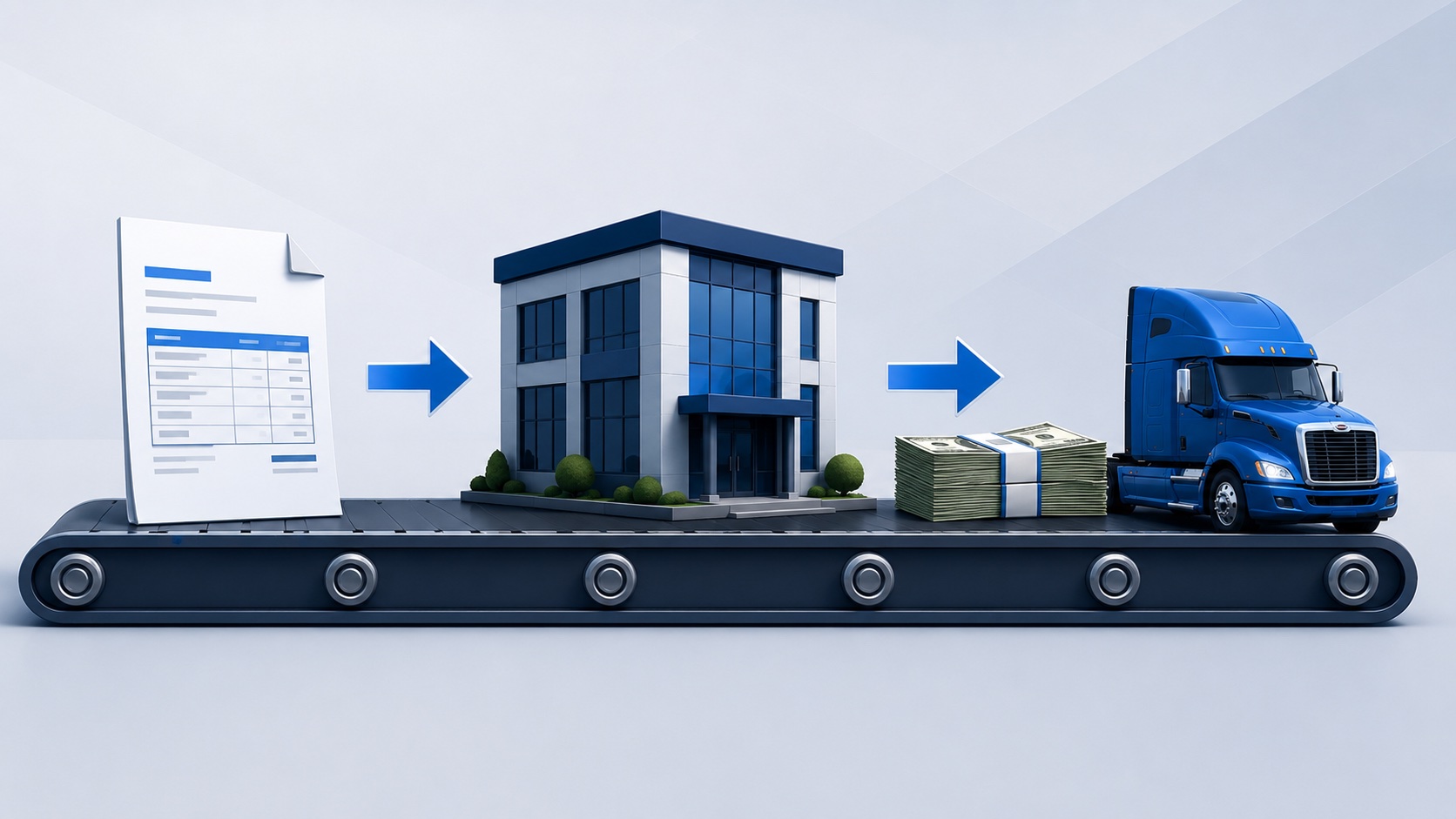
Freight factoring works by selling an unpaid invoice to a third-party company, called a factor, in exchange for immediate cash, usually 85–97% of the invoice value paid the same day. Brokers pay in 30 to 90 days. Factors pay today. Those two facts have never lined up on their own. That gap is why the factoring industry exists, and why what factoring actually costs is one of the most important financial decisions a carrier makes.
For owner-operators and small fleets, the math matters more than the concept. Most articles on this topic explain what factoring is without ever showing what it does to a real invoice. This article does the opposite: here is a $1,000 load, here is the arithmetic at each step, and here is what lands in your account on day one versus day 45. Once you see the numbers, the decision about whether to factor, and which company to use, becomes a lot more straightforward.
You deliver a load. The rate confirmation says $1,000. The broker has 30-day payment terms, but you have fuel to buy, a truck payment due, and exactly zero interest in waiting a month for money you already earned. You submit the invoice to your factoring company instead. Here is exactly what happens next.
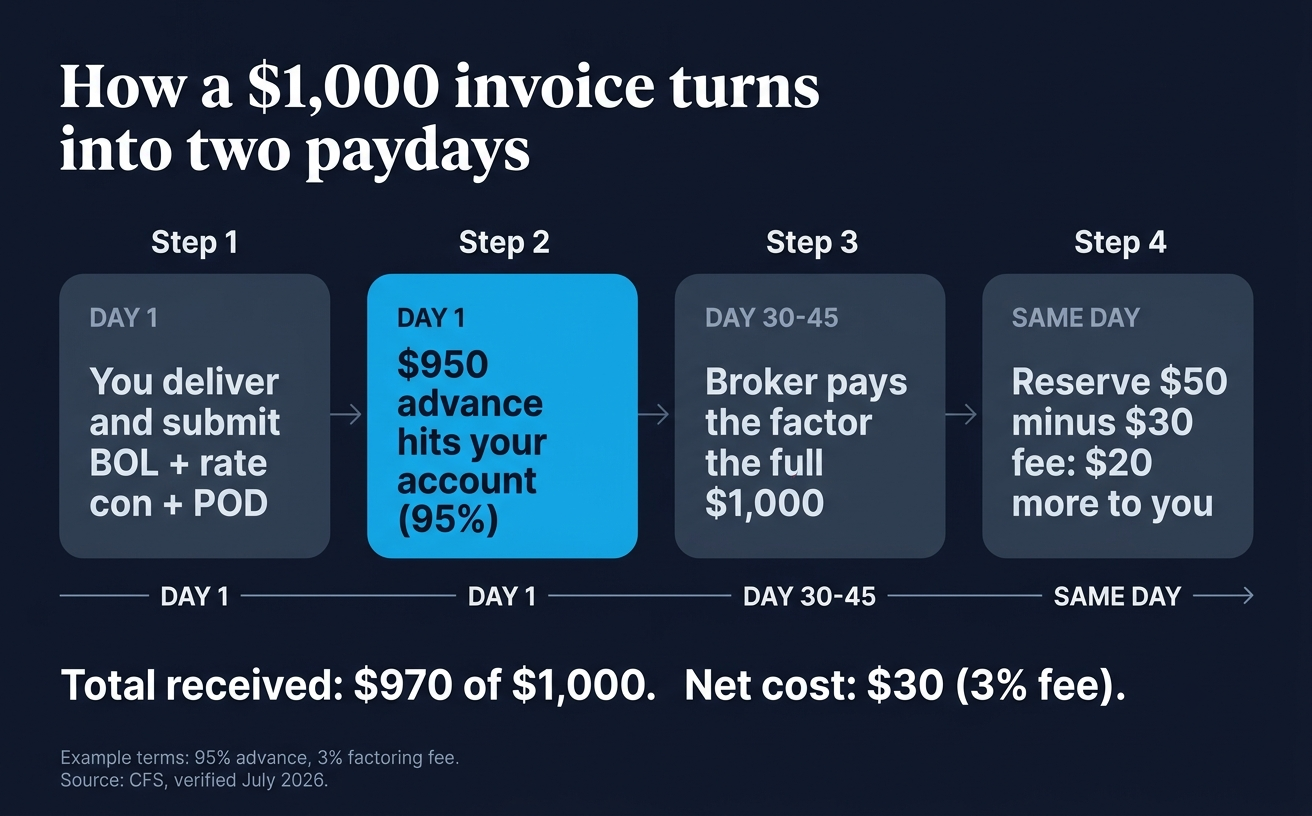
Step 1: The advance. Your factoring company advances you a percentage of the invoice immediately upon verifying the load. This is the advance rate, and it typically runs 85–97% depending on the company and your contract. At a 95% advance rate, that's $950 deposited to your account today. Some companies, including eCapital, which advertises up to 100% advance rates, eliminate the holdback entirely, though those structures often come with different fee arrangements.
Step 2: The reserve (if applicable). If your advance rate is below 100%, the factoring company holds the remaining percentage in a reserve account. On this $1,000 invoice at 95%, that's $50 held. The reserve is not lost; it is returned to you once the broker pays the factor. Some companies call this a "rebate" or "holdback." The terminology varies; the mechanic is the same.
Step 3: The factoring fee. This is the cost of the service. The fee is almost always calculated as a percentage of the gross invoice, not the advance amount. At a 3% factoring fee, you owe $30 on a $1,000 invoice. That $30 is deducted from the reserve balance, not taken upfront. The factor collects $30 from the $50 reserve and releases the remaining $20 to you when the broker pays.
Step 4: The final settlement. When the broker pays the factor, typically 30 to 45 days after delivery, you receive the reserve balance minus the factoring fee: $50 − $30 = $20.
Your total payout on a $1,000 invoice:
That $30 bought you 30–45 days of early access to $950. Whether that's worth it depends entirely on your operating costs and cash position. But at least now you know the number before you sign anything.
Want to see these numbers at your own rates and volume? Run them in our freight factoring calculator.
What does that cost at scale? Most single-truck owner-operators factor $10,000–$25,000 per month in invoices. Here's what three major factoring companies would cost at $10,000/month, based on their standard published rates as of Q1 2026 (rates are subject to change; verify with each company before signing):
Company · Rate · Monthly fee at $10K volume · Annual cost
The difference between OTR's starting recourse rate (2.5%) and the high end of the market, a traditional factor running an effective 5% once setup, ACH, and per-invoice fees are counted, is $3,000 per year at $10,000/month volume. That gap is what choosing carefully, and reading the full fee schedule instead of just the advertised rate, actually means in practice.
To see how the major companies compare on rates, advance percentages, and carrier reviews, start with our factoring company rankings.
Advance rate is the percentage of the invoice value the factoring company pays you on day one. An 85% advance on a $1,000 invoice means $850 today; a 97% advance means $970 today. The reserve, the remaining percentage, is held until the broker pays, then released to you minus the factoring fee. Higher advance rates mean more cash upfront, but compare the fee structure, too: a company offering 100% advance with a 5% fee may cost more than one offering 95% advance with a 2% fee.
Most carrier-facing factoring content presents the four types as equivalent options you'll consciously choose between. In practice, the company you're talking to has already made that decision for you: it's in the contract. Knowing the distinction before you sit across from a sales rep is worth something.
1. Recourse factoring. The most common type. If the broker doesn't pay the invoice, the liability returns to you: you either buy back the invoice or replace it with another. In exchange for taking on that risk, you pay a lower fee. OTR Solutions' starting recourse rate of 2.5% is a good benchmark for what the market looks like at the premium end of a reputable provider. Carriers with a reliable book of brokers (established shippers, known freight networks) are generally fine here, because default risk is genuinely low on creditworthy accounts.
2. Non-recourse factoring. The factor assumes the risk of non-payment, but only under specific conditions that vary dramatically by company. Most non-recourse agreements only cover insolvency (the broker goes bankrupt), not general non-payment disputes or slow-pay situations. If the broker disputes the invoice over a delivery issue, non-recourse typically doesn't protect you. The extra fee (OTR charges up to 4% for non-recourse vs. a starting 2.5% for recourse) often buys you less protection than the name implies. Read the default definitions in the contract closely.
3. Spot factoring. You factor invoices individually, on demand, without a long-term contract. The flexibility is real; the cost is higher, often 3–5% per invoice. Spot factoring is useful for carriers who have adequate cash flow most of the time but occasionally need to accelerate payment on a specific invoice: a large load, a new broker relationship with 45-day terms. If you're factoring every invoice, a contract arrangement will almost always be cheaper.
4. Contract (whole-ledger) factoring. You commit to factoring all of your invoices, or a defined volume, with one company for the duration of the contract. In exchange, you get the best rates. The catch is the "all invoices" requirement: some contracts require you to factor every load, including ones where you could comfortably wait 10 days for a fast-paying shipper. Missing that detail locks you into paying factoring fees on invoices where you didn't need the service. Understanding the volume minimums and exclusivity terms before signing is not optional.
For owner-operators running one or two trucks, most factoring relationships are effectively contract arrangements: you're factoring the majority of your loads through one provider. The rate you see advertised is almost certainly a contract rate; spot pricing will be higher.
The advertised factoring rate is never the all-in cost. Standard add-ons include: ACH transfer fees ($1–5 per transaction), same-day wire fees ($15–25), monthly minimum volume fees, broker setup fees, and contract termination penalties that can run 90 days of estimated volume. Get the full fee schedule in writing before signing, add up every per-invoice cost, and calculate your effective rate at your actual monthly invoice volume. A 1.5% advertised rate with $3 per-invoice ACH fees on $500 average loads works out to roughly 2.1% effective. That difference compounds quickly across a full year of invoices.
This is the most important misconception in freight factoring, and it trips up carriers at both ends: those who assume they'll be denied because of a rough credit history, and those who assume approval means the factor has done thorough due diligence on who they're hauling for.
Factoring companies are not extending credit to you. They're advancing money against an asset, your invoice, and they're betting on the broker's ability and willingness to pay, not yours. When you apply to factor with a company, they will run a credit check on your brokers. Not you. The question they're answering is: does this broker have a history of paying on time? Is their business credit score above a threshold that makes this invoice worth advancing against?
Business credit scores for freight brokers are measured on a 0–100 scale by freight-specific credit bureaus like TransCredit and Ansonia. On that scale, scores of 87 or above are considered low default risk; scores of 70–86 fall into the medium-risk range; and scores below 70 are considered high risk. Many factoring companies will either decline to advance on high-risk brokers or reduce the advance rate. TransCredit and Ansonia track invoice-level freight payment behavior that general commercial bureaus like Dun & Bradstreet don't capture, making their data the industry standard for factoring underwriting decisions.
The practical implication for carriers: a brand-new owner-operator with no business credit history, a bankruptcy in their past, or personal credit problems can be approved by a factoring company in the same week they get their authority. The factor's underwriting decision turns entirely on the creditworthiness of the brokers in the carrier's freight network. If you're hauling for reliable, established brokers, you will likely be approved. If you're hauling for newer or lower-credit brokers, the factor may decline those specific invoices or offer a lower advance rate, not because of you, but because of them.
This also means factoring can serve as a passive broker vetting service. Most reputable factoring companies (Apex Capital, OTR Solutions, and others) include free broker credit checks as part of the service. Before you book a load with a new broker, your factor can tell you whether that broker has a track record of paying carriers. That information has real operational value beyond the cash flow benefit. Rohit Handa, an owner-operator we profiled, learned its value the hard way: he delivered three loads for a broker who then went silent on $2,900 for months. He doesn't factor, but as he put it afterward, a factor's broker due diligence would have flagged that account before he ever took the load (his full story).
For more on how recourse vs. non-recourse agreements change who bears the risk when a broker doesn't pay, see our full breakdown: Recourse vs. Non-Recourse Factoring: What Carriers Actually Need to Know.
Watch for blanket assignment clauses in factoring contracts. A blanket assignment clause requires you to factor every invoice through that company, including invoices for brokers who pay quickly and where you don't need the advance. More importantly, it prevents you from working with any other factoring company simultaneously. If you sign a blanket assignment and then try to factor with a second company for a specific load, both agreements are in conflict and you may be in breach. Read this clause carefully: if it's in the contract, you need to know exactly what it covers, what the exclusions are, and what the penalty is for any invoice that gets processed outside the arrangement.
The application process for a factoring company is materially simpler than applying for a bank loan or line of credit. There is no personal credit pull in most cases, no collateral requirement, and no multi-week underwriting timeline. Most carriers can have a factoring relationship active within one to three business days of completing the application.
What you'll need to apply:
Some companies ask for a few months of operating history or a minimum monthly invoice volume. Others, including providers that specifically serve new carriers, will approve applications from day one of operating authority. If you're brand new, ask specifically about their new authority policy before applying, because not all companies advertise this clearly.
The setup process once approved:
You'll receive a notice of assignment letter. This is the document your factoring company sends to each broker informing them to remit payment directly to the factor, not to you. This is a standard part of every factoring arrangement. The broker's accounting team will update their records to pay the factor's lockbox address. From your side, the operational change is simple: instead of sending the invoice to the broker and waiting, you submit the invoice to your factoring company, typically through a mobile app or web portal, and the factor handles everything downstream.
Most modern factoring companies offer same-day or next-day ACH advances. Wire transfer options (same-day, same-hour) are usually available for an additional fee. If you need cash on a specific delivery day, confirm the cutoff time for submissions: most companies require invoices submitted by 2–3 p.m. local time for same-day funding.
Questions worth asking before you sign:
For a full breakdown of what factoring actually costs at different rate structures and volume levels, see our guide: How Much Does Freight Factoring Actually Cost?
Before signing with any factoring company, request the full fee schedule and ask them to calculate your effective rate at your actual monthly invoice volume. Then ask one more question: what happens to the relationship if your primary broker goes out of business? Their answer tells you more about how the company operates than any marketing material will. A company that explains the recourse process clearly, including timelines, liability amounts, and your options, is a company that will be straightforward to work with when something goes wrong. A company that gives you a vague answer is one to approach carefully.
How do factoring companies make money?
The simple answer is: the factoring fee. When you factor a $1,000 invoice at 3%, the factoring company collects $30 for the service. Multiply that across hundreds or thousands of invoices per month across their entire carrier base, and the business model is straightforward. The fee compensates the company for three things: the capital cost of advancing money before the broker pays (they're tying up their own cash for 30–90 days), the administrative cost of verifying invoices and managing collections, and the credit risk they assume on each broker relationship.
In recourse arrangements, the carrier absorbs most of the default risk: if the broker doesn't pay, the carrier owes the advance back. In non-recourse, the factor absorbs the risk of broker insolvency in exchange for a higher fee. The fee differential between recourse and non-recourse (typically 0.5–1.5 percentage points) is essentially an insurance premium priced against the broker default rate in the factor's portfolio.
Some factoring companies also generate revenue from add-on services: fuel card programs (where they earn interchange fees), same-day wire charges, broker credit check fees (if not included), and technology platform subscriptions. The best factoring companies for small carriers make the base economics transparent. The ones to watch are companies where the fee schedule requires a phone call to understand.
What are the four types of factoring?
Recourse, non-recourse, spot, and contract, covered in detail in Section 2 above. The most practically important distinction for most owner-operators is recourse vs. non-recourse, because that determines your exposure if a broker defaults. Most single-truck operators start with recourse factoring on the strength of working with creditworthy brokers, then evaluate non-recourse later if their broker mix changes. Read the full breakdown here: Recourse vs. Non-Recourse Factoring: What Carriers Actually Need to Know.
Does factoring affect my relationship with brokers?
Not materially. The notice of assignment letter is standard and brokers deal with factoring companies routinely; it is not a red flag to a broker that their carrier uses factoring. The operational change is that the broker's accounting department will now pay a different remittance address. Your relationship with the broker's dispatch and operations team is unchanged. Some carriers worry that factoring signals financial distress; in the trucking industry specifically, it does not: factoring is a normal operating tool used by carriers at every size, from single owner-operators to fleets of hundreds of trucks.
Is factoring the only way to get paid faster?
No. The main alternative is broker quick pay, where the broker itself pays you early, typically within one to seven days, for a fee of 1.5–3% of the load. On a per-invoice basis, quick pay can be cheaper than factoring. The catch is coverage: quick pay only applies to that one broker's loads, terms and speed vary from broker to broker, and every other invoice on your ledger still pays on standard 30–45 day terms. Factoring covers every invoice from every broker under one fee structure, and bundles in broker credit checks and collections. Carriers who haul mostly for two or three large brokers with cheap quick-pay programs sometimes skip factoring entirely; carriers with a varied broker mix usually can't. The full cost comparison, with the math run both ways, is here: Freight Factoring vs. Quick Pay.
How does factoring work differently for owner-operators?
The mechanics are identical: submit invoice, receive advance, pay fee, get reserve when broker settles. The practical difference is that owner-operators typically operate at lower monthly invoice volumes, which affects the rate they're offered. Many factoring companies tier their pricing: fleets moving $100K+ per month in invoices may get rates as low as 1–1.5%, while a single-truck operator doing $15–25K per month will typically fall in the 2.5–3.5% range. The best factoring companies for owner-operators, those that structure pricing fairly at single-truck volume levels, are ranked and reviewed on our main factoring comparison page. Understanding the cost structure first, starting with What Is Freight Factoring, will help you evaluate those rankings with more precision.
New authorities (carriers with less than 90 days of operating history) are not automatically disqualified from factoring, but the approval terms can differ. Some factoring companies require a longer contract term, a higher reserve holdback, or a minimum number of established broker relationships before approving a new authority at standard rates. A handful of companies specifically target new carriers and build their onboarding process around same-week approval. If you're in your first 30–60 days of operations, ask the factoring company directly what their new-authority policy is and whether the rate you're being quoted is a promotional offer that resets at 90 days.
"With a factoring company, they do their own due diligence of what broker to work with and what broker to not work with."
New articles for owner-operators, delivered twice a month.