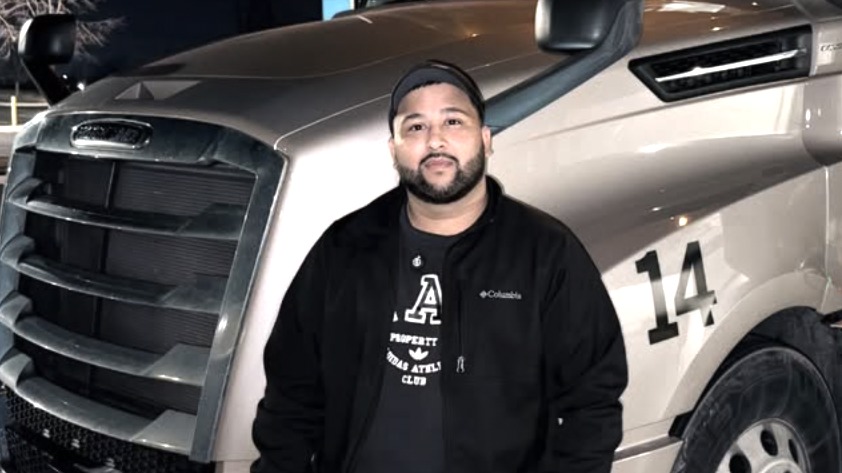
Rohit Handa has run Handa Transport LLC out of the Chicago area since early 2024, launched at 27 with money he saved as a company driver. One truck and one trailer, both paid off in 18 months; 157,000 miles logged in 2025; $62,359 in profit across a recent 90-day stretch between trucking and YouTube.
Around seven years ago, Rohit Handa was a college student driving Uber after class around Chicago with zero dollars to his name. He kept picking up truck drivers, and he noticed a pattern: the passengers who owned their trucks tipped big and seemed happy.
Last December, his one-truck company grossed $21,350. He kept $15,378 of it. In a single month.
No fleet. No investors. No dispatcher, no factoring, and no payments, because the truck and trailer are already paid off. The engine behind all of it is the most boring superpower in trucking: a savings habit that started at $600 a week. This is the story of how Handa Transport got built.
Rohit's road to a trucking company started in the back seat of his own car. At 22 or 23, he was going to college full-time in the Chicago area and driving Uber and Lyft after classes. The money went out as fast as it came in: "All the money I was making from Uber was pretty much just going into me buying shoes, clothes... Really no financial discipline when I was young."
The truck drivers he kept picking up changed that. He spent almost a year researching the industry after work, and landed on a number: $60,000 would be enough to start a trucking company with a used truck, a trailer, and the permits.
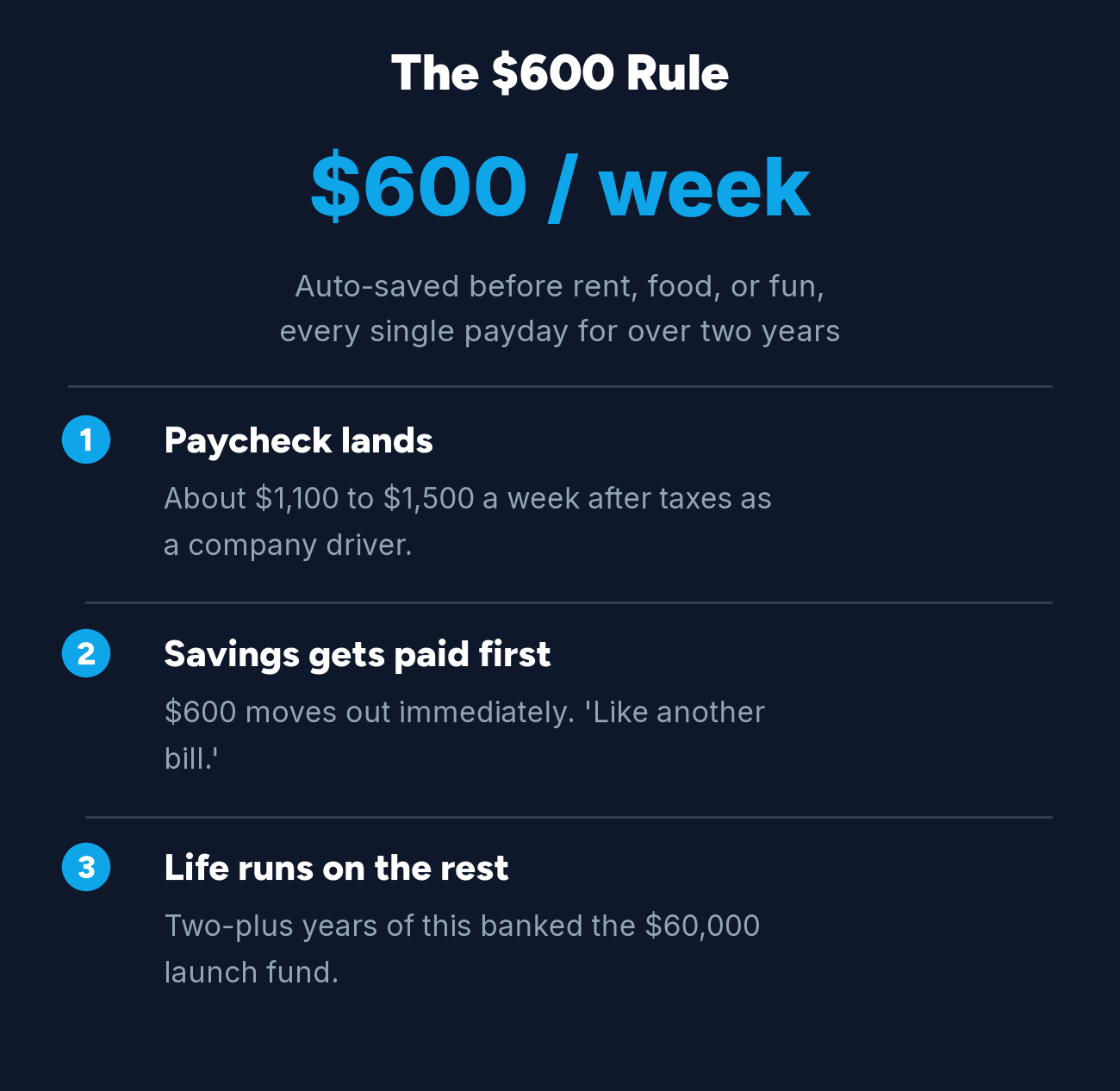
Getting there took a system, not a windfall. He paid about $5,000 of his $8,000 in savings for CDL school, then spent a little over two years as a company driver making $1,400 to $1,800 a week gross. Every single week, $600 went into a savings account before anything else. "I was basically treating the savings account as like another bill. So $600 was due every week."
The company-driver years also showed him what he didn't want. "In these worst conditions, you know, snowstorms, I was still getting calls from my company telling me to go faster, break all kind of laws," he said of that stretch. He kept driving, kept saving, and took only two or three weeks off in more than two years. It took grit, determination, and laser focus on his goal to carry him through.
By the time he hit his number, he'd also read Dave Ramsey's The Total Money Makeover and made an unusual decision: he wouldn't spend the whole $60,000. He deployed about $25,000 and kept the rest in reserve, "so my company does not fail."
Handa Transport LLC runs general freight in a dry van out of the Chicago suburbs. The equipment is exactly two assets: a 2021 Freightliner Cascadia with about 290,000 miles that Rohit bought for $70,000 (about $78,000 after taxes and fees) in early 2024, and a 2025 Great Dane dry van trailer he bought new for about $45,000. FMCSA records back the picture: one power unit, 157,000 miles run in 2025.
He is his own entire back office. He books 80 to 85% of his loads off the spot market himself, negotiates his own rates, and does his own invoicing. Regular lanes run from Chicago into Indiana, North Carolina, Virginia, South Carolina, and Texas, and every load and expense goes into a spreadsheet he tracks "to the penny."
With the equipment paid off, his fixed costs are startlingly small: $85 for the ELD (the required electronic logging device), $200 for yard parking, $100 for load boards, $916 for insurance (down from roughly $24,000 a year when his authority was new), and $800 set aside for maintenance. Around $2,100 a month, total, whether the truck moves or not.
One deliberate omission from that cost sheet: factoring. Rohit skips it because his cash reserves let him wait out net-30, 60, and 90 payment terms, and he'd rather keep the 2 to 3% fee. That trade only works because the reserves exist; for a new authority without a cushion, same-day pay is often what keeps the wheels turning, and our rankings of the best freight factoring companies for trucking break down which companies do it without long-term contracts. As Rohit found out the hard way (more on the $2,900 below), factoring companies also vet broker credit before you ever haul the load. Factoring isn't for everyone, but for many truckers, it could just be the secret sauce that keeps your wheels on the road while giving you peace of mind that you'll get paid on time.
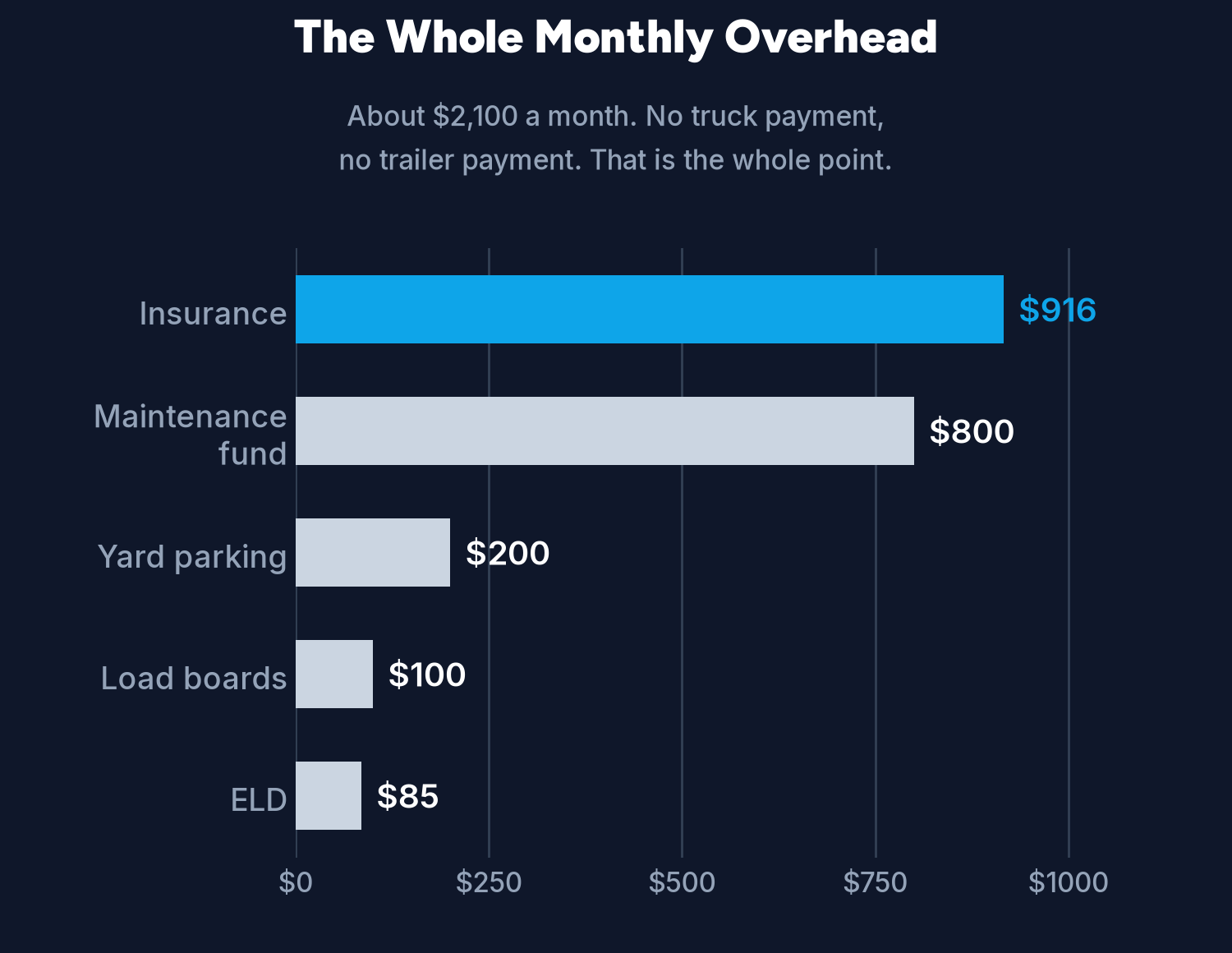
Roughly $2,100 a month keeps the company alive, with no equipment payments left.
Rohit's growth chart isn't a revenue curve. It's a debt curve, and it only goes one direction.
From zero dollars at 22, to $60,000 saved by 27, to roughly $115,000 of equipment debt in early 2024, to a paid-off trailer six and a half months later, to completely debt-free by month 18. Only then did the income story start compounding: a $21,350 December with $15,378 kept, and a 90-day stretch in spring 2026 that cleared $62,359 in profit across trucking and a fast-growing YouTube channel.
Then the summer 2026 rate run-up hit, and the debt-free machine showed what it does in a hot market. In July he logged his most profitable week since founding the company: $8,200 grossed, $1,899 in expenses, $6,301 kept in seven days, at $4.58 a mile across 1,788 miles. One of those loads paid $1,500 for 190 miles. By his own accounting, the first half of 2026 had already matched everything he made in all of 2025.
So how does a 27-year-old with a used Cascadia outlast the 80 to 90% of new carriers that fail? Four decisions did the work.
~2019: Broke, but paying attention
College full-time, Uber at night, $0 saved, and a $60,000 plan forming.
CDL school: The first $5,000
Most of his savings goes to school; he starts driving for a carrier.
Two-plus years: The $600 weeks
$600 auto-saved every payday until $60,000 is banked.
Early 2024: Handa Transport launches
Truck and trailer bought at 27. About $150,000 all-in.
Mid 2025: Debt-free
Trailer paid off in six and a half months, truck by month 18.
Dec 2025: The proof month
$21,350 grossed, $15,378 kept. First YouTube video posted.
Today
One paid-off truck, three income streams, and a second truck waiting on the right contract.

From a $60,000 savings target to a fully paid-off company in 18 months.
Four decisions did most of the work in getting Handa Transport from an idea in an Uber to a debt-free operation clearing five figures a month. The first happened before he ever owned a truck: an automatic $600-a-week savings habit. The second was refusing to spend his whole stack when he finally bought in. The third was attacking the equipment loans like they were on fire. The fourth was stacking a second income engine on top of the truck without letting it distract from the truck.
| Growth Lever | |
|---|---|
| 1 | The $600-a-Week System: Funded the entire launch from a company-driver paycheck, no investors needed |
| 2 | Launching With Reserves, Not Fumes: Kept $35,000 in the bank so no bad month, slow broker, or fuel spike could kill the company |
| 3 | The 18-Month Debt Sprint: Cut fixed costs to about $2,100 a month and turned every load into mostly profit |
| 4 | A Second Income Engine That Doesn't Need a Second Truck: Added $17,800 of YouTube income in 90 days without adding a second truck |
Everything else in this story runs downstream of one habit Rohit built as a broke 23-year-old: pay the savings account first, and treat it as non-negotiable.
The mechanics were almost insultingly simple. There are no excuses here for why you can't do it too. As a company driver he cleared roughly $1,100 to $1,500 a week after taxes. The moment a paycheck landed, $600 moved to savings. Not what was left over at the end of the week. First. "Before even paying myself, before even spending on bills, before even buying food... I was basically treating the savings account as like another bill. So $600 was due every week." That takes discipline, folks. A lot of it.
Rohit's diagnosis of why other drivers stay stuck is blunt: "When they get paid, they inflate their lifestyle and that's something you don't want to do." The $600 rule made lifestyle inflation structurally impossible, because the money was gone before he could spend it. Two-plus years of that, with only two or three weeks off, got him to $60,000.
He's transparent that his situation helped: he lived with his parents, rent-free, with a paid-off car. He takes care of them now. But the mechanism itself scales to any living situation; the number just changes.
If you're a company driver planning your own authority, this is the copyable part. Pick the number, automate it, and treat it like a bill from your future company. The discipline you build saving for the truck is the same discipline that later keeps the truck.
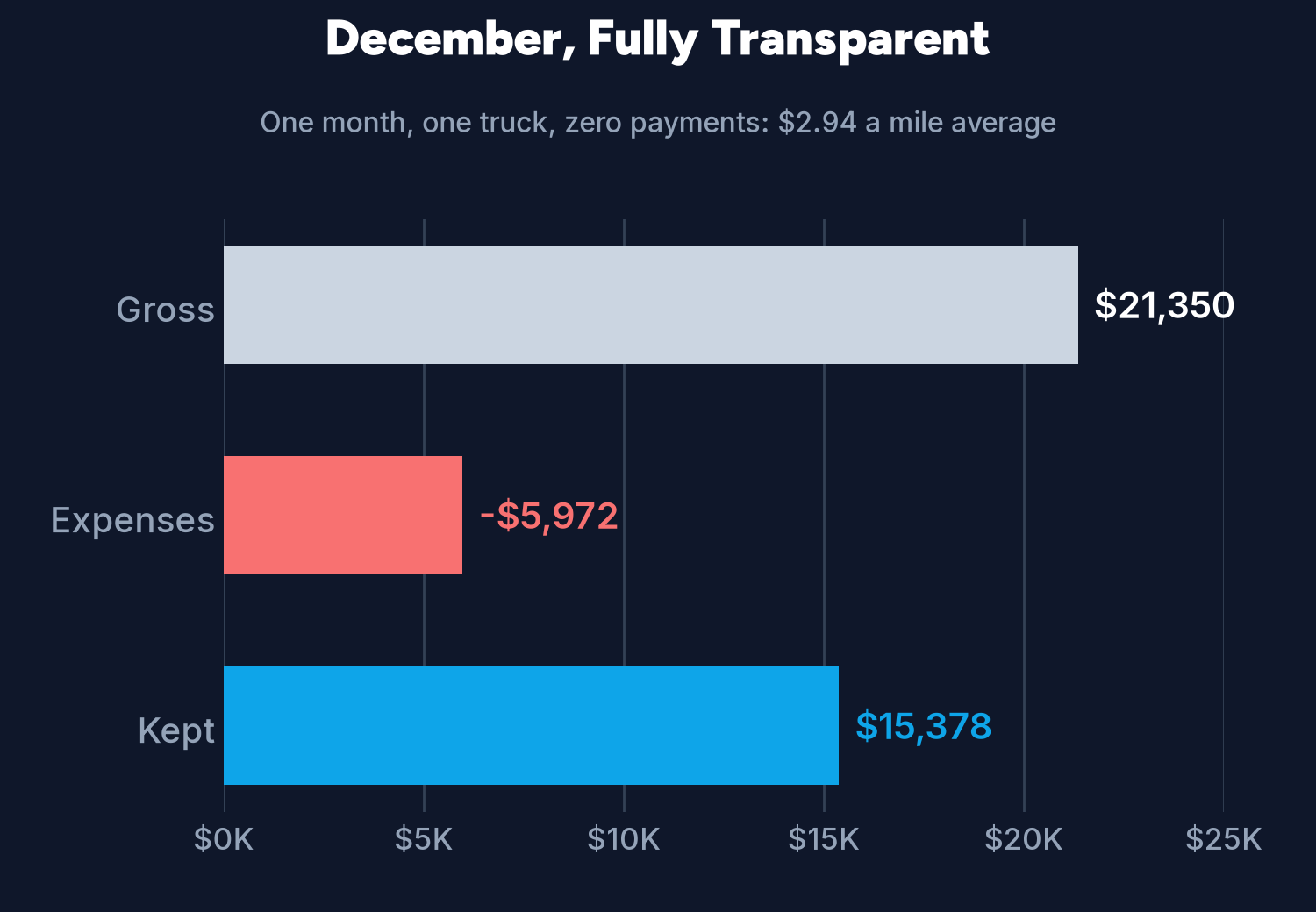
December 2025: $2.94 a mile average, zero breakdowns, and 72% of gross kept.
"I was basically treating the savings account as like another bill. So $600 was due every week."
When Rohit finally had $60,000, he did something most new owner-operators don't: he only spent $25,000 of it.
The truck and trailer went on loans he already had a payoff plan for, the down payments and startup costs came out of the $25,000, and roughly $35,000 stayed in the bank as a firewall. His reasoning: "I'm always one step ahead and my company does not fail."
The reserves show up everywhere in how Handa Transport operates. They're why he can wait 30, 60, or 90 days for brokers to pay. They're why a broker stiffing him $2,900 was infuriating but not existential. They're why the 2026 fuel spike, which he estimates cost him $300 to $500 a week in profit, was a margin problem instead of a survival problem.
December's math shows the payoff: $21,350 grossed, $5,972 in expenses, $15,378 kept, at an average of $2.94 per mile across all miles, with zero breakdowns.
The zoom-out for any operator: the industry's 80 to 90% failure rate for new carriers isn't mostly about freight. It's about running out of cash before the good months arrive. Rohit decided before day one that he'd never be in that position.
Most new authorities do not launch with $35,000 parked in the bank, which makes the 30-to-90-day wait the one part of this story you cannot copy on a thin reserve. If your cushion is closer to $5,000, the alternative is letting a factor front the invoice: our rankings of freight factoring companies price that trade company by company, and the OTR Solutions review walks through the one we rank first.
Most owner-operators carry a truck payment for five years and call it a cost of doing business. Rohit treated his loans like an emergency.
He'd read Dave Ramsey's The Total Money Makeover before he ever signed the paperwork, so the payoff plan existed before the debt did. He knew he was taking on $70,000 for the truck, $45,000 for the trailer, and about $5,000 for his authority and setup. Living with his parents and spending almost nothing on himself, he shoveled extra principal payments at the trailer first and killed it in about six and a half months. The truck followed. Eighteen months after starting the company, Handa Transport owed nobody anything.
The obvious change is margin: with no payments, his fixed overhead is about $2,100 a month, which is how a $21,350 month becomes $15,378 kept. The less obvious change is negotiating posture. "The broker should know that you're not in any rush to move their freight at cheap rates," he says; when nothing is due, walking away from cheap freight costs him nothing, and in the same example he books a $3,300 load after being willing to wait a day. He points out the old-timers had this figured out: "Old school truckers pretty much had it down to a T. They had their equipments paid off and they used to not move freight at cheap rates."
If you're financing equipment right now, the lesson isn't that debt is evil. It's that every payment you eliminate converts directly into rate leverage, staying power, and sleep.
In December 2025, almost two years into running the company, Rohit uploaded his first YouTube video from the driver's seat. He didn't even know how to get monetized; that took a month and a half, partly because he ignored the W9 email. When the first sponsor reached out in mid-February, he assumed it was a scam and didn't reply. They emailed again.
Ninety days into 2026 (March through May), the channel and the consulting calls it generated had produced $17,804 on top of $44,236 in trucking profit, plus $319 from the $29 Trucking Success Academy community he launched for people who want the full playbook. Total: $62,359 in profit in 90 days, tracked in the same spreadsheet as everything else.
He's clear-eyed about which engine is the business. He's turned down offers to sell the channel ("The feeling you get when you grow something on your own cannot be compared") and stopped taking paid consulting calls to protect his time. "YouTube is good but it's very, very unpredictable. One month can be good, one month can be bad... Business is something you can always count on", as he put it while explaining why the next dollar goes into trucking.
The takeaway isn't "start a YouTube channel." It's that his second income stream cost him no capital, compounds his reputation, and feeds the same disciplined balance sheet, instead of competing with the truck for money. Alex Nino ran the same structure at a much larger scale, using a 2-million-subscriber channel to fund a truck rather than replace one.
Before the broker story, a confession Rohit only recently started telling on camera. He launched Handa Transport right after the COVID freight boom collapsed, when the market average had sunk to around $2 a mile. New authority, truck payment, trailer payment, an insurance bill running roughly $24,000 a year, and rates scraping the floor. "There were times where I even thought to myself that maybe I made the wrong decision. Maybe I shouldn't have started my company." The exit he kept circling was the obvious one: sell the truck, sell the trailer, go back to being a company driver.
What kept him in was the same math that runs the whole story. "The only way to become successful in trucking is to have a lot of leverage. And the only way for you to get leverage as an owner-operator is to have very low expenses." The lower his costs got, the less the truck had to move to break even, and every payment he killed lowered that bar further, until the market stopped being able to scare him. Two years later, the guy who almost sold everything is shopping for truck number two.
The ugliest stretch in Rohit's two years wasn't mechanical. It was a broker who simply decided not to pay. (Sammy Lloyd made the opposite trade: he factors every load so the chasing never lands on his desk.)
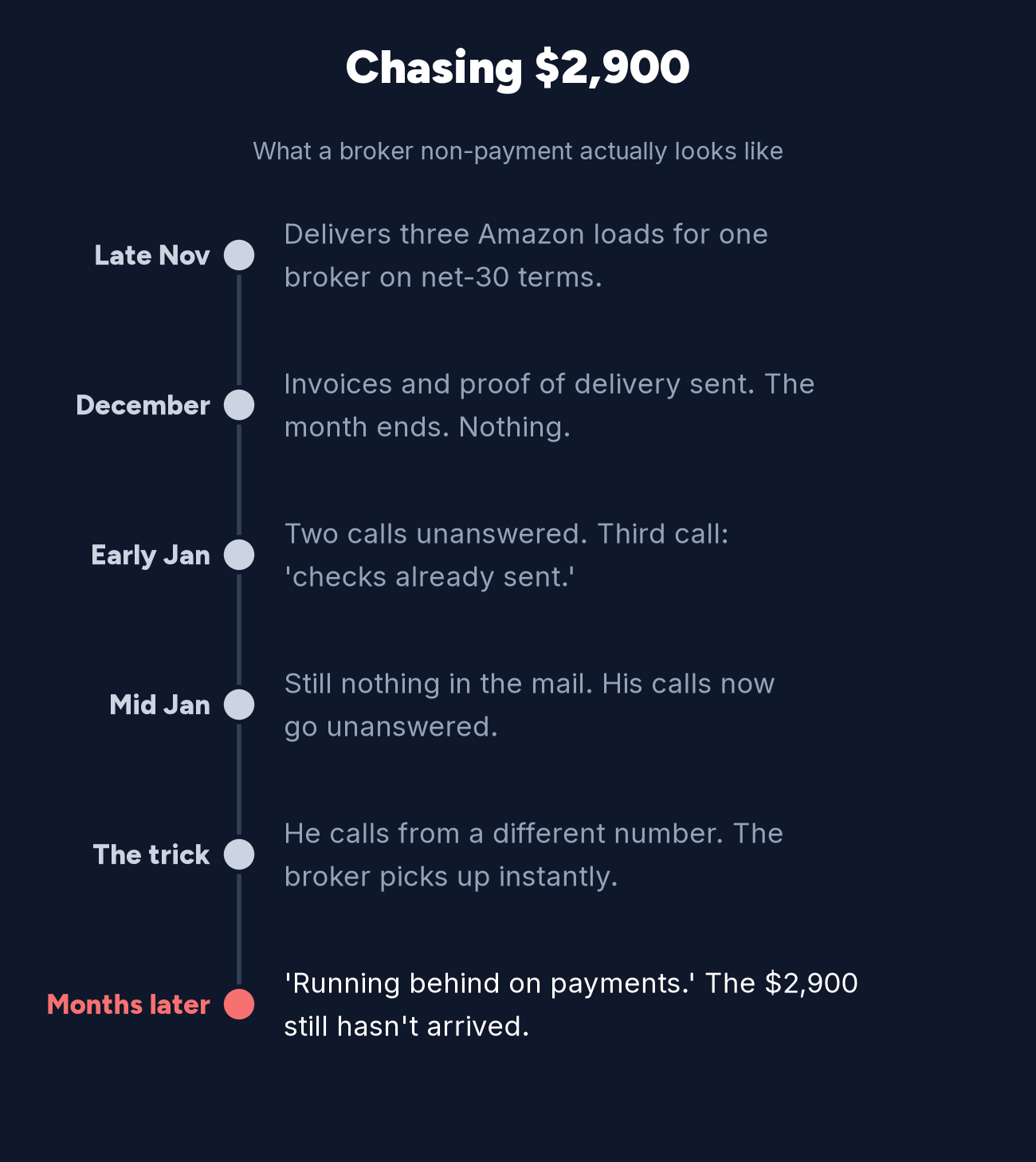
In late November 2025 he delivered three Amazon loads for one broker on net-30 terms, sent the proof of delivery, the invoices, and the signed rate confirmations, and waited. December ended. Nothing. He called twice; no answer. The third call got picked up, and the broker said the checks were already in the mail. Two more weeks, still nothing. Then the broker stopped answering his number entirely, so Rohit called from a different phone, and the broker picked up immediately. The eventual admission: "We're kind of running behind on payments." Months later, the $2,900 still hadn't arrived. "I keep going back to that $2,900."
His own post-mortem is the useful part. The reserves meant the loss stung instead of sinking him. But he also points out the protection he'd opted out of: factoring companies vet broker credit before you haul, because their money is on the line. "With a factoring company, they do their own due diligence of what broker to work with and what broker to not work with." That check is exactly what OTR Solutions, the company at the top of our rankings, runs on a broker before you haul the load. He still chooses to self-invoice, but now with a harder rule: check the broker before you check the rate.
The same season brought the 2026 fuel spike, with diesel near $5 a gallon eating $300 to $500 a week out of his profit. His response wasn't panic; it was the same spreadsheet, tighter lane selection, and the cushion doing exactly what it was saved for.
Years before Handa Transport existed, Rohit had a family emergency and asked his employer for a day off.
The answer, as he tells it: "Either you quit or you shut up and keep driving."
He was a company driver at the time, carrying credit-card debt and other payments, and he did the math every indebted employee does in that moment. "I only had two options. Quit or keep working." He kept working. The emergency waited.
"At that moment, I knew that if I was debt-free, I probably could have just quit the job on the spot... I realized in that moment how important it really was to become debt-free in life."
That was the moment the whole plan crystallized. The $600-a-week rule, the reserves, the 18-month sprint on the equipment loans: all of it traces back to never wanting to hear "shut up and keep driving" while being financially unable to walk.
Today the leverage runs the other direction. When a broker lowballs him, the guy with no payments doesn't have to say yes.
1
Rohit's entire company was funded by $600 a week leaving his checking account before he could touch it. If you're driving for someone else and planning your own authority, automate the transfer on payday and size the rest of your life around what remains. Waiting until you "have extra" is how six years pass with $0 saved.
2
He saved $60,000 and spent $25,000. The other $35,000 is why a deadbeat broker, a fuel spike, and slow winter rates never threatened the company. If your startup plan spends every dollar you have on equipment, your real plan is hoping nothing goes wrong for six months.
3
Paying off $115,000 of equipment in 18 months turned Handa Transport into a 5-figure-a-month operation where a good month is 72% profit, and where cheap freight can be refused. Scale built on payments can be fragile; scale built on paid-off equipment negotiates from strength.
4
The $2,900 lesson: net-30 terms are a loan you're making to a stranger. Check broker credit before you haul, whether through a factoring company that does the due diligence for you or your own homework. The load that doesn't pay is worse than the load you never booked.
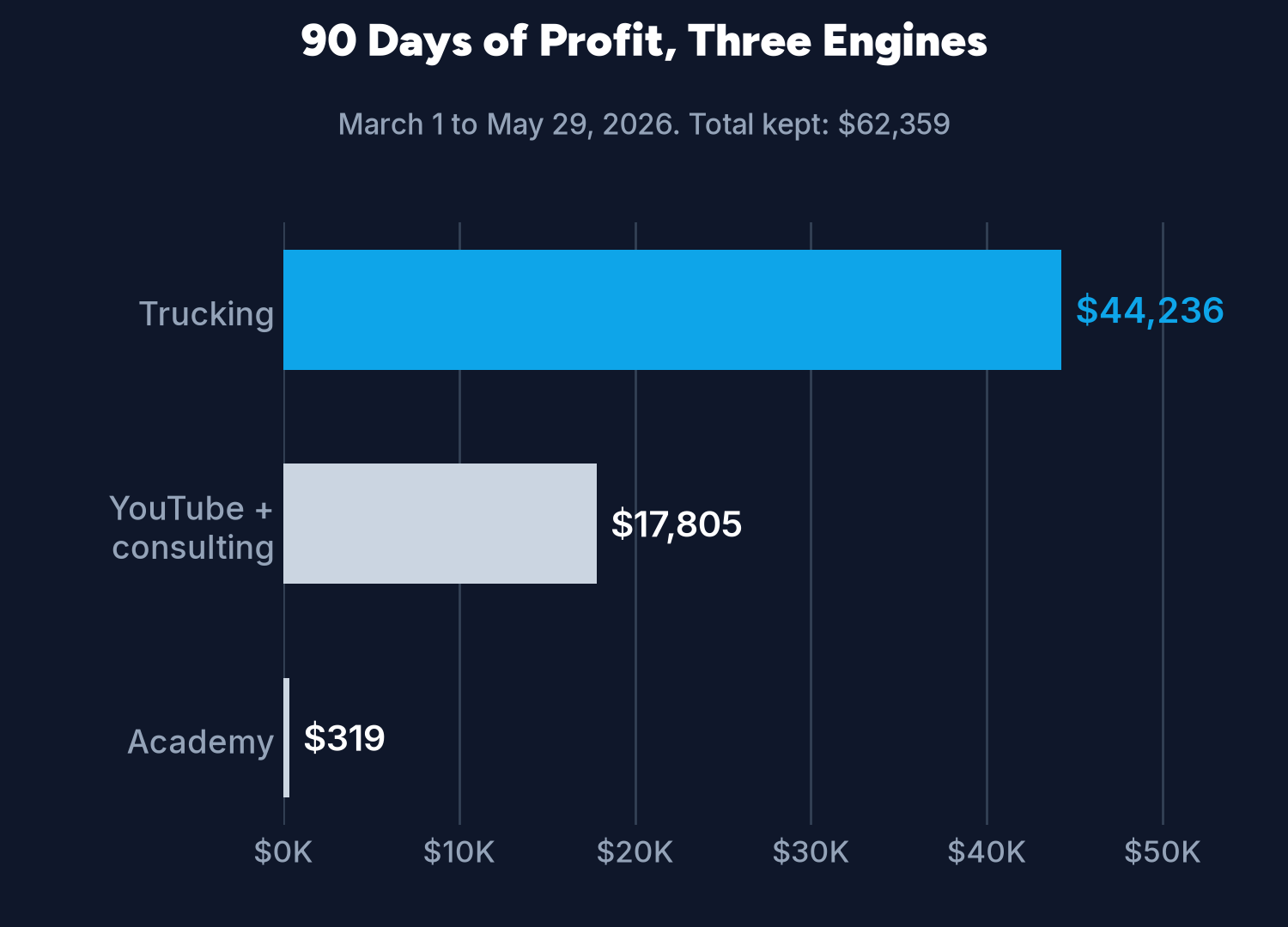
Profit for March through May 2026 across all three income streams.
His next move is deliberately unhurried: a second truck, but only when it comes attached to a specialized contract rather than more spot-market exposure. That is the lever Box Truck Bros pulled: a four-truck dedicated contract was the single biggest jump in his 2025 revenue. "If I buy another truck I'm going to be getting specialized contract... that's where my mind is every day. How to grow my company." By mid-2026, that move had gotten closer on its own. With a paid-off truck and two years of clean revenue, banks started sending him pre-approved financing offers for truck number two without him asking; he notes the first truck was a paperwork fight to finance, and the second is being offered to him. The plan for it is the same playbook run again at fleet scale: buy the second truck, pay it off with the first truck's income, then let two paid-off trucks fund the third. He's cut paid consulting calls, keeps the Trucking Success Academy running for people who want the full walkthrough, and treats YouTube as a bonus engine rather than the plan.
Zoom out and the through-line of this whole story is almost uncomfortably simple: nothing Rohit did required a hot market, a connection, or a secret. A savings transfer, a cushion, a payoff plan, and a spreadsheet. The hard part was doing it every single week for six years while nobody was watching. That part is available to anyone with a CDL.
Rohit Handa is the owner-operator behind Handa Transport LLC, a single-truck dry van operation based in Bolingbrook, Illinois, in the Chicago metro. He started the company in early 2024 at age 27 with money saved during two years as a company driver, runs general freight across the Midwest and Southeast with his own authority, and paid off his 2021 Freightliner Cascadia and 2025 Great Dane trailer in 18 months. He documents the business, including full income breakdowns, on YouTube at @RohitHandaOfficial and on Instagram at @rohit_handa.
New articles for owner-operators, delivered twice a month.
OTR Solutions: Instant 24/7 funding, no contract, no hidden fees. 4.7/5 across 1,390+ carrier reviews.