Freight factoring rates at major providers run between 2% and 6% as of July 2026. But that number, by itself, tells you almost nothing about what factoring will actually cost your business. The advertised rate is a single variable in a calculation that also includes ACH fees, per-invoice fees, monthly minimums, fuel advance fees, and contract termination penalties that can run into the tens of thousands of dollars. Most articles in this space give you the rate ranges and stop there. This one does the math.
Whether you're factoring $10,000 or $50,000 per month, the difference between choosing carefully and signing the first contract you're offered compounds into a real dollar figure every single month. By the time you're done reading, you will know what eight major factoring companies charge, why a 3.25% rate can cost less than a 2.5% rate, what early termination fees look like in dollars, not percentages, and exactly which questions to ask before you put your signature on anything.
Most factoring companies do not publish their rates publicly; you have to request a quote to get specific numbers. That opacity is itself worth noting. The providers below have either published rate information on their websites, provided on-record quotes, or had rates confirmed through independent third-party reviews. All figures were verified as of July 2026 and are subject to change; verify directly with each company before signing anything.
OTR Solutions charges recourse rates in the 2.5%–3.5% range depending on carrier size, volume, and whether the OTR Fuel Card is bundled. True Non-Recourse runs up to 4.0%. At the single-truck level, expect to be quoted toward the middle-to-upper end of that range. OTR is a premium provider: those rates reflect True Non-Recourse coverage, same-day funding, and free fuel advances as part of the base service. One thing to know going in: OTR does not publish rates on its own site, so the figures here come from independent 2026 reviews. Treat them as a realistic quoting range, not a price sheet, and get your own number in writing. For carriers who want the full-service model, OTR is the market benchmark.
Bobtail Capital charges 3.25% for a one-truck operation (its homepage advertises negotiable rates capped at 3.24%, an immaterial difference on any real invoice), with no ACH fee and no per-invoice fee. That structure matters more than it looks. In Section 2, we'll show what "no ACH fee, no invoice fee" actually saves you versus a competitor offering a lower headline rate with both.
eCapital publishes a 2%–6% range for freight factoring on its own educational pages, the widest band and the highest published ceiling among the majors. That spread is the honest version of quote-based pricing: where you land inside it depends on volume, broker mix, and negotiation. eCapital also carries an early termination fee of 1–5% of your account limit, covered in full in Section 4, because the dollar amounts are significant. Our OTR vs eCapital comparison prices that whole trade in dollars.
DAT Outgo uses a tiered volume structure: owner-operators factoring less than $18,000/month pay 3% flat; carriers between $18,000 and $80,000/month pay 2.5%; and carriers above $80,000/month receive custom pricing. ACH is free; wire transfers cost $20. Cancellation requires 15 days' notice. DAT's volume tiers make it particularly competitive for carriers who are growing: as your volume increases, your rate drops automatically.
Apex Capital does not publish rates. Third-party reviews report a roughly 2% flat recourse rate, but Apex itself confirms no number; expect a quote range when you apply. The company's strong reputation comes from service and flexibility rather than headline pricing.
Riviera Finance reports an average discount rate of 2%, with fees ranging from 1% to 5% depending on invoice terms and broker risk profile. Riviera charges no setup fees and no monthly maintenance fees. A $5 wire transfer fee applies when applicable. Note: Riviera advances up to 95% on non-recourse factoring, a solid figure that keeps the reserve holdback small, though several majors now advertise 97–100% advances.
RTS Financial does not publish rates publicly and requires an application for a quote. Third-party sources report rates competitive with the broader market range. RTS does not charge ACH fees, invoice-upload fees, or volume fees, a similar no-add-on structure to Bobtail. One important detail: RTS operates on a one-year contract that auto-renews with 60 days' cancellation notice required to exit.
Love's Financial (formerly partly TBS Factoring, acquired December 2025) advertises up to 99% advance rates with no hidden monthly or annual fees. Rate information is available by quote only. Note: Love's Financial acquired three factoring firms in December 2025 (TBS Factoring, Saint John Capital, and Financial Carrier Services), and technology integration is ongoing through early-to-mid 2026. If you're evaluating Love's Financial, it's worth asking specifically whether you're being onboarded onto the Love's platform or one of the legacy systems.
What does this cost at your actual monthly volume? The table below uses the confirmed published rates above and calculates monthly and annual fees at two realistic volume levels: $10,000/month (single truck, lighter volume) and $50,000/month (small fleet or high-volume single operator). All figures use base rates only and do not include per-invoice or ACH fees, which are additive.
Company · Rate · Monthly fee at $10K · Annual at $10K · Monthly fee at $50K · Annual at $50K
The gap between OTR's mid-range recourse rate (3%) and the top of eCapital's published band (6%) is $3,600 per year at $10,000/month volume, and $18,000 per year at $50,000/month volume. That is the cost of not reading the fee schedule. For a ranked comparison of providers including overall value, not just rate, see our full freight factoring company rankings.
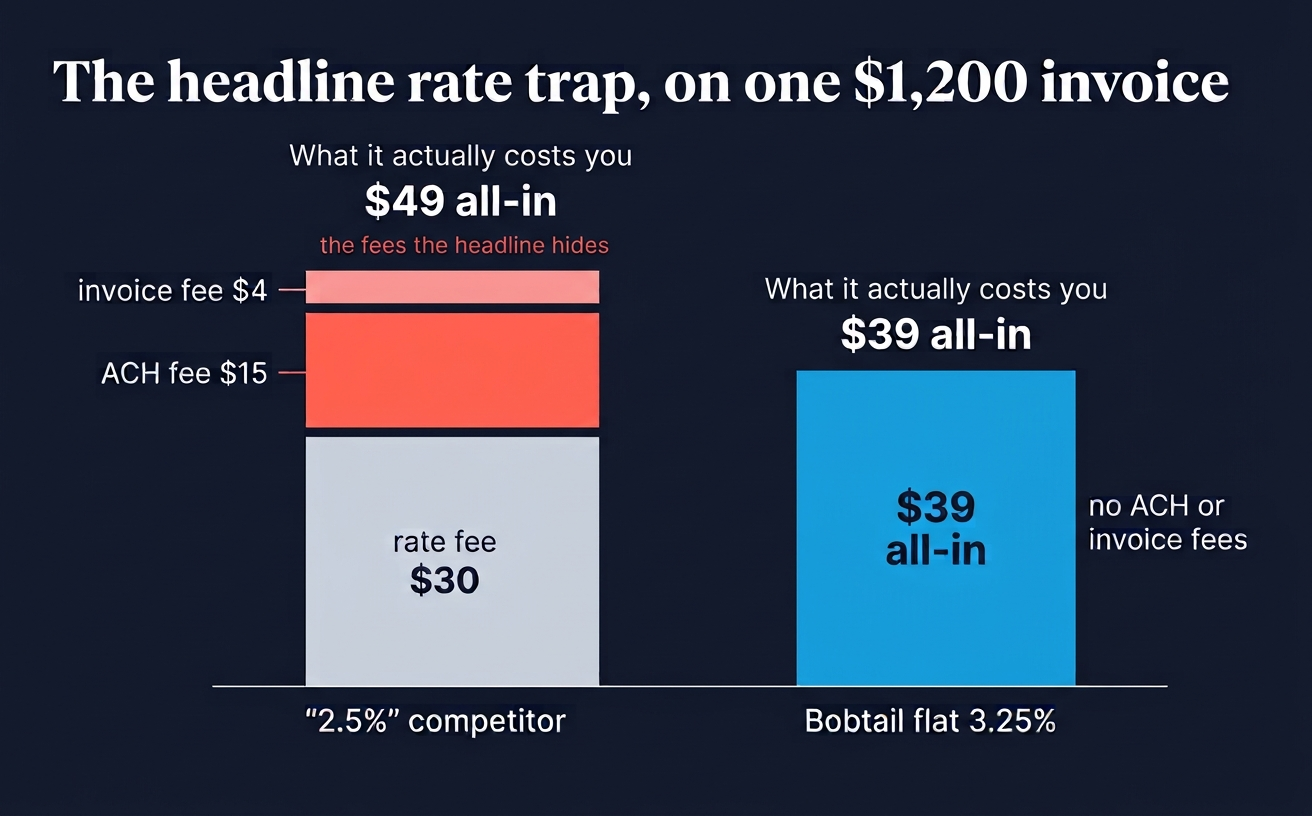
Effective rate is the true cost of factoring calculated as total fees paid divided by total invoice value, expressed as a percentage. A company advertising 2.5% with $15 ACH fees and $4 per-invoice fees on $1,200 average invoices has an effective rate of approximately 3.3%, not 2.5%. Always calculate effective rate at your actual average invoice size and monthly volume before comparing companies. The advertised percentage is a starting point, not a final answer.
Here is a real example, not hypothetical and not constructed for illustration, from Bobtail Capital's own published blog post. A competitor to Bobtail offered a factoring rate of 2.5% along with a $15 ACH fee and a $4 per-invoice processing fee. On a $1,200 invoice, the math works out as follows: 2.5% of $1,200 is $30, plus $15 ACH fee, plus $4 invoice fee. Total cost: $49. Bobtail's rate on the same $1,200 invoice at 3.25% with no ACH fee and no invoice fee: $39. The lower-rate competitor cost the carrier 25% more on that invoice.
This is not a niche scenario. It is the dominant pattern in the factoring industry: companies advertise a competitive base rate, then recover margin through per-transaction fees that carriers don't notice until they're reading their monthly statement three months in. The fees below are the most common ones to ask about explicitly before signing. They are legal, they are common, and they are rarely disclosed prominently.
ACH transfer fees. When you request an advance via ACH (the standard bank transfer method), many factoring companies charge $1–$5 per transfer. If you're factoring 20 invoices per month and paying $3 per ACH, that's $60/month in fees that don't appear in the headline rate, adding roughly 0.6% to your effective rate on $10,000/month volume.
Same-day wire fees. Wire transfers clear faster than ACH, typically within hours, and most factoring companies charge $15–$25 per wire. DAT Outgo charges $20. If you need same-day cash on a regular basis and wire it every time, this fee alone can add up to $300–$500 per month for a high-volume operator.
Per-invoice processing fees. Some companies charge $2–$5 per invoice processed, separate from the factoring percentage. On a month where you factor 30 invoices, that's $60–$150 in flat fees regardless of invoice size, a fee structure that disproportionately punishes carriers moving smaller loads.
Monthly minimum volume fees. If your contract includes a minimum monthly volume (say $20,000) and you fall short in a slow month, you may owe a fee on the gap. This fee is often buried in the contract and rarely comes up during the sales conversation.
Fuel advance fees. Some factoring companies offer fuel advances against pending invoices: cash before the invoice is even submitted. Convenient, yes. Free, no. Fuel advance fees vary but commonly run 1–3% of the advance amount on top of your standard factoring fee. OTR Solutions includes fuel advances in its base service. Not everyone does. Ask.
Setup and onboarding fees. Less common at reputable companies, but still present at some providers: a one-time fee to process your application, run UCC filings, and set up your account. These can range from $100 to $500. Ask before you apply.
To understand what the factoring fee is actually covering (the advance, the reserve, and the collection process), read our full walkthrough: How Does Freight Factoring Work.
Before comparing factoring companies on rate alone, request the full fee schedule in writing and calculate your effective rate at your actual average invoice size. Take your average invoice amount, multiply by the factoring rate, then add every per-invoice fee (ACH, processing, fuel advance) to get the total cost per invoice. Divide by your average invoice size and multiply by 100. That number is your effective rate, and it is the only number worth comparing across companies. A company with a 1.5% advertised rate and $3 per-invoice ACH on $500 average invoices has an effective rate of 2.1%. A company with a 3.25% all-in rate on the same invoice costs $16.25, and the "cheaper" company costs $18.50.
Factoring rates are not fixed. They are negotiated, and the two biggest variables in that negotiation are how much you factor per month and how long you've been operating. Understanding both helps you know whether the rate you're being quoted is fair, and when you have room to push back.
New authorities pay more. Carriers with less than 90 days of operating history have limited leverage. There's no track record for the factoring company to evaluate, no volume history to underwrite against, and no demonstrated pattern of working with creditworthy brokers. The result: new authorities typically pay upper-end rates: 3% and above. OTR Solutions has indicated that pricing for a one-truck company typically starts at 3%. That 3% is the floor for a new single-truck operator, not a promotional rate. Expect to be quoted in the 3–4% range if you're within your first 90 days.
As your operating history grows, typically at the 6-month and 12-month marks, it's worth initiating a rate review with your factoring company. If your broker mix is creditworthy, your invoice volume has been consistent, and you've had no non-payment issues, you have a real case for a rate reduction. Factoring companies want to retain carriers with stable, low-risk invoice pools. They'll often negotiate rather than lose your business.
Volume tiers change the math. Most factoring companies price more favorably as monthly volume increases. DAT Outgo's published tier structure is the clearest example in the market: 3% below $18K/month, 2.5% from $18K to $80K/month, custom pricing above $80K. That drop from 3% to 2.5% saves a $50,000/month operator $250 a month, $3,000 a year, compared to a carrier doing $15,000/month at the same company. The business logic is straightforward: more volume means more revenue for the factor on the same infrastructure cost, so they pass some of that back.
For carriers growing from single-truck to small fleet, this means your factoring rate structure should be reassessed when your volume crosses key thresholds. What was a fair rate at $10,000/month may be uncompetitive at $40,000/month, either at your current provider or through a competitor with more favorable volume tiers.
The fleet-level comparison. Here is what $50,000/month in factored invoices costs annually at three different rate structures:
Rate structure · Monthly fee · Annual cost
A carrier running a 5-truck fleet paying the top of eCapital's published band instead of DAT Outgo's fleet tier is paying up to $21,000 more per year in factoring fees on identical invoice volume. That is not a rounding error. It is the cost of not shopping the rate.
What you can and can't negotiate. Base percentage rates are often negotiable with volume and tenure. Per-invoice fees, ACH fees, and wire fees are usually fixed by the company's fee schedule and are rarely waived. Early termination fees are almost never negotiable down; they are set in the contract and enforced. The time to negotiate any term is before you sign, not after. The best leverage is always a competing offer in hand.
If you've been with a factoring company for 6–12 months without any non-payment issues and your monthly volume has grown or held steady, call and ask for a rate review. Come with a specific number: "I've been averaging $22,000/month with zero recourse events in the last 8 months, and I'd like to discuss moving to X%." Factoring companies retain profitable, low-risk carriers. They would rather give you 0.25–0.5% back than lose your account. If they say no, you now have exactly the information you need to shop a competing quote.
The fees in the previous sections are frustrating but manageable: you can calculate them, anticipate them, and build them into your cost-per-load math. The costs in this section are different. They surface only when something changes: you want to switch providers, your contract auto-renews, or you need to take on a second factoring relationship. By then, the contract is already signed. These are the fees worth the most attention before you sign anything.
Early termination fees, in dollars. Most factoring contracts run 12–24 months. If you want to leave before the term ends, you owe a termination fee. The structure varies: some companies charge a flat fee ($500–$2,000), others charge a percentage of your remaining estimated volume, and some calculate it as a percentage of your account credit limit.
Some factoring companies calculate their early termination fee as a percentage of your account credit limit, not a flat dollar amount and not a percentage of remaining volume. That structure sounds abstract until you run the math. A carrier with a $100,000 account limit faces a $1,000–$5,000 exit fee at 1–5%. A carrier with a $500,000 account limit (not uncommon for a 5-truck fleet) could face a $5,000–$25,000 penalty to leave. That is not a fee. That is a lock-in mechanism. Before signing any contract, ask specifically: "How is the early termination fee calculated? Is it based on my account limit, my remaining volume, or a flat amount?" Get the answer in writing and run the dollar number at your actual account limit before you sign.
Auto-renewal clauses. RTS Financial operates on a one-year contract that auto-renews unless you give 60 days' written notice before the renewal date. Miss that window by a week and you're in for another year. Auto-renewal with a long notice window is not exclusive to RTS; it's common across the industry, and easy to overlook when you're focused on the rate during the sales conversation. Put the renewal date and the notice deadline in your calendar the day you sign.
Blanket assignment clauses. A blanket assignment clause requires you to factor all of your invoices through one company, not just the ones you choose to factor. This means you cannot selectively factor large invoices while waiting for quick-paying shippers to settle directly. More importantly, it means you cannot factor any invoice with a second company while this contract is active. If you sign a blanket assignment and a load comes in through a broker your current factor won't approve, you may be stuck: either you don't haul the load, or you're in breach of contract. Read the scope of assignment carefully and ask what happens when the factor declines a specific invoice.
Reserve holdback and recourse window. On recourse factoring contracts, the factoring company will come back to you if a broker doesn't pay within the recourse window, typically 60–90 days. At that point, you either buy back the invoice (repay the advance) or replace it. This is not a hidden fee exactly, but it is a cost that carriers underestimate. If you have a cluster of invoices with a slow-paying broker all hit recourse in the same month, you could owe the advance back on $10,000–$30,000 in invoices simultaneously. Know your recourse window, and factor only for brokers whose payment history you're confident in.
For a complete breakdown of red flags to check before signing any factoring contract (including blanket assignment language, personal guarantee scope, and UCC filing terms), see our guide: Freight Factoring Contract Red Flags.
Before signing any factoring contract, calculate the early termination fee in dollars using your expected account limit, not as a percentage. Ask: "If my account limit is $X, what is the termination fee if I want to leave at month 6?" Get the answer in writing. A $500,000 account limit with a 5% early termination fee equals a $25,000 exit penalty, the kind of number that makes a factoring rate comparison largely irrelevant. A slightly higher rate on a contract with reasonable termination terms may be significantly cheaper over 3 years than a lower rate on a contract you can't leave without a five-figure penalty.
What is a good factoring rate for trucking?
For a single-truck owner-operator with a solid broker mix and at least 90 days of operating history, a rate of 2.5–3.25% all-in (base rate plus all per-invoice fees) is the current market benchmark for a reputable provider. Rates below 2% are possible at high volume ($100K+/month) or with specific promotional structures, but they typically come with stricter contract terms or higher add-on fees. If you're being quoted above 4% as an established carrier with creditworthy brokers, ask why, and shop a competing quote. For new authorities (under 90 days), 3–4% is the realistic range.
Do factoring rates include the advance?
No. The factoring rate, the percentage you pay, is the fee for the service. The advance is the percentage of the invoice the factoring company pays you upfront: typically 85–97%. These are two separate numbers. A company offering a 3% rate with a 97% advance means you receive 97% of the invoice immediately and owe 3% of the total invoice value as the fee. For a full step-by-step walkthrough of how advances and reserves work on a real invoice, see How Does Freight Factoring Work.
Why do factoring rates vary so much between carriers?
Three variables drive most of the rate variation: your monthly invoice volume (more volume = lower rate), your broker creditworthiness (higher-risk brokers = higher rate), and your operating history (newer authority = less leverage = higher rate). A carrier running $80,000/month with a 12-month track record and established national brokers will get a meaningfully different quote than a new authority doing $8,000/month with smaller regional brokers. Both quotes are "market rate"; they're just market rate for different risk profiles.
Can you negotiate a factoring rate?
Yes: before you sign, and with a competing offer in hand. Once you've signed, the rate is typically fixed for the contract term. Volume-based rate tiers (like DAT Outgo's structure) are the most reliable path to a lower rate without active negotiation: grow your volume past a threshold and the rate drops automatically. Beyond that, 6–12 months of clean payment history and consistent volume gives you a real argument for a rate review. The key is to initiate the conversation with a specific number, not a vague request: "I'd like to renegotiate" is less effective than "I've been averaging $25,000/month with zero recourse events, so I'd like to move from 3.25% to 2.9%." The full playbook, scripts included, is in our guide to negotiating a lower factoring rate.
What is the cheapest factoring option for owner-operators?
"Cheapest" depends on your volume and how you factor. At under $18,000/month, DAT Outgo's 3% flat rate with free ACH is one of the most transparent low-cost structures in the market. Bobtail Capital's 3.25% all-in (no ACH fee, no invoice fee) delivers a lower effective rate than many competitors advertising lower percentages with add-on fees. For carriers prioritizing total cost over headline rate, the right approach is calculating effective rate at your actual invoice size and volume across three to four competitors, not reading the advertised percentage and stopping there.
Is factoring worth the cost?
That depends on your operating model. If your average broker payment window is 30–45 days and you're running weekly fuel and maintenance costs, the cash flow benefit of same-day payment is often worth 3% of invoice value, particularly for newer carriers with limited working capital. For established carriers with strong cash reserves and fast-paying brokers, the math may not favor factoring on every load. The real question is not "is factoring worth it" in the abstract. It is "what is the cost of waiting 35 days for cash versus paying $300 this month at my current volume?" Run that number against your actual operating costs before deciding.
Love's Financial acquired TBS Factoring, Saint John Capital, and Financial Carrier Services in December 2025. Technology integration of the three acquired companies is ongoing through early-to-mid 2026. If you're evaluating Love's Financial as a factoring provider, ask specifically which platform you'll be onboarded onto and whether the rate and fee structure you're being quoted is part of the consolidated Love's platform or a legacy system that may change during integration. This is a period of transition, and the service terms may evolve as the platforms merge.
"If I was to hire an accountant or a bookkeeper or accounts receivable and payable person, good luck on finding that for $400 a month."
New articles for owner-operators, delivered twice a month.