Recourse vs non-recourse factoring in trucking comes down to one question: who takes the loss if a broker doesn't pay? With recourse factoring, the answer is you: if the factor can't collect, you buy the invoice back. With non-recourse, the factor absorbs the loss. That straightforward difference is real, but the way most factoring contracts actually define "non-recourse" is far narrower than carriers expect when they sign up.
The hidden story in this comparison isn't the rate difference. It's the exclusion clauses. Nearly every non-recourse factoring contract on the market contains language that carves out disputes, documentation errors, ghosting, and informal closures from coverage. Those exclusions turn a protection that sounds comprehensive into something closer to bankruptcy-only insurance, and most carriers don't discover this until a broker goes dark and the chargeback arrives anyway. And the stakes are rising: the industry closed 2024 with 3,104 fewer freight brokerages on the books, and FreightWaves is forecasting another wave of brokerage failures through 2026, many of them large. The more brokers fail, the more this one contract definition decides who eats the loss. This article explains exactly how both types work, what the fine print actually says, and how to evaluate any non-recourse contract before you sign.
Every factoring contract eventually comes down to one question: when a broker doesn't pay, who eats the loss, you or the factor? That's all "recourse" means, and it's the most expensive word carriers skim past.
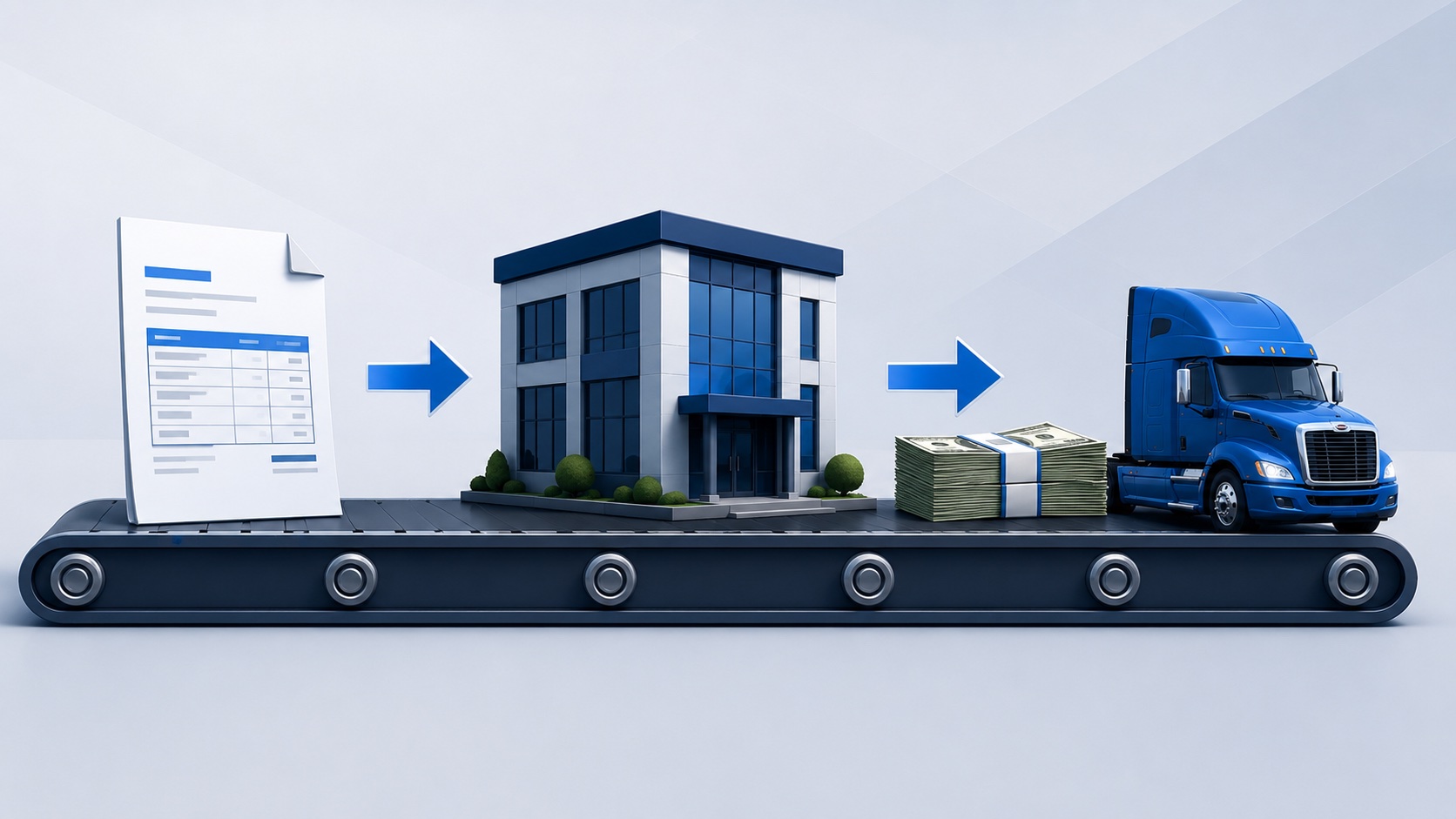
Freight factoring, regardless of type, starts the same way: you deliver a load, submit your invoice and proof of delivery to the factoring company, and receive an advance, typically 85–97% of the invoice value, the same day. The factor then collects payment from the broker. The difference between recourse and non-recourse only matters when the broker fails to pay.
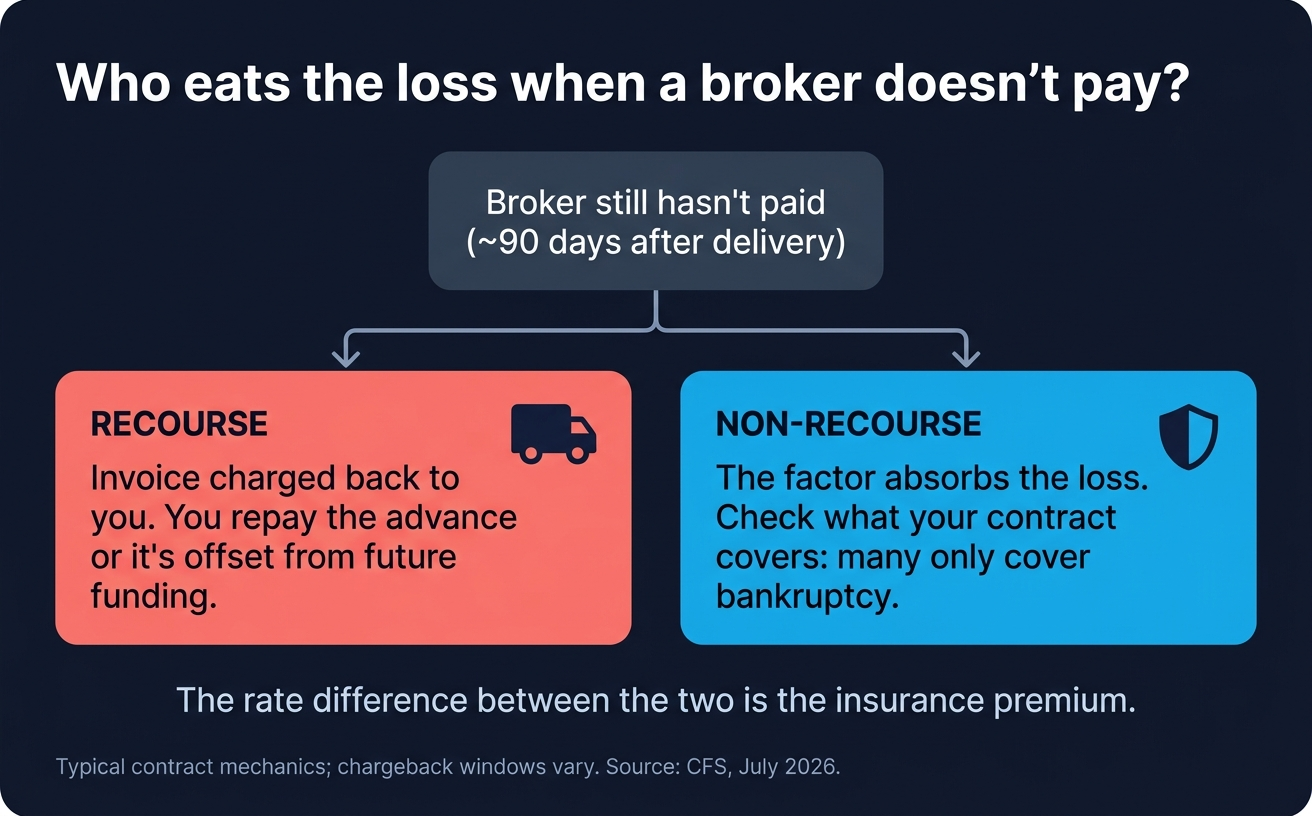
With recourse factoring, the factor has a right of recourse against you if it cannot collect. If the broker still hasn't paid after a standard collection window (typically 90 days), the factor charges the invoice back to your account. You either repay the advance you received, or the factor offsets it against future invoices. You bear the credit risk of every broker you haul for.
With non-recourse factoring, the factor assumes that credit risk. If the broker fails to pay for a covered reason, the factor eats the loss. You keep the advance. Nothing comes back to your account.
The mechanical difference matters most in the rate you pay. As of Q1 2026, OTR Solutions charges recourse rates in the 2.5%–3.5% range and True Non-Recourse at up to 4.0%, a premium of roughly 0.5–1.5 percentage points depending on your volume and contract. To illustrate the cost: at OTR's starting recourse rate of 2.5% vs. 4.0% non-recourse, the difference on a $1,000 invoice is $25 vs. $40. Scale that to $10,000/month and recourse costs approximately $250/month versus $400/month for non-recourse: an extra $150/month, or $1,800/year, at those rates. That figure is what you are paying the factor to absorb broker default risk on your behalf.
Rate verification note: OTR Solutions rates cited above are Q1 2026 figures based on publicly available information for owner-operators with 1–3 trucks; actual rates vary by volume and broker mix. Confirm current rates directly with the factor before signing.
Bobtail Capital operates on a recourse model, with rates starting at 3.25%. Bobtail does not offer a non-recourse program; instead, it uses multiple collection methods, including broker bond accounts (federally required to be a minimum of $75,000) and shipper subrogation, to pursue unpaid invoices before initiating a chargeback. That approach reduces the practical frequency of chargebacks under recourse, but the contractual liability remains with you.
The advance rate also differs by program type. Non-recourse programs typically carry a slightly higher advance rate because the factor has already priced the credit risk into the fee: there is less reason to hold a large reserve. Recourse programs may hold a marginally larger reserve as a buffer against potential buyback situations. At OTR Solutions, for example, the recourse program advances roughly 92% while the non-recourse program advances roughly 96%, a real difference of about $40 in day-one cash on a $1,000 invoice.
Recourse factoring: If the factor cannot collect payment from the broker, the invoice is charged back to you: you repay the advance or offset it against future invoices. You keep the lower rate but carry the credit risk.
Non-recourse factoring: If the broker fails to pay for a covered reason, the factor absorbs the loss and you keep the advance. You pay a higher rate in exchange for that risk transfer, but "covered reason" is defined by the contract, not by marketing language.
This is the section most factoring company blog posts skip over, and it is the most important thing to understand before choosing a non-recourse program. The word "non-recourse" in a contract heading does not mean "protected under all circumstances." It means protected under the specific circumstances defined in that contract, and those circumstances are almost always narrower than what the marketing implies.
Here are the five exclusion clauses that appear, in various forms, in most standard non-recourse factoring agreements. Read each one carefully. Any one of them can convert a non-recourse invoice back into your liability.
Exclusion 1: "Non-recourse applies only to credit-approved invoices." Before you factor an invoice, the factor must pre-approve the specific broker it is owed by. If you submit an invoice from a broker the factor has not evaluated and approved, and that broker fails to pay, the invoice is recourse, regardless of what your contract type says. Factors set approval limits per broker based on their credit profile. If you haul for a mix of established and smaller brokers, some of those invoices may not qualify for non-recourse coverage at all, and you may not know until after the fact.
Exclusion 2: "Non-recourse applies only in cases of verified insolvency." This is the exclusion that surprises carriers the most. Most non-recourse contracts protect you only if the broker files for formal bankruptcy: a Chapter 7 or Chapter 11 proceeding with a court filing. Non-payment, ghosting, going silent, shutting down informally, or even being widely known to be out of business does not trigger coverage. According to reporting from Summar Financial and analysis across multiple factoring company disclosures, non-recourse typically only applies if the debtor is "legally insolvent," which requires a formal legal process that many failed brokers never initiate. The broker who simply stops answering phones is not bankrupt in the legal sense, and the factor can charge that invoice back to you. This is not a theoretical gap. Rohit Handa, an owner-operator we profiled, delivered three loads for a broker who then went silent on $2,900: no bankruptcy filing, months of dodged calls, and eventually an admission that they were "running behind on payments." A ghosting broker is the most common way carriers get stiffed, and it is precisely the scenario a bankruptcy-only clause does not cover (his full story).
Exclusion 3: "Disputed invoices are not covered." Any freight claim, short-pay, delivery dispute, or disagreement about load terms removes the invoice from non-recourse protection. If the broker says the load was late, damaged, or that there was a rate discrepancy (even if you believe the claim is frivolous), the invoice becomes recourse the moment a dispute is documented. This is one of the most common paths to unexpected chargebacks, because disputes are easy for brokers to manufacture and difficult for carriers to disprove quickly.
Exclusion 4: "Non-recourse does not apply if the carrier was negligent." This clause is intentionally vague. It allows the factor to assign a portion of non-payment to carrier negligence (a missed delivery window, incomplete paperwork, a damaged shipment) and reclassify the invoice as recourse. The factor is the party interpreting what constitutes negligence under this language. Carriers with incomplete documentation practices are particularly exposed here. The same family of conduct carve-outs covers breaches of the factoring agreement itself: if you send an invoice directly to the broker instead of through the factor, or a broker payment lands in your account and you keep it, most contracts void non-recourse coverage on that invoice on the spot.
Exclusion 5: A 90-day maximum collection window. Some non-recourse contracts include a hard window, typically 90 days, after which the factor's obligation to absorb the loss expires. If the broker has not paid and has not filed for bankruptcy within that window, the invoice may be charged back to you regardless of what happens afterward. OTR Solutions specifically distinguishes their True Non-Recourse program from this structure by guaranteeing no chargebacks after 90 days. Standard non-recourse contracts from other factors may not offer that guarantee. Always check whether the non-recourse protection has a time limit.
Most non-recourse factoring contracts only protect you if the broker files for formal, legal bankruptcy. Non-payment, ghosting, informal shutdown, and disputed invoices are typically excluded, meaning the invoice gets charged back to you just like it would under a recourse agreement. You may be paying a premium for protection that does not apply to the most common ways brokers actually fail to pay.
The phrase "True Non-Recourse" is OTR Solutions' marketing term, but the concept behind it is a legitimate and meaningful distinction. OTR defines True Non-Recourse as: once your invoice is approved and funded, the payment is final under any circumstance: broker bankruptcy, broker default, refusal to pay, or inability to collect. No chargebacks. Ever. OTR explicitly states that it handles and assumes liability for all collections after funding, and that their non-recourse protection has no 90-day expiration.
That stands in direct contrast to standard non-recourse programs where, as documented above, coverage is limited to formal insolvency, subject to dispute exclusions, carrier negligence carve-outs, and time caps. The difference between "non-recourse" and "True Non-Recourse" is not just marketing. It is the difference between insurance that pays out and insurance with exclusions that void most claims.
To be clear: not every carrier needs True Non-Recourse. The 1 percentage point rate premium is real money over the course of a year. But every carrier deserves to know exactly what type of non-recourse they are buying before signing. Use this checklist of five questions with any factor advertising non-recourse coverage:
1. Which events trigger non-recourse coverage? Push for an exhaustive list: bankruptcy only, or also default, ghosting, and refusal to pay? Get this in writing.
2. What qualifies as a "dispute" that voids coverage? Ask for the specific dispute definition in the contract. A dispute clause that is broader than "documented formal freight claim" can swallow almost any non-payment scenario.
3. Is there a time limit on non-recourse protection? Some contracts expire the non-recourse coverage at 90 days. Ask: "If you cannot collect after 90 days, does the invoice come back to me?"
4. Does each invoice require pre-approval for non-recourse coverage? If yes, find out whether you will be notified at submission time if a broker is not approved, so you can make a different choice rather than discovering it when a chargeback arrives.
5. How is "carrier negligence" defined in the contract? Ask for the exact language. Vague negligence clauses are a vector for the factor to reclassify invoices at its discretion.
If a factoring company cannot answer all five of these questions with specific contract language, not verbal assurances, that is a signal about how clearly their non-recourse coverage is actually defined.
For internal reference, the broader landscape of what to watch for in factoring contracts (including blanket assignment clauses, personal guarantees, and auto-renewal terms) is covered in detail at Freight Factoring Contract Red Flags.
Ask every factor this question before signing: "If the broker has not paid and has not filed for bankruptcy after 90 days, does this invoice come back to me?" If the answer is yes, or if the answer is vague, you are not buying full non-recourse protection. You are buying partial coverage at a non-recourse price.
There is no universal answer. The right factoring type depends on your broker mix, your cash reserves, and how much financial uncertainty your operation can absorb without threatening cash flow.
Choose recourse factoring if: You haul consistently for a small number of established, high-credit brokers. When your broker mix is stable and creditworthy, the probability of a default is low, and the rate savings from recourse, roughly $1,200 to $1,800 per year at $10,000/month volume depending on your rate tier, are real money back in your business. Recourse also makes sense if you have enough operating capital to absorb an occasional buyback without disrupting operations. If a $1,500 chargeback would create a cash flow crisis, that changes the calculation.
Choose non-recourse factoring if: You haul for a varied mix of brokers, including smaller or newer brokers you cannot fully vet, and your margins don't leave room to absorb a sudden chargeback. Owner-operators running lean, newer carriers without large cash reserves, or anyone expanding into new broker relationships where creditworthiness is unknown are all strong candidates for non-recourse. The $100/month premium at $10,000 volume is a predictable, budgetable cost. A $3,000 chargeback three months into a slow quarter is not.
The broker credit mix is the key variable. Factors evaluate brokers before approving invoices: most major factors use internal scoring that considers payment history, time in business, financial health, and load board reputation. If you primarily work with brokers that consistently score well on that credit review, recourse factoring carries low practical risk. If you regularly take loads from newer brokers, small operations, or anyone whose credit profile is harder to read, non-recourse (real non-recourse, with the fine print reviewed) is worth the premium.
One nuance worth flagging: if your priority is protecting cash flow against the most common broker payment failures (disputes, slow payment, ghosting), standard non-recourse contracts may not provide the protection you think they do. As detailed in Section 2, those scenarios are frequently excluded. If that is your primary concern, True Non-Recourse, where the factor absorbs all non-payment risk regardless of cause, is the correct product, and the rate differential reflects that broader coverage.
For a full breakdown of how factoring fees work and how to compare total cost across providers, see Freight Factoring Rates and the company-by-company comparison at Best Freight Factoring Companies for Trucking.
Before choosing between recourse and non-recourse, pull a 90-day list of every broker you have hauled for and check their credit rating on your factor's broker approval tool. If more than 20% of your broker mix is unrated or low-rated, the non-recourse premium is almost certainly worth paying. If your top five brokers represent 80%+ of your volume and all carry strong credit, recourse is likely the more efficient choice.
Is non-recourse factoring worth the higher rate? It depends entirely on two things: the quality of your broker mix, and which type of non-recourse you are buying. If your brokers are creditworthy and you have reserve capital, recourse is often the more cost-efficient choice. If you haul for a varied broker mix and cannot absorb a surprise chargeback, non-recourse is worth the premium, but verify the exclusion clauses before signing. Paying extra for non-recourse that only covers formal bankruptcy is paying for a narrow product.
Can a factor charge me back even on a non-recourse invoice? Yes. Under most non-recourse contracts, the factor can still charge back an invoice if a dispute is raised, if the invoice was not pre-approved for non-recourse coverage, if documentation is incomplete, or if the carrier is deemed negligent. These exclusions are standard. The only structure that eliminates chargebacks entirely is a True Non-Recourse agreement with no carve-outs.
What happens when a broker goes out of business under a recourse agreement? Your factor initiates its collection process, which may include drawing on the broker's federally required surety bond (minimum $75,000), pursuing the shipper under U.S. subrogation law, or filing a claim in bankruptcy proceedings if applicable. If those efforts fail within the recourse window (typically 90–120 days), the invoice is charged back to you. Factors vary significantly in how aggressively they pursue collection before initiating a chargeback.
Does my personal credit affect which type of factoring I can access? No. Factoring approval, for both recourse and non-recourse programs, is based on the creditworthiness of your broker or shipper, not your personal credit score. Non-recourse programs do apply stricter scrutiny to the brokers they will pre-approve, but that is the broker's credit under review, not yours.
What is a "chargeback" and how does it affect my account? A chargeback is the factor's mechanism for recovering an advance it made on an invoice that did not get paid. Under recourse, this is expected and clearly defined: you receive notice, and the amount is either debited from your reserve account or offset against future funding. Under non-recourse, a chargeback is a signal that the factor is applying an exclusion clause and reclassifying the invoice as your liability. Always request written explanation of the specific clause being invoked when a chargeback arrives on a non-recourse account.
Is recourse factoring risky for owner-operators? It can be, but the risk is manageable if your broker mix is creditworthy and your factor has a strong collection track record. The practical risk is lower than the theoretical risk suggests, because most established factors screen brokers before approving invoices, under both recourse and non-recourse programs. The scenario to watch for is a rapid change in your broker mix: if you start hauling for smaller or newer brokers, your recourse exposure increases without any change to your contract.
Neither is universally better. Recourse is cheaper and fine when you haul for solid brokers you know. Non-recourse costs a little more and protects you when a broker fails, which matters most for spot-market carriers hauling for strangers.
Credit failure: the broker goes bankrupt or simply never pays. It does not cover disputes, shortages, or paperwork problems, which remain your responsibility with every factoring company.
Typically 0.5% to 1% above recourse pricing. On $25,000 a month, that is $125 to $250. One broker default on a single $2,500 invoice pays for many months of the protection.
A chargeback is when a recourse factor takes back money it advanced because the broker did not pay, usually after 60 to 90 days. It arrives exactly when you can least afford it, which is the entire argument for non-recourse.
No, and definitions vary widely. Some carve out broker bankruptcy from their 'non-recourse' program. Check who on our rankings offers true no-chargeback protection before you sign.
Recourse factoring is not inherently unsafe. It is the most common factoring structure in the industry, and most established carriers use it successfully. The risk is not recourse itself; the risk is hauling for unvetted brokers under a recourse agreement without the cash reserves to absorb a chargeback. Matching your factoring type to your actual broker mix and cash position is more important than choosing non-recourse by default.
Non-recourse factoring is not a blanket guarantee. It is protection for a defined list of scenarios, and most carriers don't read that list until after a chargeback arrives.
New articles for owner-operators, delivered twice a month.