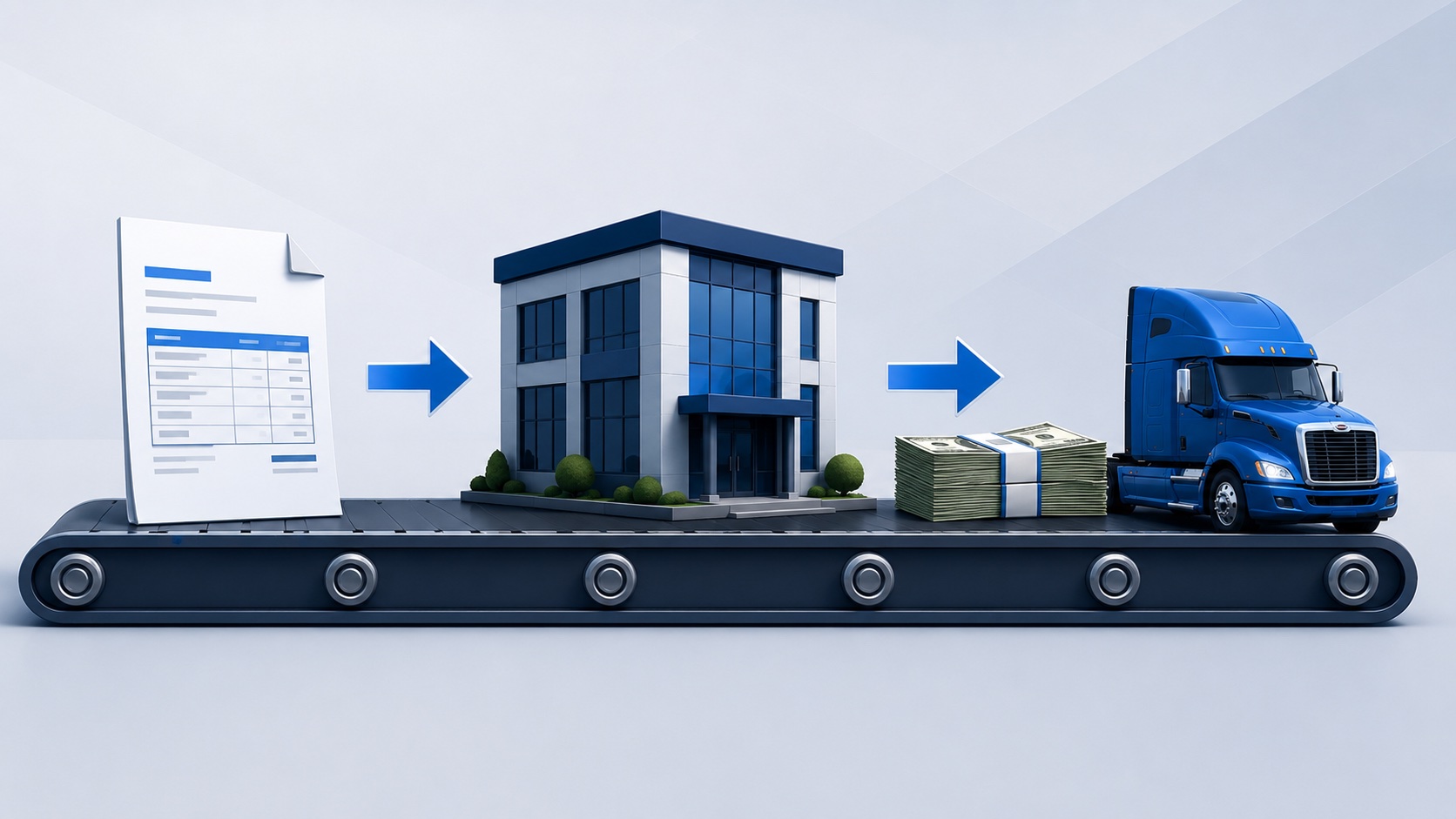
Is freight factoring worth it? It is worth it when waiting costs you more than the fee: when a 30–90 day broker payment cycle means turned-down loads, floated fuel, missed payments, or stress that changes how you book freight. It is not worth it when you hold enough cash to ride out the wait, because then the 1.5–5% fee buys speed you already own. Either way it is arithmetic, and our freight factoring calculator runs it on your numbers in about a minute.
That answer has two halves, and almost everything written on this question was published by factoring companies, so you only ever hear the first half. This article prices both. You will see the real advantages with numbers attached, the disadvantages the sales pages skip, and something no other article on this keyword has: two carriers we profiled, with real revenue, who looked at the same product and rationally chose opposite answers.
Factoring is a price paid for time. The factor advances you 85–97% of an invoice the day you deliver and keeps a fee of 1.5–5% when the broker eventually pays. Whether that trade is worth it is not a matter of opinion. It is arithmetic on two numbers.
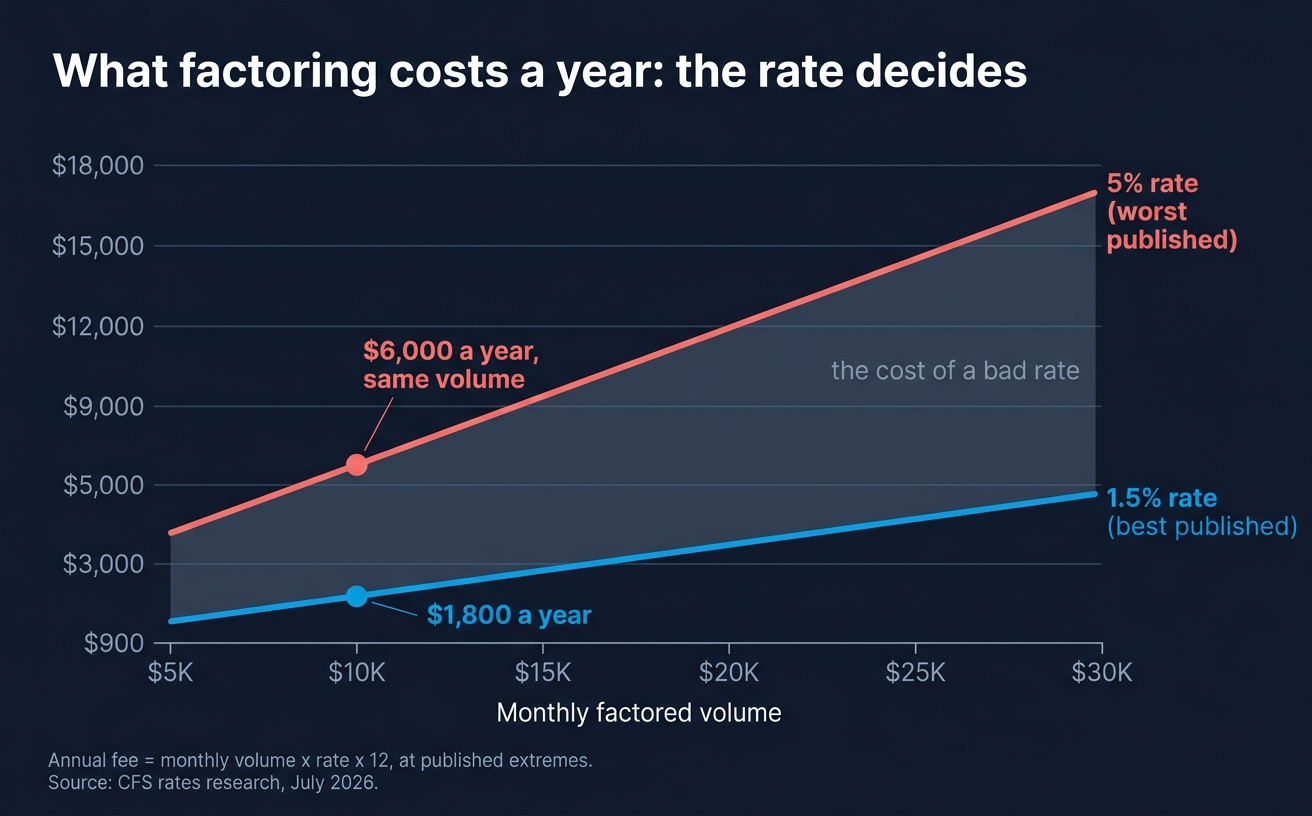
The first number is the fee. A single-truck operation factoring $10,000 a month pays roughly $150 at the best published rates and $500 at the worst: $1,800 to $6,000 a year. The spread between those published extremes on identical volume is about $3,612 a year, which is why the companion question to "is it worth it" is always "at what rate," covered in our freight factoring rates guide.
The second number is the cost of waiting. This one hides in your operation instead of on a statement, which is why carriers undercount it. It is the load you did not book because fuel money was parked inside an unpaid invoice. The late fee on the insurance payment. The quick-pay discount you gave a broker anyway. The Thursday night math with a near-zero balance. Total that honestly for a quarter, and most thin-reserve operations find it dwarfs $300 a month.
Worth it, then, is not a property of factoring. It is a property of your bank account. Which is exactly what the two carriers later in this article prove. First, both sides of the ledger in full.
Cost of waiting: everything a 30–90 day payment cycle takes from your operation while the money is stuck in a broker's payment terms: loads you could not book, fees you paid late, discounts you gave to get paid faster, and reserves you drained. It is the number the factoring fee has to beat, and most carriers have never actually totaled it.
The pros of factoring are real. They are just more specific than the brochures make them.
Same-day cash without debt. Factoring is a sale, not a loan. You are converting an asset you already earned into cash, so nothing lands on your balance sheet as debt, there is no interest clock, and your personal credit is not what gets underwritten. Approval runs on your brokers' credit, which is why brand-new authorities with thin credit files get approved routinely.
A back office you do not have to hire. For a one-truck operation, the factor is the invoicing department, the collections department, and the receivables ledger. Sammy Lloyd, the Georgia owner-operator behind Lloyd Trucking, has factored since 2018 and prices it exactly that way: hiring a bookkeeper or an accounts-receivable person for what his factoring fees cost him each month is not possible, a point he makes bluntly on his channel. One workflow for every broker, no chasing, and the fee is a write-off.
Broker vetting before you haul. Factors check broker credit before buying invoices, because their money is on the line. For a carrier booking off load boards, that credit check is a free scam filter on every new broker, arguably worth part of the fee on its own.
Predictability. A known percentage beats an unknown wait. Carriers running tight weekly cycles often value the certainty as much as the speed: fuel on Friday stops depending on which broker felt like paying.
Every one of those advantages is strongest for the same carrier profile: low reserves, varied brokers, high sensitivity to timing. Hold that thought, because the disadvantages cluster around the opposite profile.
Factoring can quietly subsidize bad freight. Same-day cash makes a cheap load feel survivable, and carriers who factor everything sometimes stop noticing that the underlying rates are the real problem. If you are factoring at 3% to keep hauling $1.60-a-mile freight, the fee is not your issue. Run your rate-per-mile math separately from your cash flow math.
Search this topic and you will find cons sections written by factoring companies, which is why they are three hedged bullets long. Here is the honest list.
The fee compounds on every load, forever. Three percent does not sound like margin until you annualize it: $300 a month on $10,000 of volume is $3,600 a year, on freight you already hauled. For a healthy operation, that can exceed the year's maintenance fund. The fee is only cheap relative to a genuine cost of waiting; with no waiting problem, it is just margin leaving.
Contracts create exit costs. Volume minimums, auto-renewal windows, exit fees calculated on your account limit, and liens that must be released before anyone else will fund you. Leaving a factor is a process with its own price tag, documented clause by clause in our factoring contract red flags guide.
The NOA rewires your payments. Every factored broker is formally notified to pay the factor, and unwinding that at exit takes a release letter the factor controls. It is routine paperwork going in and leverage against you going out; see our notice of assignment guide.
Recourse risk survives the marketing. Under recourse factoring, and under most "non-recourse" contracts too, a broker who disputes, short-pays, or simply ghosts can put the invoice back on you as a chargeback. The protection carriers think they are buying is usually narrower than the name.
Service quality varies wildly. A slow verification desk or an unresponsive account rep turns same-day funding into a two-day argument. This cost never appears in a rate quote and is the reason carrier reviews matter as much as percentages.
None of these kills the case for factoring. Together they define who should not bother: the carrier with reserves, stable brokers, and no waiting problem. Which brings us to two real carriers who sit on exactly opposite sides of that line.
Do not sign a 12–24 month factoring contract to find out whether factoring is worth it. Test the answer cheaply first: use spot factoring, a 30-day agreement, or a no-minimum program for a month or two, then commit once your own numbers make the case. The carriers who regret factoring are almost never mad about the fee; they are mad about the contract they signed to get it.
The clearest proof that "is it worth it" depends on the operation and not the product is that two profitable owner-operators we have profiled looked at the same math and split.
Sammy Lloyd factors everything. The MakeCents creator has run Lloyd Trucking out of Ringgold, Georgia since 2017 and has factored since 2018. His reasoning is a one-man operation's reasoning: sixteen open invoices on net terms means six to eight thousand dollars of his own fuel money floating in other people's payment departments, and chasing it is a job he refuses to hold. "I'm just a one-man operation. I need my money now," he said on his channel. For Sammy, the fee is a payroll line for a back office he never had to hire.
Rohit Handa factors nothing. The Handa Transport owner-operator launched in 2024 with a deliberate cash cushion, about $35,000 held back at startup specifically so he could float net-30, 60, and 90 terms and keep the 2–3%. For him, the fee buys speed his reserves already provide. But his no came with a tuition bill: a broker ghosted him on $2,900 across three delivered loads, and his own post-mortem conceded that a factor's broker credit check would have flagged the account before he ever hauled it. He still self-invoices, now with harder vetting rules. His full story is here.
Same product, same math, opposite answers, both rational. The variable was never factoring. It was reserves and broker mix. Sammy has no cushion by design and hauls for whoever pays best this week; Rohit built the cushion first and eats the occasional loss it exposes him to.
Find yourself on that line and the decision mostly makes itself.
Pull your last ten invoices and score the decision on your own freight: total the factoring fee you would have paid at a real quoted rate, then list what the actual wait cost you across those same loads, floated fuel, anything paid late, any load you passed on. Ten invoices is enough signal. If the wait column wins, factoring is worth it at your current size; if the fee column wins, bank the difference.
Factoring is usually worth it when:
Factoring is usually not worth it when:
The nearest alternatives answer a different question. A line of credit or working-capital loan is borrowed money: underwritten on your credit and time in business, repaid with interest whether freight moves or not, and sitting on your balance sheet the whole time. Factoring is the sale of an asset you already earned: underwritten on your brokers, costing nothing in months you do not use it, and scaling automatically with your volume. New carriers usually cannot get meaningful credit lines at all; established carriers with strong financials often can, and at that point a cheap line can genuinely outprice a 3% fee. The honest sequence for most operations is factoring first, credit lines later, reserves always.
The decision after "worth it" is "with whom," and that one is about rates, contracts, and service rather than concept. Our rankings of the best freight factoring companies for trucking compare all three, carrier-first.
Usually, yes, if broker payment terms are squeezing your cash flow. A 3% fee on a $2,500 load is $75, which is cheap insurance against missing a fuel payment or a truck note while waiting 30 to 45 days for a check.
When you have built roughly 60 days of operating costs in reserve and your customers pay reliably. At that point the fee buys you convenience rather than survival, and dropping it becomes a raise you give yourself.
A solo owner-operator factoring $25,000 a month at 3% pays about $750 a month, or $9,000 a year. Whether that is expensive depends entirely on what late payments would otherwise cost you in missed loads and late fees.
They solve different problems. Loans add debt and require credit history new carriers do not have. Factoring costs more per dollar but requires no debt, no credit, and scales exactly with your revenue.
Many do. Predictable same-day cash simplifies payroll, fuel, and growth planning even when the business could technically float receivables. See how the companies compare on our 2026 rankings.
The answer to this question expires. A new authority that rightly factors everything in year one may be sitting on real reserves by year three, at which point the same fee buys less. Re-run the ten-invoice math once a year, and if you stay with factoring, use the anniversary to renegotiate the rate; retention discounts go to carriers who ask.
"Quick pay for me, or even factoring for me, is a no-brainer. It makes sense."
New articles for owner-operators, delivered twice a month.