Factoring rates look like fixed prices and behave like opening offers. The factor knows your volume, your dispute rate, and exactly how expensive it is to replace you; most carriers know none of that about themselves, which is why most carriers pay the first number forever. This is the negotiation playbook: when the windows open, what leverage actually moves the number, and the word-for-word scripts, because the ask is easier when someone else wrote it. New to factoring? Read what freight factoring is first; this playbook assumes you are past the basics.
Three windows, in order of strength. The 90-day review: after 90 days of clean history you are no longer a risk profile, you are a track record, and the first review is industry-standard to request. Volume changes: every truck you add and every sustained volume step-up reopens the number. Competing quotes: any same-week quote from a rival factor opens the window immediately, because replacing you costs the factor more than a quarter point.
The strongest move is scheduling the windows in advance: ask for a written rate-review clause at signup, with dates and volume tiers. A negotiation on the calendar is an obligation; one you have to initiate is a favor. Month-to-month carriers hold the trump card here, which is one more reason our rankings weight open exits so heavily.
Track your own dispute rate and volume like the factor does: two numbers on one page turn every rate conversation from a plea into a performance review you are giving.
Factors price risk and effort. Lower either, and the rate has room to follow.
Clean paperwork history: low dispute rates and tidy BOLs make you cheap to serve; say so with numbers. Strong broker mix: invoices on solid-credit brokers carry less risk; if your book is clean, that is a discount you have already earned. Consistent volume: predictable freight is the thing factors bid on. A competing quote: the single fastest mover; get it in writing, same week. The credible walk: month-to-month terms mean your leave-threat is real. A carrier locked in a 12-month term is negotiating with a factor who knows they cannot leave, which is not negotiating.
What does not move rates: loyalty appeals, hardship stories, and asking without numbers. Bring arithmetic, not feelings.
Competing quotes expire fast: factors treat quotes older than a week or two as stale. Collect them the same week you intend to negotiate, not months ahead.
The 90-day review ask: We have factored $[X] over the past 90 days with zero disputes and clean paperwork throughout. I would like to schedule a rate review. Based on our volume and record, we are targeting [current rate minus 0.5]. What can you do?
The competing-quote script: I have a same-week written quote from [competitor] at [rate] with [matching terms]. I would rather not move; the relationship works. Can you match it, or get close enough that moving is not worth my time?
The volume-step script: We are adding a truck next month, which takes us to roughly $[new volume]. Before I assume the current rate applies, I want to ask: what does that volume earn?
The walk: I appreciate the relationship, but the numbers gap is real money at our volume. Send me the buyout and release-letter process, and if you can revisit the rate before [date], I am glad to stay.
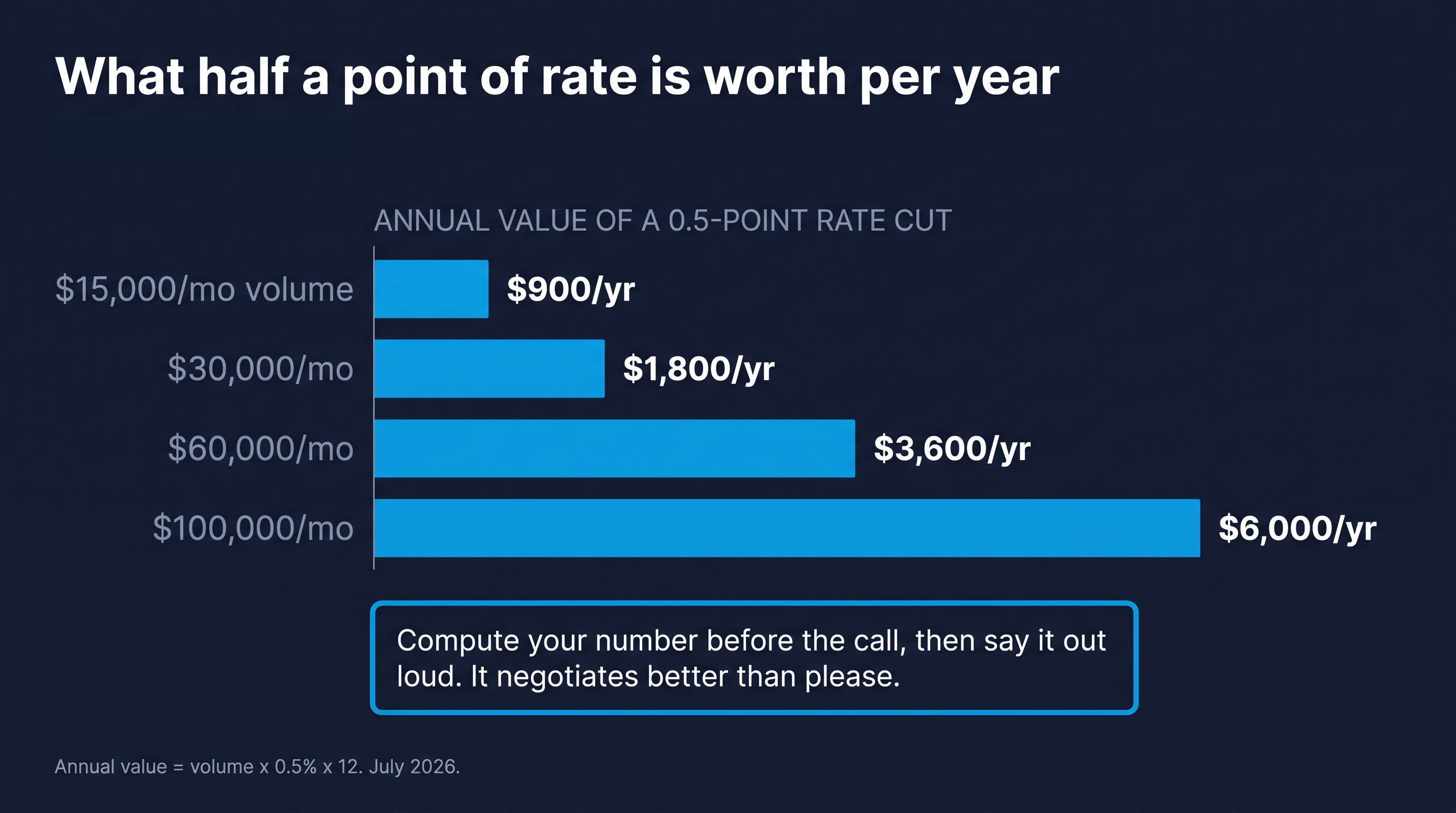
Every script works better in writing, and every one works better with the exact dollar gap computed: half a point at $30,000 a month is $1,800 a year, which is a nicer sentence than please.
Do not bluff the walk inside a 12-month contract: the factor can read your termination clause too. Real leverage starts with terms you can actually leave.
Negotiation energy should scale with the prize, so price the prize. Half a point at $15,000 a month is $900 a year. At $30,000, $1,800. At $60,000, $3,600. At $100,000, $6,000. A fleet that wins half a point and a written review clause in one phone call has done a better hour of work than a week of load-board grinding.
And check the fee schedule while you are in there: ACH fees, invoice fees, and monthly charges are negotiable too, and at small-fleet volume they can be worth as much as the rate. Our rates guide itemizes what all-in actually means, and the calculator turns any quote into your effective rate.
Negotiate the fees before the rate: ACH charges, invoice minimums, and processing fees come off with a yes from a manager, while rate cuts need a committee. Start where yes is cheap.
Every carrier with 90 clean days, a volume change, or a competing quote is holding an unopened negotiation window. Compute the dollar gap, pick the script, put it in writing, and schedule the next review before you hang up. If the answer is no twice, the switching guide is the sequel; factors know that too, which is why the scripts work.
Yes: rates are opening offers priced on risk and effort. Clean history, strong broker credit, consistent volume, and same-week competing quotes all move the number.
Request the first review at 90 days, then at every volume step or truck added, and hold an annual review regardless. Written review clauses at signup make the cadence automatic.
Half a point is $1,800 a year at $30,000 monthly volume and $6,000 at $100,000. Fee-schedule lines are often worth as much again at small-fleet scale.
Get a same-week competing quote and ask once more in writing. If the answer is still no and the gap is real, switching is routine: see our step-by-step switching guide.
Enormously: a carrier who can leave next month negotiates from strength, while one locked in a 12-month term is asking for favors. It is the quiet reason flexible contracts out-earn their rate difference.
Rate cuts have a floor: no factor prices below the risk on your broker mix. When two competing quotes land within a tenth of a point, you have found the market, and the remaining wins live in fees and funding speed.
The factor already knows what you are worth. Negotiation is the process of finding out yourself.
New articles for owner-operators, delivered twice a month.