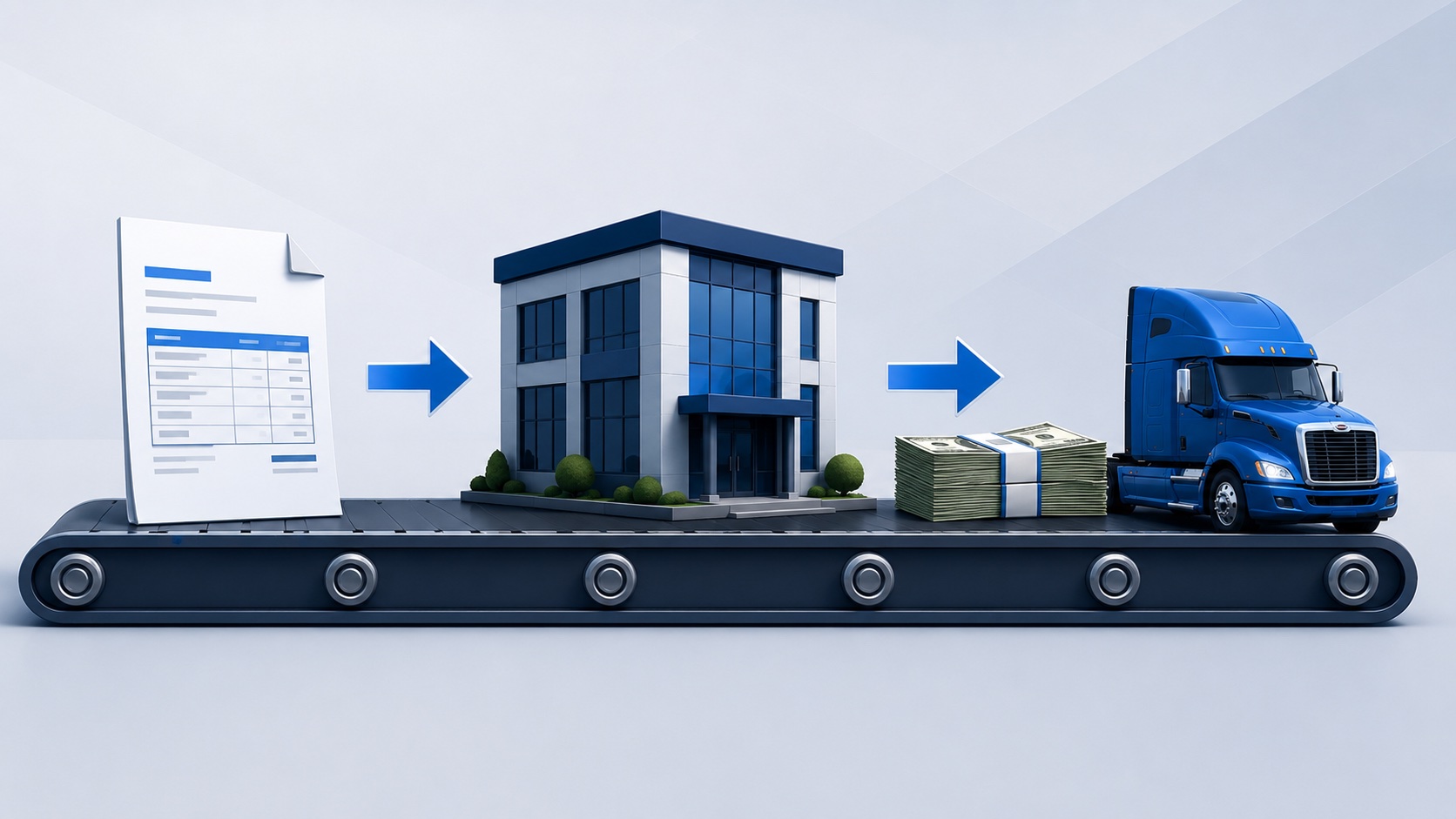
A fuel advance is money against a load you have not delivered yet, and that one sentence explains both why carriers love them and why they deserve a hard look. The load is picked up, the fuel gauge disagrees with the distance remaining, and someone will front you half the linehaul right now. This guide explains exactly how fuel advances work, what they cost in practice, and the honest decision tree for when an advance beats a fuel card, a credit line, or simply factoring faster.
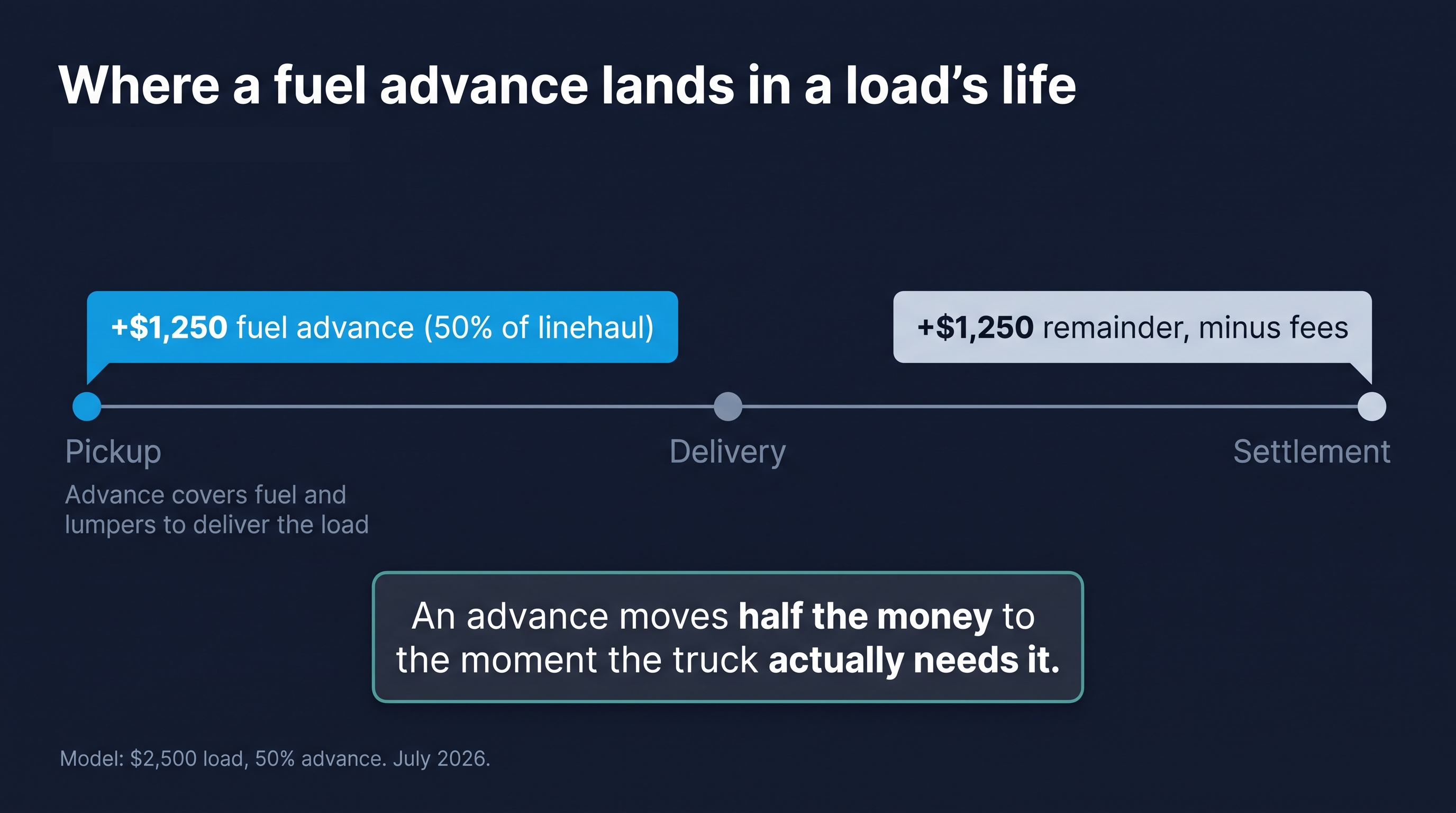
A fuel advance pays you a portion of a load's linehaul, typically up to 50 percent, after pickup but before delivery. You send the rate confirmation and proof the load is on your truck; the factor or broker sends money for fuel and road expenses; the advance is deducted from your settlement when the load delivers.
On a $2,500 load, a 50 percent advance is $1,250 mid-route, which comfortably covers the fuel to deliver it plus a lumper fee. Mechanically it is a bridge inside a bridge: factoring accelerates payment from delivery, and the advance accelerates part of it to pickup. OTR Solutions, for example, offers advances up to 50 percent of linehaul to factoring clients; most major factors run some version.
Linehaul: the base rate paid for hauling the load, excluding fuel surcharges and accessorials. Fuel advances are calculated as a percentage of this number.
Three cost shapes exist, and the label rarely tells you which one you are holding. Flat fees: some factors charge a per-advance fee, often $10 to $25. Percentage fees: others take a percentage of the advanced amount. Bundled free: some factors include advances in the factoring relationship at no separate charge, treating them as a retention feature.
The math that matters: a $15 fee on a $1,250 advance you hold for two days is small in dollars but enormous in annualized terms. That is fine, because you are not buying an interest rate, you are buying a delivered load. The real comparison is against the alternative: cash-price fuel on a personal card, a bounced fuel purchase, or turning the load down. Ask your factor the fee for your specific program and get it in writing; this line varies more than any other factoring fee.
Broker-paid fuel advances sometimes carry steeper fees than factor advances and complicate your invoice when you also factor the load. If you factor, take the advance from the factor.
Here is the decision tree, honestly.
A fuel card beats an advance for routine fuel. Cards with $0.47 to $0.59 average discounts save money on every gallon with zero paperwork per fill-up. Advances are for the gap the card cannot cover: lumpers, unexpected repairs, the week before your card exists.
Factoring faster beats both for the underlying disease. If you constantly need advances, the real problem is settlement speed. A factor paying in minutes, 24/7, keeps yesterday's delivery funding today's fuel, which shrinks the mid-route gap advances exist to fill. Our funding-speed guide ranks the rails.
The advance wins in exactly one scenario: a booked load you cannot afford to deliver without money you do not have yet. In that moment it is the cheapest option on the table, because the alternative is not hauling the load at all.
Track how many advances you took last quarter. More than a handful is not a fuel problem; it is a settlement-speed problem, and it is fixable with a faster factor.
Cheap: occasional advances on long or expensive loads, taken through your existing factor, with clean paperwork so the deduction reconciles cleanly at settlement. Used this way, an advance is working capital priced in coffee money.
Expensive: advances as a lifestyle. Taking 50 percent early on every load means every settlement arrives pre-shrunk, which pushes you toward the next advance, which is how carriers end up permanently half a load behind their own money. If that loop sounds familiar, the fix is structural: faster factoring, a fuel card that removes the cash-price penalty, and one deliberately un-advanced week to reset the cycle. Our worth-it math covers the broader cash-flow picture.
Price every advance in dollars before you tap it: 2 percent of a $1,500 advance is $30 for a bridge of a day or two. Fine occasionally, expensive as a lifestyle.
Fuel advances are a legitimate tool for a specific moment: a committed load, real fuel costs, and settlement money that has not arrived yet. Take them through your factor, know the fee in writing, and treat a growing advance habit as a signal to fix settlement speed instead. The rankings note which companies fund fast enough to make advances rare.
Typically up to 50 percent of the linehaul after pickup, verified against the rate confirmation and load documents. On a $2,500 load, that is up to $1,250 mid-route.
It varies by factor: flat fees around $10 to $25, a percentage of the advance, or bundled free with factoring. Ask for your program's fee in writing; this line varies more than any other.
No. A card discounts every gallon at the pump; an advance fronts cash against one specific load. Cards handle routine fuel cheaper; advances handle the gaps cards cannot.
Yes, through factors that serve new authorities: the advance is secured by the load, not your credit history. See our new-authority factoring picks.
Because a delivered load is in everyone's interest: the advance protects the invoice the factor is going to buy anyway, and it keeps carriers hauling instead of stranded.
Timing is half the product: an advance taken Friday against a Monday delivery bridges the exact gap where most factors are closed. A factor that funds weekends closes that gap, and the fee with it.
A fuel advance is the cheapest money you can get in the one moment it is the only money you can get.
New articles for owner-operators, delivered twice a month.