Every carrier eventually hears the same advice from someone who has never floated a fuel bill: just get a line of credit, it is cheaper than factoring. Sometimes that is true. More often it compares a product you cannot get to a product you already have, using math that ignores how trucking actually cashflows. Here is the honest comparison: what each product is, who actually gets approved, and what each one costs at real carrier margins.
A line of credit is debt: borrowed money you repay with interest. Factoring is a sale: you sell an invoice you already earned and receive most of it immediately. That distinction drives everything downstream.
Debt sits on your balance sheet, requires repayment regardless of whether brokers pay you, and depends on your credit profile. Factoring creates no debt, repays itself when the broker pays, and depends on your broker's credit. One product bets on your history; the other bets on your paperwork. For how the factoring side works mechanically, start with how factoring works.
Revolving balance: the portion of a credit line you carry month to month, accruing interest. The convenience of a line and the cost of a line are the same feature.
Here is the part the just-get-a-line advice skips. Banks typically want two years of business history, solid revenue, and personal credit before extending a meaningful line, and even fintech lines want months of bank statements and healthy deposits. A first-year authority with thin credit is not choosing between factoring and a credit line; the line said no.
Factoring approves the carrier the bank rejects, because the underwriting runs on broker credit: OTR, Bobtail, and Apex all approve day-one authorities. The realistic sequence for most carriers is factoring first, credit line later, once two clean years exist to show a bank. If bad credit is the specific obstacle, our bad-credit factoring guide covers that lane.
Factoring is not reported as debt, which keeps your balance sheet clean while you build the two-year history banks want. The products are sequential more often than they are rivals.
The naive version says factoring at 3 percent per invoice annualizes to a terrifying number while a line runs 12 to 25 percent APR, so the line wins. Real math is messier, in both directions.
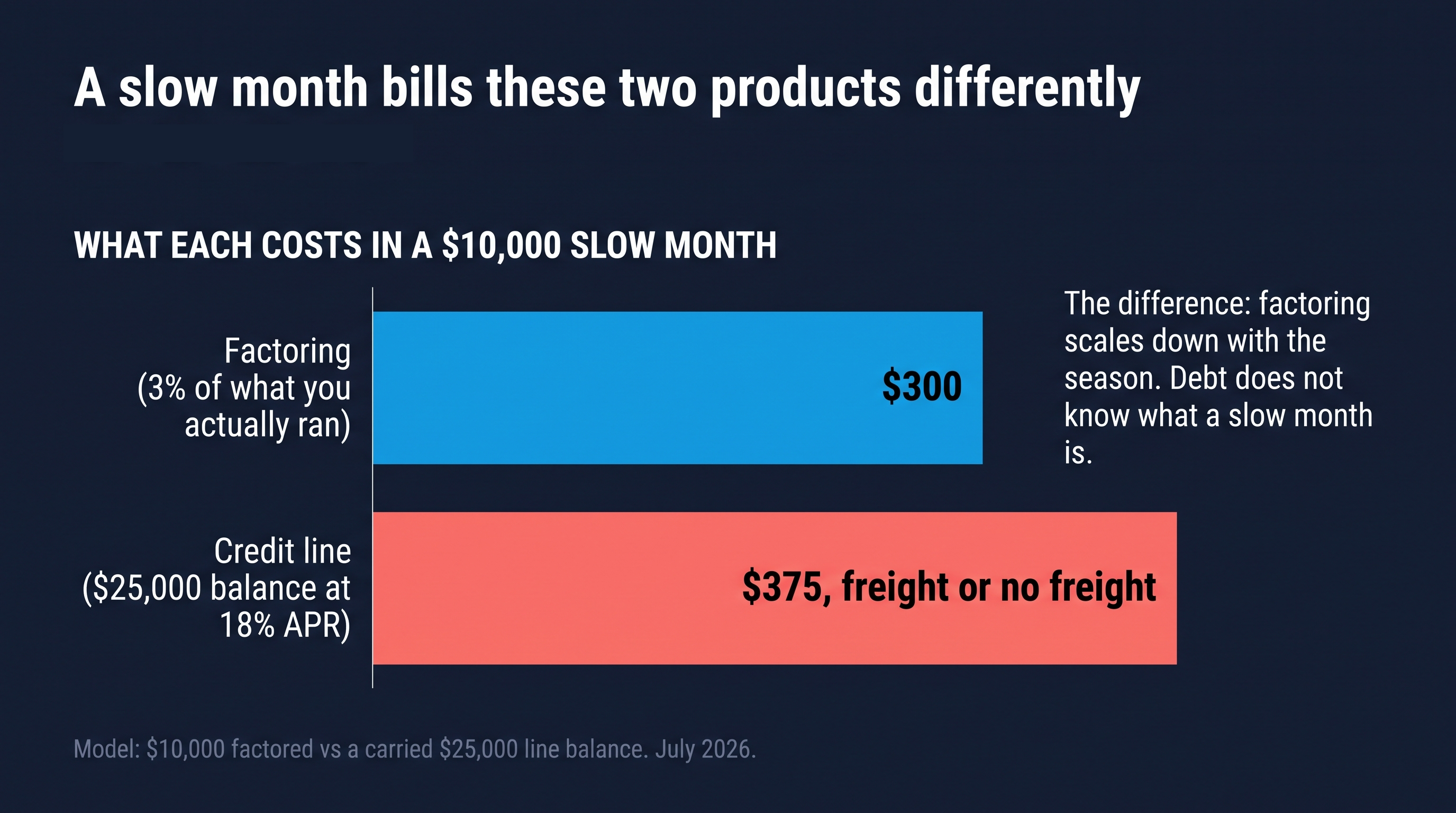
The factoring fee buys more than money: collections, invoicing, broker credit checks, and often a fuel card returning around $600 a month at solo volume. Subtract the back office you did not hire and the fuel you saved, and the effective cost shrinks fast. The line's interest is only part of its cost: draw fees, annual fees, personal guarantees, and the discipline tax of a revolving balance that quietly becomes permanent. A $25,000 balance carried at 18 percent is $375 a month whether freight moved or not.
The structural difference: factoring costs scale with revenue, debt costs scale with balance. In a slow month, factoring costs almost nothing because there is little to factor; the credit line bill arrives anyway. Run your own numbers in the calculator.
Watch personal guarantees on business lines: many make you personally liable. Factoring's recourse terms deserve the same scrutiny; read both contracts like they are pointed at you, because they are.
The line of credit wins for lumpy non-invoice expenses: a transmission, a tire set, an insurance down payment. Those are not invoices you can sell, and a line at bank rates beats any cash-advance product for them. It also wins for established carriers with fast-paying customers who need occasional flexibility, not weekly liquidity.
Factoring wins for the core trucking problem: fixed weekly costs against 30-to-45-day receivables, at any scale where waiting hurts. It requires no history, adds no debt, and brings the operational stack with it.
The grown-up answer is often both: factoring as the revenue engine, a modest line as the repair fund. They solve different problems, and pretending one replaces the other is how carriers end up using the wrong tool at the worst time.
Apply for the line in a strong quarter, before you need it: banks approve on your best months and lend against your worst. Even a line you never draw is leverage, and it costs nothing to hold.
For young authorities and any carrier living on broker terms, factoring is the practical winner: it approves when banks will not, adds no debt, and its cost breathes with your revenue. Lines of credit earn their place later, as the repair fund beside the revenue engine. Compare the factoring options on our 2026 rankings and price both products against your actual months, not your best ones.
Per dollar of liquidity, often no; per month of real trucking operation, often yes, once collections, credit checks, fuel savings, and slow-month scaling are counted. The honest answer depends on your volume and how much of the factoring stack you use.
Rarely at meaningful size: banks typically want about two years of history and solid financials. Factoring approves day-one authorities because it underwrites your brokers, not you.
Generally no; it is not debt and does not appear as a loan. Clean factored revenue history plus growing deposits is exactly the record banks want to see for a future line.
It works until it compounds: borrowing monthly against receivables recreates factoring with extra steps and a balance that grows. Selling the receivable is the cleaner version of the same move.
Usually yes, though the lender and factor will coordinate UCC filing positions. Many established carriers run exactly this pairing: factoring for revenue speed, the line for equipment surprises.
The two products stack cleanly: factoring smooths receivables while a small line covers true emergencies like a blown engine. What the line should never cover is payroll while you wait on slow invoices; that is the factoring job, at factoring prices.
Debt bills you in slow months. Factoring barely notices them.
New articles for owner-operators, delivered twice a month.