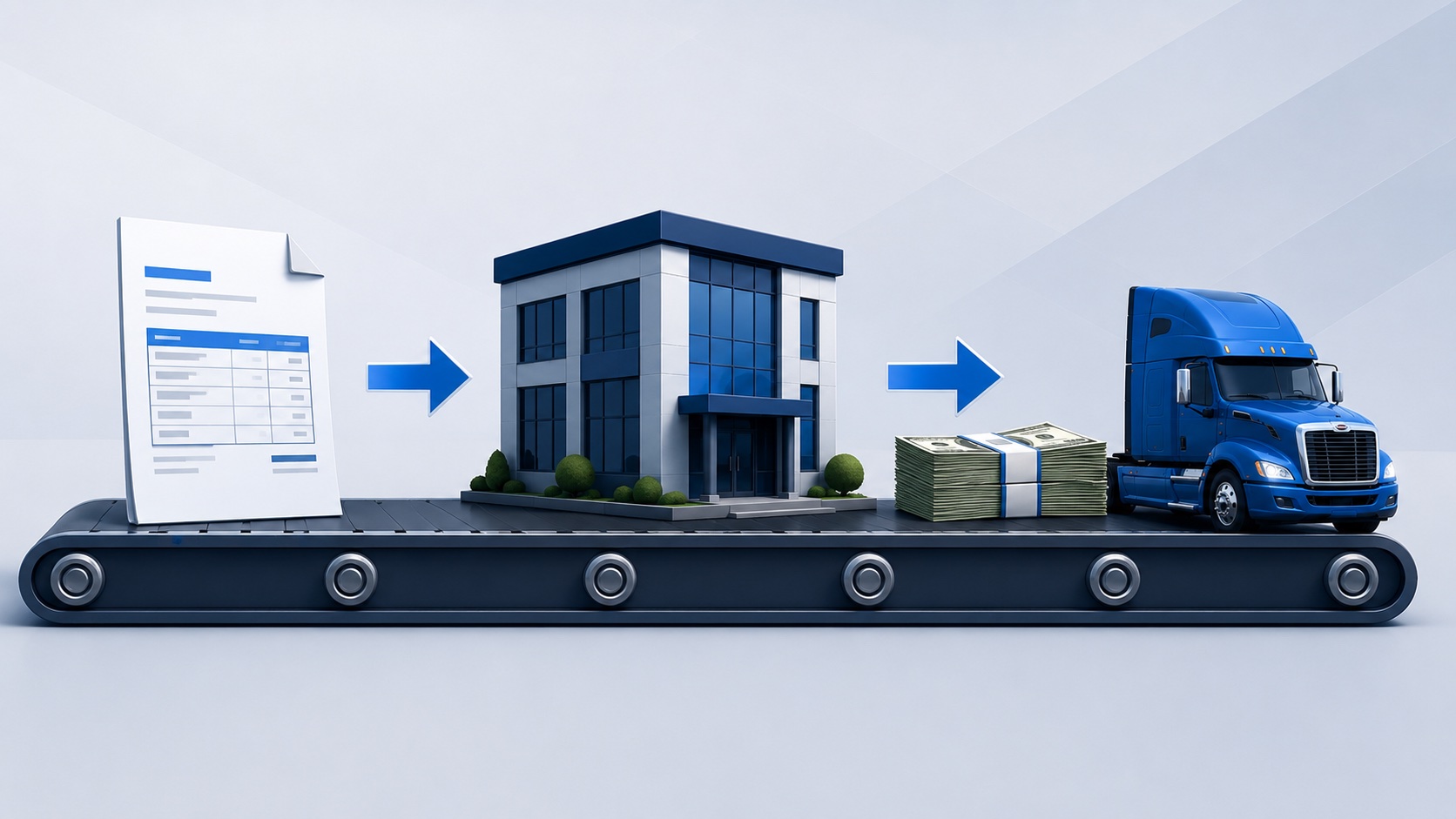
Can you get freight factoring with bad credit? Yes, and not as a grudging exception: carriers with rough credit are close to the core customer factoring was built for. A bank lends against your history, so a 550 score, a past repossession, or a thin file gets you declined. A factoring company buys your invoice and collects from the broker who owes it, so the credit that matters belongs to the broker, not to you. Your FICO score is not on the application because it is not part of the bet.
That is the honest headline, and if the article stopped there it would be no better than the marketing pages that already say it. The part they skip: there are real cases where your record does matter, none of them a credit score, all of them business-record issues (tax liens, open bankruptcies, old UCC filings, a prior factoring blowup). This guide covers both halves: why score genuinely does not matter, exactly when your history does, and how to walk into an application with either situation handled.
Follow the money and the logic is obvious. When you factor a $2,000 invoice, the factor advances you most of it today and collects $2,000 from the broker in 30 to 45 days. The repayment risk in that transaction is entirely about whether the broker pays. You already did your part: you hauled the load, and the signed POD proves it. There is no scenario where your personal payment behavior decides whether the factor gets their money back, so there is nothing for your credit score to predict.
That is why factoring approval runs on a different checklist entirely: active authority, real insurance, a registered business, clean load paperwork, and brokers the factor can approve (the complete list, item by item, is in our factoring requirements guide). Notice what the checklist verifies: that the invoice is real and collectible. You are the source of the asset, not the borrower.
Contrast the alternatives a credit-challenged carrier is usually offered:
Against that menu, paying a factoring fee of a few percent on invoices you already earned, with no debt created and no personal score in play, is why factoring is the default working-capital tool for carriers banks won't touch. (What those fees actually run, and the games played with headline rates, is covered honestly in Freight Factoring Rates.)
One clarification that saves confusion later: some factors run a soft background review on the business owner, screening for fraud and the specific issues in Section 2. That is not a FICO gate, it does not ding your credit, and a low score passes it fine. What it catches is exactly what the next section covers.
Soft pull vs. hard pull: a hard credit inquiry is the kind lenders make when you apply for debt; it requires your authorization and can affect your score. Most factoring applications involve at most a soft review of public business records (liens, judgments, UCC filings, prior bankruptcies), which does not touch your personal score. If a factor's application asks to authorize a hard personal pull, ask why: it is not the industry norm for standard freight factoring, and the answer tells you whether something nonstandard (like a personal guarantee with real teeth) is in the agreement.
Here is the section the "bad credit OK!" marketing pages skip, and the one that decides real applications. None of these are score problems; all are public business-record problems, and factors check for every one of them.
Unresolved tax liens. The heavyweight. An IRS lien can attach to your assets, including your receivables, with priority that can jump ahead of the factor's claim. A factor advancing you 95 percent of an invoice the IRS might legally intercept is taking a risk no rate covers, so unresolved liens stall applications hard. The fix is established: get on an installment agreement with the IRS, and in many cases the factor will work with a lien subordination that puts their interest in your receivables ahead of the government's. Slower than a normal approval, entirely doable, and factors handle it routinely, but only when they know.
Open bankruptcy. A discharged bankruptcy years back is largely a non-event in factoring. An open, active proceeding is different: your assets and contracts are under court supervision, and a factor generally cannot buy your receivables cleanly without the process accounted for (in some cases, court approval). Expect a decline or a much more involved path until the case resolves.
An active UCC filing on your receivables. If a previous factor or lender still holds a lien covering your invoices, a new factor cannot take the first-position interest they need. Common causes: an old factoring relationship that never got formally terminated, a fintech loan with a blanket lien, or a pre-filing from an application you abandoned. The fix is mechanical (payoff, buyout, or termination of the stale filing) and the whole process is mapped in our UCC filing guide.
A prior factoring default or fraud flag. The industry has a memory. A past relationship that ended with unpaid chargebacks, or worse, paperwork games (double-brokering invoices, factoring the same load twice), follows the owner, not just the entity. Honest history with a rough patch is workable, especially with the old balance settled; a fraud flag is close to terminal. If you owe a former factor money, resolving it is the prerequisite to everything.
The pattern across all four: they are checkable in advance, and they are all better disclosed than discovered. Which is Section 3.
"No credit check factoring" marketing deserves one squint: nobody reputable is ignoring public records, and a factor that truly checked nothing about anyone would be pricing that chaos into everyone's rate. The phrase accurately means "no personal FICO minimum," which nearly every freight factor could honestly claim. Judge factors on their actual rate, fee schedule, and contract terms, not on how loudly they advertise the absence of a check that standard factoring never required in the first place.
The mechanics of applying are identical regardless of your credit (the document checklist); what changes is preparation.
Pull your own records first. Before any factor searches you, search yourself: your state's UCC records for old filings, and your own knowledge of any liens, judgments, or open cases. Fifteen minutes of looking eliminates every surprise a factor could find, and surprises are what kill momentum.
Disclose with the fix attached. The winning version of every awkward conversation is the same shape: "There is an IRS lien; here is the installment agreement and the contact for subordination." "A prior factor's UCC is still showing; here is the zero-balance letter and the termination request I sent." Factors process situations like these constantly. A disclosed problem with paperwork reads as an organized operator with history; a discovered problem reads as concealment, and the application rarely recovers its speed.
Expect normal pricing, mostly. Because your score is not an input, bad credit does not, by itself, buy you a worse factoring rate. Your rate is driven by volume, broker quality, and program type (recourse versus non-recourse, explained here). Where the exceptions in Section 2 exist, expect the process to slow before the price changes; a lien subordination adds steps, not usually points.
Beware the desperation trap. Carriers in credit trouble are the exact audience for bad contracts: the highest rates, the stickiest auto-renewals, the broadest personal guarantees get signed by people who believe nobody else will take them. The entire point of this article is that the belief is false: standard factors approve credit-challenged carriers as a matter of course, so shop at least two offers like anyone else and run the contract red flags checklist before signing anything. Bad credit is not a reason to accept a bad contract; it is the situation bad contracts hunt.
Watch the personal guarantee clause with special care when your credit history is rough. A limited "validity guarantee" (you personally promise the invoices are real, standard and fair) is very different from a broad personal guarantee of every obligation under the agreement, which quietly converts no-recourse-to-you factoring into something your personal assets backstop. Carriers with clean credit get offered the narrow version; carriers who look like they can't shop around get offered the broad one. You can shop around. Read the guarantee language, and negotiate it like the deal point it is.
The twist in "no credit check" factoring: it is the most credit-checked corner of trucking. The checks just point at your customers.
Every invoice you factor gets advanced only after the factor approves the broker behind it, scored against freight-specific bureaus (TransCredit and Ansonia, on their 0-to-100 scales where 87 and up is low-risk and below 70 is high-risk) and the factor's own collections experience. Haul for strong brokers and everything funds smoothly at full advance; haul for weak ones and you meet declined invoices and reduced advances, regardless of how pristine your own finances are. In factoring, you inherit your brokers' creditworthiness.
For a credit-challenged carrier, this inversion is genuinely good news, played correctly:
Your approval odds are in your control this week. You cannot fix a credit score by Friday, but you can absolutely book your next three loads with 90-score brokers instead of 60-score ones. The factor's portal makes the check instant and free, which means the tool that gates your funding is also handed to you.
The vetting is a service you would otherwise pay for. A carrier without reserves cannot afford a $2,900 ghosting, and broker credit screening is precisely the protection against it (what that scenario looks like, and the escalation ladder when it happens anyway). Rohit Handa, the owner-operator in that story, does not factor, and his own conclusion after months of chasing an unpaid broker was that a factor's due diligence would have flagged the account before he ever took the load.
Payment history can rebuild your actual credit. Factoring itself is not a credit product and does not report your score up; what it does is keep cash arriving predictably, which is what lets you pay insurance, truck notes, and cards on time, which is the slow, boring, real mechanism by which business owners repair credit. Factoring funds the behavior; the behavior fixes the score.
Make the factor's broker credit check part of booking, not an after-the-fact surprise: before accepting any load from a new broker, run them through the portal and set yourself a floor (many carriers use the 87+ low-risk threshold for meaningful volume). Every load you book above your floor funds smoothly and protects the cash flow that is rebuilding your credit; every load below it is a gamble you are taking with the exact stability you are trying to restore. The discipline costs thirty seconds per booking.
Is there any minimum credit score for freight factoring?
As an industry standard, no; most factors run no hard personal pull and publish no score minimum, because your score does not predict whether your broker pays your invoice. What factors do screen are public business records: liens, open bankruptcies, existing UCC filings, and prior factoring history, per Section 2. A 540 score with clean business records beats a 750 with an unresolved IRS lien, every time.
Will factoring help fix my credit score?
Indirectly, and honestly that is the only way anything fixes it: factoring stabilizes your cash flow so your actual credit obligations (truck note, cards, anything reporting) get paid on time, and on-time history is the repair mechanism. Claims that factoring itself boosts your score oversell it; factoring is the cash-flow floor under the behavior that does.
I had a bankruptcy two years ago. Am I wasted effort?
A discharged bankruptcy is routine in this industry and factors work with post-bankruptcy carriers constantly; expect the question, answer it with dates and discharge paperwork, and it is unlikely to be the deciding factor. An open, undischarged case is the harder situation, per Section 2, and generally needs to resolve before standard factoring works.
Can I get factoring if I owe money to a previous factoring company?
Not cleanly, until it is addressed. The old factor likely still holds a UCC position, and the industry cross-checks; the standard path is a payoff or negotiated settlement, often executed as part of a buyout by your new factor. Bring it up first, with numbers: "I owe roughly $X to my former factor; can you structure a buyout?" is a normal Tuesday for a factoring sales team. Hiding it is the version that fails.
Does bad credit change my factoring rate?
By itself, no; rate is driven by your volume, your broker mix, and program structure, none of which read your FICO. What rough credit can cost you is indirect: if it steers you toward the "anyone approved!" corner of the market instead of comparison shopping, you will pay that corner's rates and sign its contracts. The defense is shopping two or three mainstream quotes, exactly as covered in our rates guide, because the mainstream would have approved you all along.
Usually, yes. Factoring approval rides on your brokers' credit, not your personal score. Factors care whether the broker will pay the invoice, and your score does not change that. Expect at most a rate on the higher side of normal to start.
Indirectly. Factoring keeps bills paid on time, which protects your payment history with fuel vendors, insurers, and lenders. Some factors also report positive payment activity. The bigger effect is avoiding the late payments that dig the hole deeper.
Often, yes, especially once the bankruptcy is discharged. Factors will look harder at your paperwork and may start with a conservative arrangement, but a past bankruptcy is not the automatic no that it is with bank lending.
Most run a soft pull on the owner during setup, mainly screening for fraud signals and open tax liens rather than scoring you. The hard credit analysis happens on your brokers, every load.
Personal guarantee clauses that convert business risk into personal risk, and rates padded well above market because the factor assumes you cannot shop around. You can. Compare terms on our 2026 rankings like any other carrier.
Practices described here (soft reviews, lien subordination processes, buyout handling, guarantee structures) are the industry-standard pattern verified across major factors as of July 2026; individual companies differ in their appetite for specific situations, especially open tax issues and prior factoring defaults. None of this is credit repair, tax, or legal advice: for an IRS lien, a bankruptcy in progress, or a dispute with a former factor, the respective professional (tax pro, attorney) is worth their fee before you sign anything new.
"A 540 score with clean business records beats a 750 with an unresolved IRS lien. In factoring, the checks point at your brokers, and the exceptions point at your paperwork."
New articles for owner-operators, delivered twice a month.