Freight has seasons the way weather does, and every carrier learns their own calendar: produce ramps, retail surges, the January cliff. The operators who survive slow seasons are rarely the ones who out-hustle them; they are the ones whose financial setup was built in July for a February they knew was coming. This is the playbook: what to change in your factoring setup before the slowdown, during it, and in the strong months that fund everything else.
The revenue dip is survivable arithmetic; what breaks carriers is fixed costs meeting variable income with no buffer between them. Insurance, truck payments, and permits bill identically in February and July, while spot rates and load counts sag together in the same months.
Factoring interacts with this two ways. Done right, it flattens the cash curve: every delivered load pays same-day, so thin months at least pay immediately. Done wrong, the contract itself becomes a seasonal expense: minimum-volume clauses bill phantom fees in exactly the months you cannot afford them, as our contract red flags guide prices out in detail.
Auto-renewal windows love to land mid-winter: check your contract's cancellation window now, because missing it in December can lock a bad fit through the entire next year.
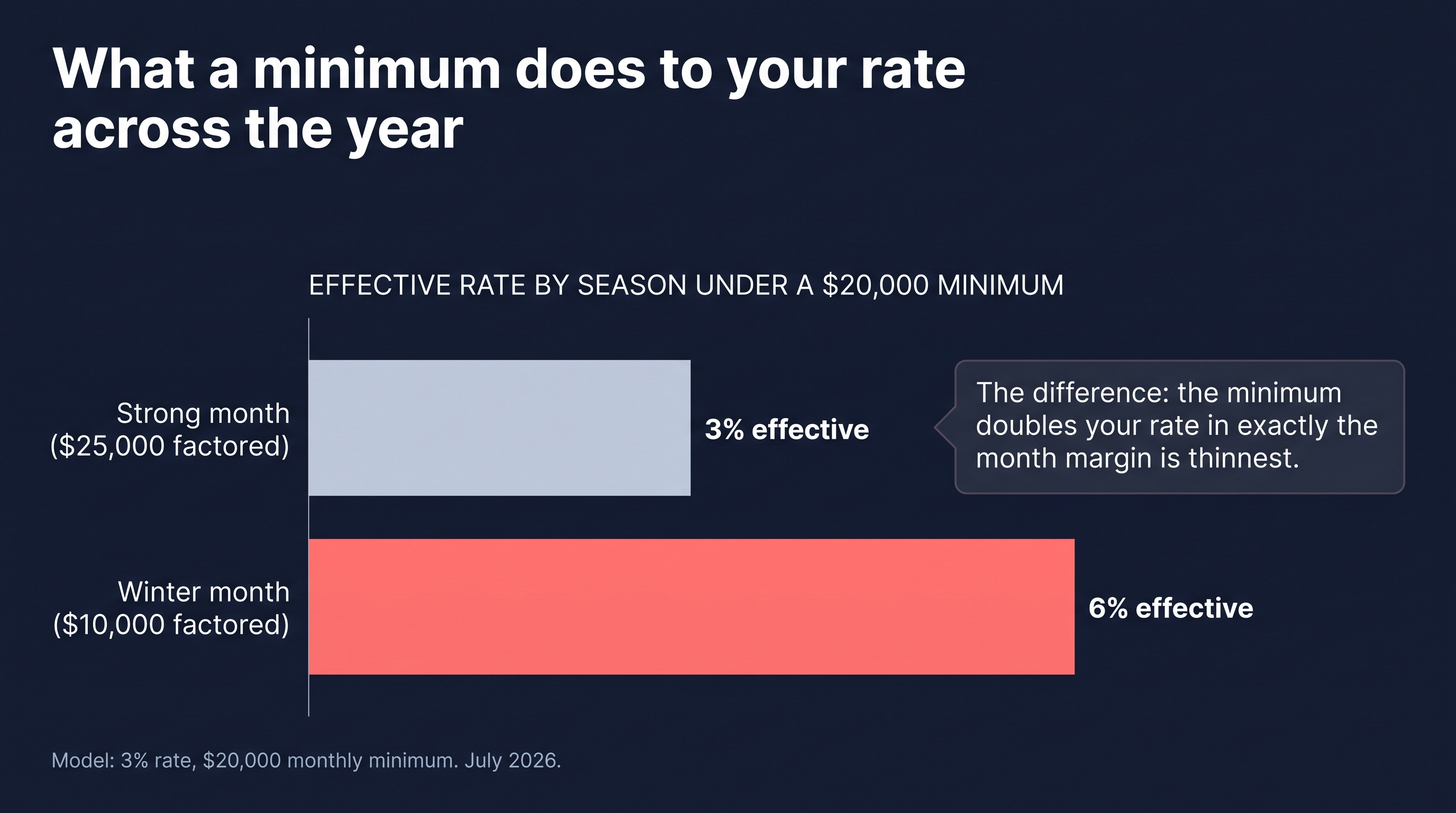
1. Audit your contract for the minimum trap. A $20,000 monthly minimum against a $10,000 winter month bills roughly $300 in fees on freight that never existed, an effective 6 percent rate in your thinnest month. If your contract has one, the renegotiation or the exit happens now, in your strong season, while your volume is worth bidding for.
2. Build the reserve on a schedule. Set aside a fixed percentage of every strong-month settlement, 5 to 10 percent, moved automatically the day funding lands. Same-day factoring actually helps the habit: money that arrives predictably is money you can skim predictably. Ninety days of fixed costs is the classic target; even 30 changes February's mood.
3. Renegotiate while you are attractive. A factor watching your $30,000 months says yes to things a factor watching $9,000 months will not. Rate reviews, fee waivers, and written seasonal accommodations all price better in season; our negotiation scripts do the asking.
Automate the reserve skim the same day funding lands: money that never touches the operating account never gets spent by accident.
Slow-season freight has a different shape: more spot loads, newer brokers, thinner margins. Two adjustments fit it.
Factor selectively where your contract allows. In tight months, every dollar of fee matters: factor the 40-day broker money, keep the 7-day shipper money whole. Per-broker or per-invoice selectivity (Bobtail, HaulPay) turns the fee into a scalpel instead of a blanket; our spot vs contract guide covers the mechanics.
Credit-check harder, not less. Broker failures cluster in soft markets, and a slow-season chargeback is the one you cannot absorb. Free broker checks and non-recourse protection both earn their keep in exactly these months.
Broker failures cluster in soft freight markets, which makes slow-season credit checks and non-recourse protection worth more precisely when freight is worth less.
Contract: no minimums, month-to-month or a term that ends before your slow season, no deposit waiting to be argued over. Reserve: automatic percentage skim in strong months, target 90 days of fixed costs. Fee posture: selective factoring in thin months, full-book factoring when volume is high and the back-office relief is worth more. Calendar: renegotiation in peak season, contract review 60 days before renewal windows, and a written plan for which trucks sit if January runs long.
None of this is exotic. It is the same discipline the worth-it math always points to: match the tool's cost to the months it earns its fee, and stop paying for it in the months it does not.
Book the rate review for early fall, while your trailing three months still show peak-season volume. The same ask in January negotiates from your weakest numbers.
Seasonal carriers do not need a different factoring product; they need the flexible version of the normal one, arranged before the season arrives. No minimums, open exits, a scheduled reserve, and selective factoring will carry a well-run seasonal operation through winters that end over-committed competitors. The rankings mark which companies fit that shape.
Yes, with the right contract shape: no minimums and open exits. Same-day payment matters most when loads are scarce, and the fee scales down automatically with volume.
Target 90 days of fixed costs; even 30 days changes decisions. Skim 5 to 10 percent of every strong-month settlement automatically the day it lands.
They bill as if the volume existed: a $20,000 minimum met with $10,000 of freight costs about $300 in phantom fees at 3 percent. Seasonal carriers should not sign minimums at all.
Yes, where your contract allows selectivity: factor slow broker money, keep fast-paying customers whole, and the fee shrinks to match the season.
In peak season, when your volume is the thing factors bid for. Renegotiating in February is asking; renegotiating in July is offering.
Slow season is when factor service gets tested: funding cutoffs, weekend coverage, and dispute help matter most when every load is load-bearing. Note the friction during busy season; decide about it before the slow one.
February is not survived in February. It is survived in July, on purpose.
New articles for owner-operators, delivered twice a month.