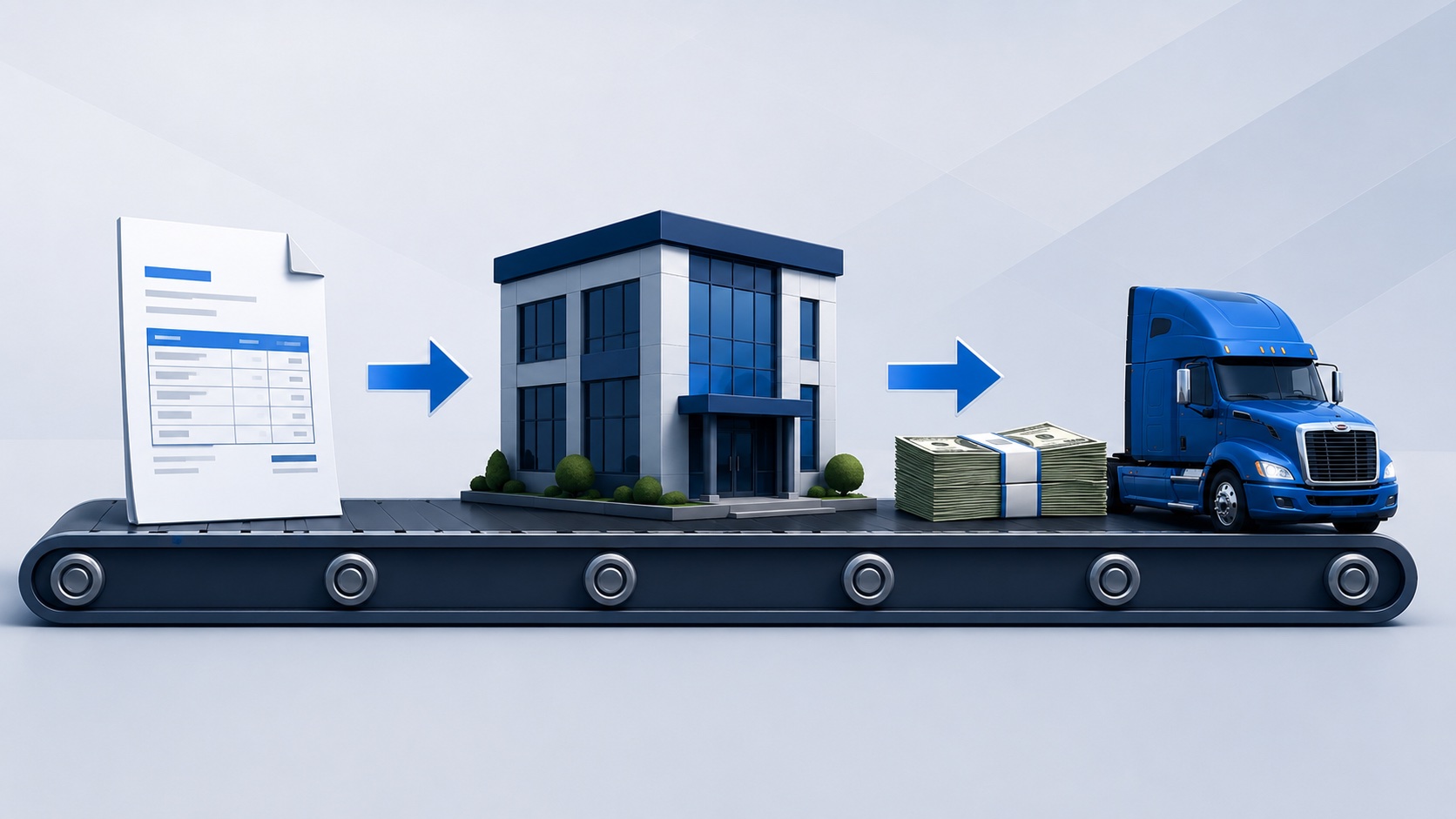
Growing a trucking company from one truck to two is a cash-flow problem before it is a freight problem: the second truck starts spending on day one (a down payment, an insurance deposit, weekly driver pay, daily fuel) while its first invoices come back in 30 to 45 days, and the only thing bridging that gap is money you already had. Add a truck without that cushion and truck one ends up financing truck two, which is how a profitable owner-operator becomes an unprofitable fleet of two.
The numbers behind that sentence are not folklore. ATRI's 2026 cost study put the average cost of running a truck in 2025 at $2.336 a mile, with driver wages and benefits at $1.03 of it, and reported truckload operating margins of 0.4 percent, with only LTL carriers and fleets over 1,000 trucks earning healthy margins. The Bureau of Labor Statistics' survival data for transportation businesses shows roughly a quarter gone after one year and half after four. This guide walks through what truck two actually costs in 2026, the week-by-week cash gap it opens, where factoring and fuel credit fit, and a readiness test built from carriers who have made the jump and carriers who wish they had not.
Because the first truck was subsidized by you. As a one-truck owner-operator you are the driver, the dispatcher, the safety department, and the accounts-receivable clerk, and none of those people send you an invoice. The moment a second truck rolls, the biggest of those jobs, driving, becomes a payroll line. ATRI's 2025 data puts driver wages at 81.8 cents a mile and benefits at another 21 cents, together $1.028 a mile, the single largest cost of operating a truck and larger than fuel, truck payments, and insurance combined.
A box-truck fleet owner we profiled, Bigg Vic, described the arithmetic he expected and the arithmetic he got: "If one truck makes me seven grand a month, two trucks makes 14. It does not work like that." Driver pay, at roughly $2,800 a month per truck in his operation, became the biggest line on the sheet, and a driver who ran truck one dry handed him a $20,000 engine repair. He still grew, and he still runs with a factoring company he has used for five years, but his telling of the second truck is a story about costs he had not been paying himself.
The structural problem is that revenue scales by truck and costs scale faster. Two trucks mean two insurance policies, two notes, two sets of plates and permits, and two drivers' worth of mistakes, while the freight that fed one truck comfortably now has to feed two, booked by a person who is driving one of them. A fleet owner quoted in Trucknews put the ratio plainly: adding a truck does not double income, and expenses rise by about 150 percent. ATRI found that truckload fleets with fewer than five trucks had the highest repair and maintenance costs per mile in 2025.
And the margin you are scaling is thin. Truckload carriers earned 0.4 percent in 2025 on ATRI's data; flatbed lost half a percent. Multiply a thin margin by two and you have a thin margin with twice the exposure. Which is the honest reason to add a truck: not because one truck is profitable, but because you have a specific, confirmed way to make the second one more profitable than the first. So what does it cost to find out?
Owner-operator vs. fleet owner: an owner-operator drives the truck they own and keeps the driver's wage as profit. A fleet owner employs at least one driver, which turns that wage into payroll, adds employer obligations (Clearinghouse queries, drug testing, occupational accident or workers' compensation coverage), and makes the owner responsible for a truck they cannot see.
Start with the truck. ACT Research put the average retail price of a used Class 8 at $64,367 in August 2026, up from $55,215 in February, with the average unit carrying about 410,000 miles. A new Class 8 averages around $170,000 before options, per ATA. For the typical second truck, a three-to-five-year-old sleeper, J.D. Power's last published dollar benchmarks (May 2025) ran from about $57,000 for a 2021 to $76,000 for a 2022 at retail, and its 2026 updates show that segment down about 6 percent year over year.
The note. FreightWaves' June 2026 worked example is the right anchor: a $75,000 used Kenworth T680 with $10,000 down, financed at 9 percent over 60 months, is $1,349 a month and $15,940 in total interest. Stretch it to 84 months and the payment drops to $1,031 but the interest climbs to $21,604. Banks lend at 4 to 8 percent to carriers with scores above 700 and two years in business; specialty truck lenders run 7 to 12 percent for qualified borrowers and 15 to 22 percent for startups, and a 620 score on an 18-month-old authority can mean 25 to 30 percent down.
Insurance. This is where young authorities get hurt. Trucking insurance brokers publish first-year independent-authority premiums of $12,000 to $20,000 per truck per year, versus $9,000 to $14,000 for authorities past three years, and new authorities typically pay 40 to 100 percent more than established ones. ATRI's industry average is only about 11 cents a mile, but that average is dominated by large fleets. Budget the high end and expect a down payment of 20 to 35 percent of the annual premium at binding.
The driver. BLS puts the median heavy-truck driver at $58,640 a year; ATA's 2025 compensation study puts the median irregular-route truckload driver at $73,639, up 8.3 percent in two years, with most fleets planning raises for 2026. Recruiting costs are harder to pin down in a current source; the figures that circulate, $6,000 to $12,000 per hire, date from 2021. Then the employer lines: a Clearinghouse pre-employment query at $1.25 plus an annual limited query, a drug and alcohol consortium at roughly $150 to $300 per driver per year, and either occupational accident coverage for a contractor (around $1,600 to $2,200 a year per broker-published ranges) or workers' compensation for a W-2 employee.
The small stuff that is not small. Heavy Vehicle Use Tax is $550 a year per truck over 75,000 pounds. The UCR fee is $46 for a carrier with zero to two vehicles and jumps to $138 at three to five, so truck three triples it. ELD subscriptions run $15 to $60 a month per truck plus hardware. IRP apportioned plates vary by state and mileage. None of these breaks you. All of them arrive before the first invoice does.
Put the one-time money together for a $75,000 truck under a young authority: $10,000 down on the truck, $2,400 to $7,000 down on insurance, $550 for HVUT, a few hundred for ELD hardware and the consortium, plates, and whatever your first driver costs to find and onboard. Call it $15,000 to $20,000 out the door before the truck turns a wheel, on top of the $2,600 or so a month in note and insurance it will cost whether it moves or not.
That is the price of admission. The trap is what happens in the next six weeks.

Truck two is insured like a new authority even if truck one is not. Insurers price the policy on your authority's age and your loss history, and a first-year or second-year authority adding a second power unit should expect broker-published ranges of $12,000 to $20,000 per truck per year, with 20 to 35 percent due at binding. Get the quote in writing before you shop trucks.
Here is the week-by-week version, using a second truck running 2,500 miles a week at a $2.60 all-in rate, about $6,500 of gross revenue a week.
Week zero. The down payments and setup from section 2 leave your account: $15,000 to $20,000.
Weeks one through six. Truck two hauls. Its driver is paid every Friday, roughly $1,400 a week at the ATA median. Its fuel goes on the card daily, roughly 360 gallons a week at 7 miles per gallon, which at $6.28 diesel is about $2,260. The note and the insurance hit in week four, about $2,600 together. By the end of week six, truck two has spent around $24,000 in operating cash on top of the setup money. How much of its revenue has come back? If your brokers pay in 30 to 45 days, somewhere between zero and two weeks' worth. The rest, $26,000 to $39,000 per truck at that revenue, is sitting in brokers' accounts payable. FreightWaves reported in April 2026 that small carriers typically have "somewhere between $40,000 and $100,000 in completed work sitting as unpaid invoices at any given time." Double your trucks and you double that number.
Week seven onward. If nothing breaks, the invoices start landing and the gap stops widening. A nine-truck fleet owner quoted in Trucknews put the timing in one line: "your down payment is out of pocket, and it's 60 days before you show any return on your investment."
Something usually breaks. Sammy Lloyd of MakeCents Trucking bought an $80,000 second truck in December 2023 to create an income stream and a write-off, hired a driver on a generous split, and then watched the truck absorb about $26,000 just to get on the road, three idle months, a string of small failures, and a $35,000 engine rebuild. Net profit from the truck ran $4,000 to $6,000 a month, all of it swallowed by the debt it created. His verdict, in his own words: "It was a mistake buying this truck." He was not a rookie. He had been running his own authority profitably for years.
The reason the gap kills is that every outflow in it is weekly or daily and every inflow is monthly-ish. The only defenses are cash you already have, or a way to pull the inflows forward. Overdrive's long-standing rule of thumb, from accountant Ken DeWitt, is at least "six months of working capital, money that's not borrowed" before adding a second truck, because "you need to be able to withstand losing a driver for several months." A nine-truck owner in the same piece kept "$10,000 in the bank for every truck on the road." Which brings us to the second defense.
Do not fund the second truck's first six weeks with the first truck's receivables. If truck one's invoices are paying truck two's driver and fuel, one slow broker or one shop visit stalls both trucks at once, and you have turned a profitable owner-operator business into a two-truck business that cannot make payroll.
Factoring exists for the problem in section 3: it converts a 30-to-45-day receivable into next-day cash for a fee, typically 1.5 to 4 percent of the invoice in 2026, with advances of 90 to 97 percent. Our factoring basics guide covers the mechanics; what matters here is how the economics change at two trucks.
Volume lowers the rate. Both Bobtail and Apex Capital say in their own 2026 posts that your rate depends on monthly volume and your brokers' credit quality, and that more volume usually means a lower rate. Two trucks at $6,500 a week is roughly $56,000 a month factored, which is the point where many factors' tiers step down. Ask for the tier schedule in writing before truck two, not after, because the second truck is your leverage. At 2.5 percent on $56,000 that is $1,400 a month, which is the price of never carrying the $52,000 to $78,000 receivable gap from section 3. Run your own numbers in the factoring calculator, and compare the alternative in factoring vs. a line of credit: a bank line is cheaper if you can get one, and a young authority adding a truck usually cannot.
Fuel credit is the hidden second truck financing. The weekly fuel bill in section 3 was $2,260 per truck. OTR Solutions' fuel card offers weekly credit lines "starting at $1,000" per truck, backed by the factoring relationship rather than a credit score, with an average 50-cent-a-gallon discount; Apex's TCS card offers a fuel credit line from $2,500 for its factoring clients. A fuel line turns a daily cash outflow into a weekly settlement that nets against your funded invoices, which is the only piece of the six-week gap you can close on day one. Watch two things: whether the factor issues a separate line per truck (ask; the pages do not say), and whether a monthly minimum applies if truck two sits in a shop for a month. Our small-fleet factoring guide ranks the factors on exactly these two-truck questions.
What factoring does not do. It does not make an unprofitable truck profitable. FreightWaves' Adam Wingfield put it in one sentence: "Growth multiplies whatever you already have. If your first truck isn't profitable, a second one just doubles the problem." Factoring also does not underwrite your driver; factors evaluate your brokers' credit and your paperwork, and a driver who damages your safety record raises your insurance whether your invoices are factored or not. And in a slow quarter, two trucks with monthly minimums can cost more than one truck without them, the trap covered in the slow season playbook.
Used correctly, factoring plus a fuel line shrinks the six-week gap to about one week. It does not remove the need for the six months of cash. It removes the need to spend them.
Before you buy truck two, email your factor three questions: what rate tier does my monthly volume reach at two trucks, do I get a second fuel credit line and how large, and does any minimum apply in a month when one truck is down. The answers, in writing, are part of the truck's price.
Seven questions, and you want seven yeses:
The case for one or three. A pattern shows up in every forum thread on this subject and in Overdrive's reporting going back to 2008: two trucks is the hardest number. With one, you cover every job yourself. With three or more, there is enough revenue to pay a dispatcher or to stop driving and manage, and a down truck is one-third of the fleet instead of half. In a 2025 TruckersReport thread, a veteran put it as "you either need one or three or more," and a 2013 poster who had grown to three trucks and lost it all to drivers and insurance ended up back at one. ATBS's Todd Amen told Overdrive in 2008 that getting "to three to five trucks" is "a death sentence for most of those guys." The UCR fee schedule agrees in its small way: the bracket jumps at truck three. None of that means never. It means the second truck is a decision to become a three-truck company, and you should price that decision, not the truck.
If the answer is not yet. Keep the one-truck business and make it fatter: better lanes, a lower effective factoring cost, a fuel card that matches your stops, and a reserve that grows every month. The carriers who add a second truck well are almost always the ones who were ready to add it a year before they did. Our guides to how to become an owner-operator and the cost to start a trucking company are the truck-one versions of this math.
Plan on $15,000 to $20,000 out of pocket before the truck moves for a $75,000 used Class 8 under a young authority (down payment, insurance deposit, HVUT, ELD, consortium, plates), then roughly $2,600 a month in note and insurance plus weekly driver pay and fuel. ACT put the average used Class 8 at $64,367 in August 2026.
No. The second truck adds a driver's wage (ATRI: about $1.03 a mile in wages and benefits), a second insurance policy, and a second receivable gap, while your own driving labor stops being free. Fleet owners commonly describe expenses rising faster than revenue, and ATRI's 2025 truckload margin was 0.4 percent.
The clearest published rule is six months of unborrowed working capital for the whole operation, with a second rule of thumb of $10,000 in the bank per truck. The six-week gap between truck two's first expenses and its first paid invoices is where that cash goes.
Yes, specifically by closing the receivable gap: two trucks factoring about $56,000 a month at 2.5 percent pay around $1,400 a month to get invoices funded in a day instead of 30 to 45, and factor-backed fuel credit lines cover the daily fuel bill. Factoring does not make an unprofitable truck profitable or vet your driver.
Two is the hardest number because you are driving one truck and managing both. Three or more can carry a dispatcher or let you stop driving, and a down truck is a third of revenue rather than half. Treat the second truck as the first step of a plan to reach three, and price the plan.
The honest figure comes from the Bureau of Labor Statistics: for transportation and warehousing businesses started in 2021 through 2023, about 76 to 80 percent were still open after one year, 63 to 67 percent after two, and 49.7 percent of the 2021 cohort after four. The "85 or 90 percent fail in the first year" claim has no primary source.
Carrier counts move fast in this market. FTR estimated 344,766 authorized for-hire carriers as of December 1, 2025, with net revocations of 4,500 to 5,600 a month through 2025, and ATA reports that 52.9 percent of registered carriers run a single truck. The second truck puts you in a smaller club than it looks.
If one truck makes me seven grand a month, two trucks makes 14. It does not work like that.
New articles for owner-operators, delivered twice a month.