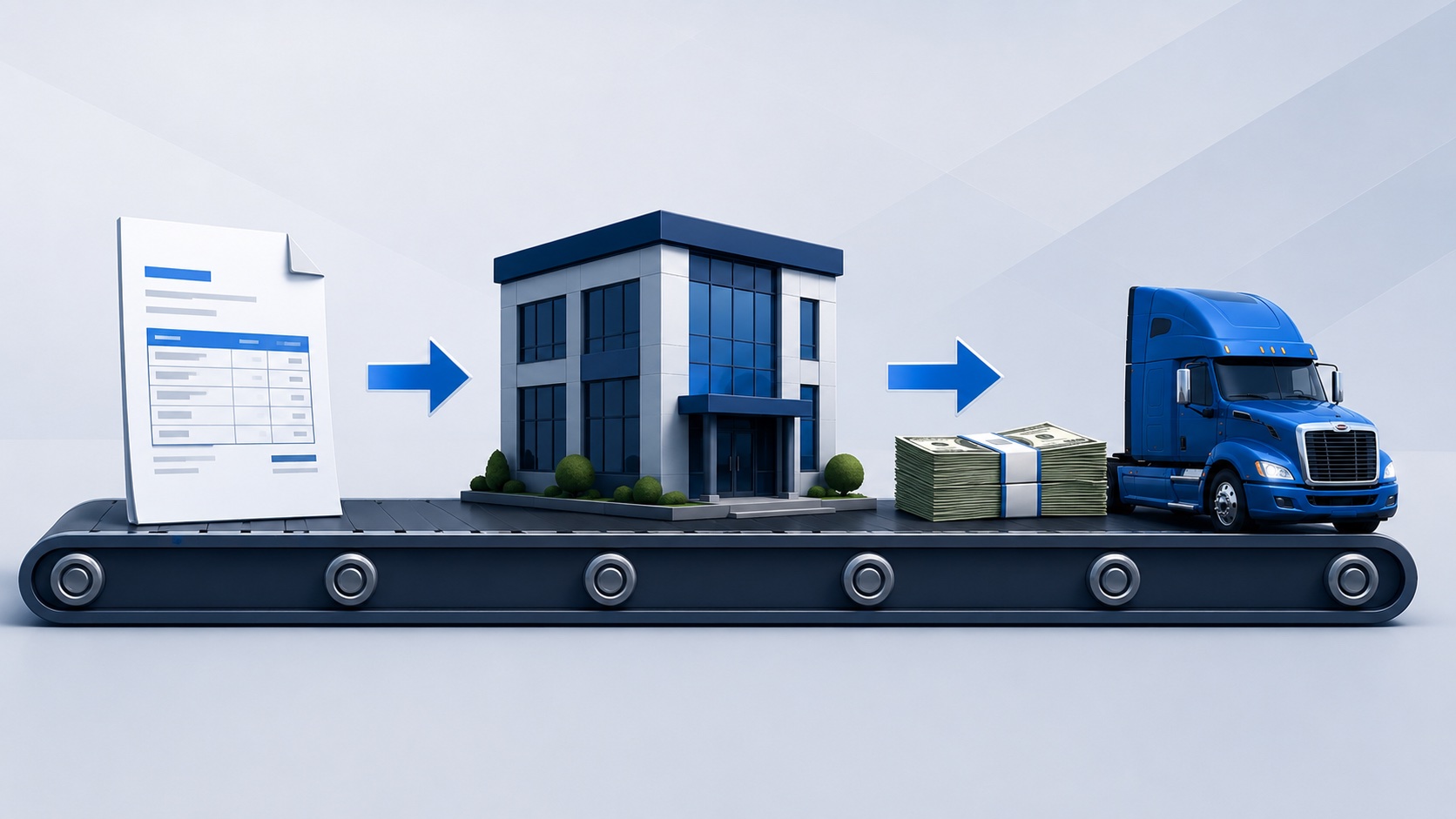
A dispatch service for owner-operators finds loads, negotiates rates, and handles broker paperwork in exchange for a percentage of your gross, typically 5 to 8 percent, and it has nothing to do with how fast you get paid. That second job belongs to a factoring company, which buys your invoice for a 1.5 to 5 percent fee and pays you within a day instead of in 30 to 45. Carriers mash the two together constantly, partly because some dispatchers sell factoring referrals and partly because both fees come out of the same load.
The mash-up costs real money. On one $2,500 van load, a dispatcher at 6 percent takes $150 and a factor at 3 percent takes $75, both out of a margin that ATRI's 2025 cost data puts around $560 before either one touches it. This guide separates the two: what each one legally is, what each one charges, who pays whom, and the four ways the same load can run so you can see which setup fits your truck.
A truck dispatcher works for you, the carrier, and only you. They search the load boards, call brokers, negotiate the rate, send your carrier packet, schedule appointments, make check calls, and in some shops handle detention requests and invoicing. You still own the authority, the truck, and the decision to take or refuse every load. Nearly every dispatch service advertising to owner-operators today calls itself "non-forced dispatch" for exactly that reason.
The legal line that matters is the one between a dispatcher and a broker. Under 49 CFR 371.2, a broker is anyone who "for compensation, arranges, or offers to arrange" transportation, while a carrier's "bona fide agent" is not a broker if they work under a continuing agreement with the carrier and do not exercise "discretion... in allocating traffic between the carrier and others." FMCSA's final guidance on this, published June 16, 2023, says a dispatcher that represents one carrier and assigns every load it finds to that carrier is a bona fide agent. A dispatcher that works for several carriers and chooses which one gets the load is, in FMCSA's words, allocating traffic, and that is brokering.
Why should you care how your dispatcher is classified? Because unlicensed brokerage carries penalties of up to $10,000 per violation under 49 U.S.C. 14916, and the statute makes the entity's officers jointly and severally liable. More practically: a dispatcher that is really a broker has no bond, no FMCSA registration, and sits between you and your money in a way a real dispatcher never does. Dispatchers need no license and no bond at all. Brokers need both, including the $75,000 in financial security that FMCSA has enforced with immediate suspension authority since January 16, 2026.
So a dispatcher is a hired back office for finding freight. What does that back office charge?
Dispatcher vs. broker: a dispatcher works for the carrier under a written agreement and sends every load it finds to that carrier. A broker arranges freight for shippers, chooses among carriers, and must hold FMCSA registration plus a $75,000 bond or trust. FMCSA's 2023 guidance says a dispatcher that picks which of its carriers gets a load has crossed into brokering.
The going rate is a percentage of gross, and the dispatch companies that publish prices cluster tightly. Pulled from their own pricing pages in October 2026: Atom Dispatch charges 3.5 percent of gross; TruckLeap charges 5 percent for a single established truck, 7 percent for authorities under six months old, and 4 percent for fleets; Logity Dispatch charges 5 percent (7 percent for hotshot); Freight Girlz charges 6 percent for established carriers, 7 percent for new authorities, and 8 percent for power-only and hotshot; Truck Dispatch Experts charges 6 percent or a $250-a-week flat fee for semis and 8 percent or $350 a week for box trucks and hotshots; Digital Storming quotes 5 to 12 percent by equipment type. None of the six lists a setup fee or a long-term contract. Several say plainly: if you do not haul, you do not pay.
That consensus hides one expensive variable: what the percentage is charged on. Only one of those six pages, Truck Dispatch Experts, says outright that its percentage applies to the gross revenue of the load including fuel surcharge. The others do not say. In September 2026, DAT's national van average was $3.01 a mile all-in, and $0.84 of that was fuel surcharge. On an 830-mile load that is a $2,500 gross made of $1,801 linehaul and $697 fuel money. Six percent of all-in is $150. Six percent of linehaul is $108. The $42 difference, 100 loads a year, is $4,200 you either keep or hand over for the privilege of the dispatcher collecting a commission on your diesel.
The flat-weekly plans change the math at volume. At $250 a week, Truck Dispatch Experts' flat plan beats its own 6 percent rate once you gross more than $4,167 a week, which is roughly two of those $2,500 loads. A truck running $6,000 weeks pays $250 flat instead of $360. A truck having a $2,000 week pays $250 instead of $120. Flat plans reward consistency and punish slow seasons, which is the same trade-off as a factoring contract with a monthly minimum, covered in our slow season playbook.
Here is the question the pricing pages do not answer: when the broker pays, who exactly gets the check?
"Percent of gross" usually means fuel surcharge included. With DAT's September 2026 van surcharge at a record $0.84 a mile, a 6 percent dispatcher charging on all-in gross collects about $42 more per 830-mile load than one charging on linehaul. Get the base written into the dispatch agreement before the first load.
The clean version is short. The broker pays the carrier. The carrier pays the dispatcher. The rate confirmation names two parties, the broker and your company, and the dispatcher is not one of them. If you factor, the notice of assignment tells the broker to pay your factoring company instead of you, the factor advances you the invoice the same day, and the dispatcher is still paid by you, out of that advance. Dispatchers that put this in writing say it themselves: the money comes to you, not to the dispatcher.
Four billing arrangements show up in practice, and they are not equally safe. The first is the standard: the dispatcher invoices you weekly and you pay by ACH or check. The second is an auto-debit from your bank account, which works if you set a per-transaction limit with your bank. The third is a "direct bill" through a partner factor: the factoring company funds your invoice, deducts its own fee and the dispatch fee at funding, and itemizes both. The fourth is the dispatcher invoicing your factor directly. The last two put the dispatcher in your money flow, and FMCSA's guidance treats that as a warning sign. Among the factors FMCSA lists that indicate a dispatch service should hold broker authority is that it "accepts compensation from a broker or factoring company."
Read that twice, because it is the hinge of this whole article. A dispatcher paid by you is your agent. A dispatcher paid by the broker or by the factor is, in FMCSA's framing, acting like a broker without a bond. It is also the arrangement where the most money goes missing, because once a third party is authorized to take a cut at the factor, the carrier is the last person to see the math on each load.
The factoring companies themselves stay out of it. None of the major trucking factors publishes a "pay your dispatcher" feature on its own site. What they publish are partner programs: Apex Capital's partner program works with dispatchers on referral and revenue-sharing terms, and Bobtail's affiliate program pays dispatchers a reward when a referred carrier reaches $20,000 in factored volume. That is the real connection between the two industries. Your dispatcher may be paid by a factor for sending you there. Nothing about that is illegal. Everything about it means the factoring recommendation you got from your dispatcher was a sales lead, not advice, and you should compare it against the 2026 rankings the same way you would any other pitch.
No dispatcher needs your factoring login, your bank login, or your FMCSA portal credentials. Those three requests are the signature of a dispatch scam, and a dispatcher who can log into your factor can change where your money goes. Give a dispatcher load-board access and a signed agreement, nothing more.
Take a real load: 830 miles of dry van at DAT's September 2026 national average of $3.01 a mile all-in, which rounds to $2,500 gross. ATRI's 2025 operating cost of $2.336 a mile puts the cost of running those miles at about $1,939, and that figure already includes $0.82 a mile in driver wages and $0.21 in benefits, so for a one-truck operation it includes your paycheck. What is left after the truck is fed and you are paid is $561. That is the pool the dispatcher and the factor both draw from.
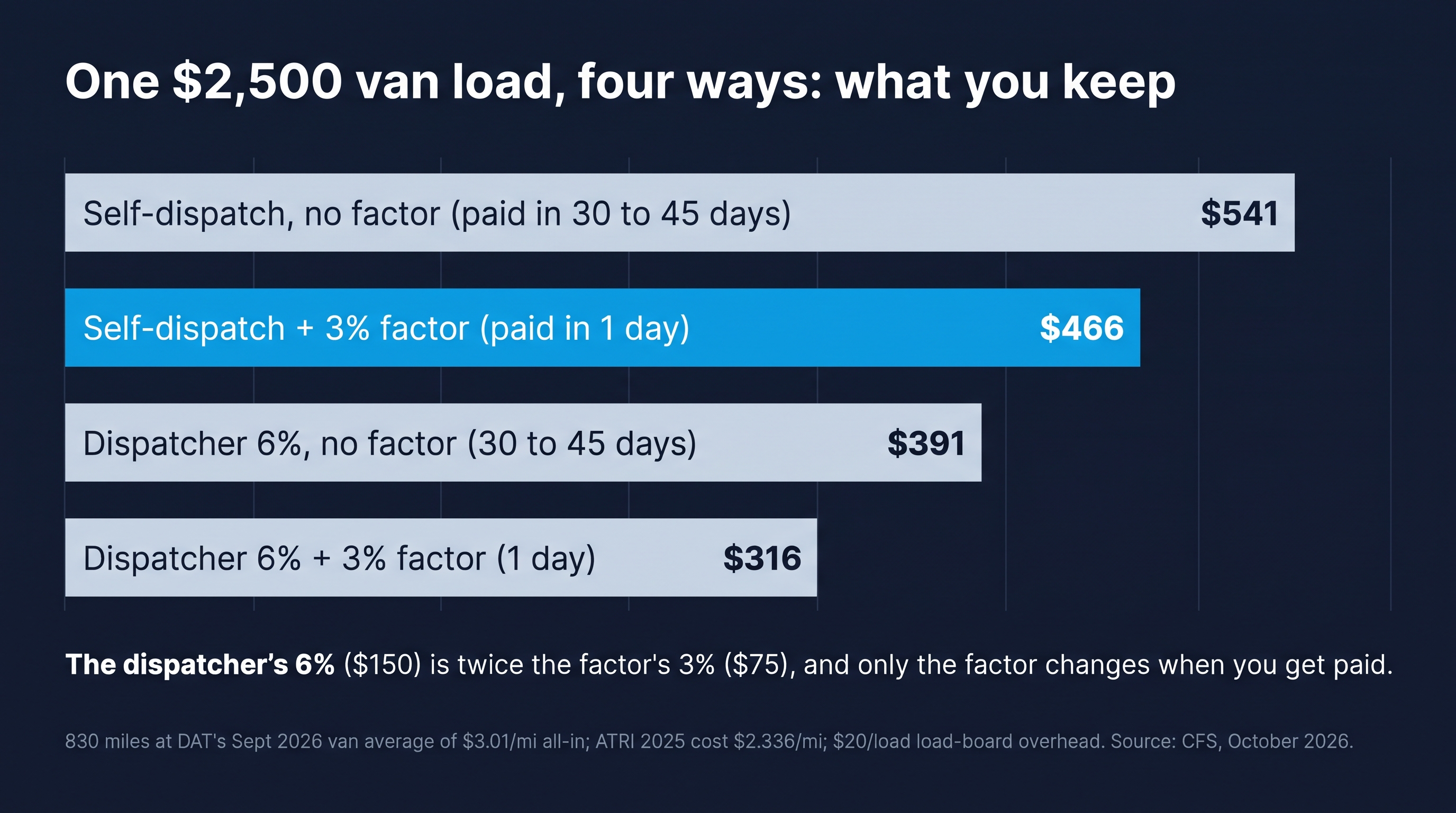
Setup A: you dispatch yourself, no factoring. You keep the full $561, and you wait 30 to 45 days for it. Your overhead is the load board, DAT One Pro at $169 a month or Truckstop Pro at $159, which spread over 100 loads a year is about $20 a load. Net: roughly $541 per load, paid late.
Setup B: you dispatch yourself and factor at 3 percent. The factor takes $75 and pays you about $2,250 within a day on a 90 percent advance, with the remaining $175 released when the broker pays (or the full $2,425 up front on a no-reserve program like Bobtail's). Net: roughly $466 per load after the load board, paid now. The $75 bought you about 35 days.
Setup C: a dispatcher at 6 percent, no factoring. The dispatcher takes $150. You keep $411 and wait 30 to 45 days for it. Note the dispatcher's fee is twice the factor's, and it did nothing for your cash timing.
Setup D: a dispatcher at 6 percent and a factor at 3 percent. Combined take: $225, or 9 percent of gross. Net: $336 per load, paid now. You gave up 40 percent of the margin on the load for a booked load and a same-day payment.
Run it over a year at 100 loads and $250,000 gross. The dispatcher costs $15,000. The factor costs $7,500. Both together cost $22,500 out of a $56,100 margin pool. The question that decides Setup C or D is what the $15,000 buys. In a 2021 Trucker Tools survey, 55 percent of owner-operators said booking a load off a board takes about 20 minutes. At 20 minutes a load, 100 loads is 33 hours a year, and you paid the dispatcher $450 an hour for them. Even if it takes you a full hour per load, the dispatcher is earning $150 an hour on your truck. A dispatcher earns that only if they book freight you could not find, at rates you could not get.
Which is the honest case for a dispatcher: not that booking takes time, but that a good one books better freight than you do. Our real cost of freight factoring guide runs the same kind of effective-rate math on the factoring side, and the calculator will do it for your own numbers.
Ask any dispatcher for ten of their recent rate confirmations for your equipment type and divide the gross by the miles. If their average is not clearly above the DAT spot average for those lanes, their fee is buying you time, not money, and you can price your own time.
Worth it: your first months under a new authority, when you do not know the lanes, the brokers do not know you, and a dispatcher with existing carrier packets at the big brokerages can get you loaded while you learn. Worth it for a fleet owner who is still driving: a second truck's loads cannot be booked from the driver's seat of the first one. Worth it for anyone whose test from the Pro Tip above comes back with the dispatcher consistently beating the board.
Not worth it: as a permanent 6 percent line on a one-truck operation that has been running the same lanes for two years. Sam Taylor, who built Box Truck Bros from one box truck to a seven-figure operation, fired his dispatch service nine months in after three straight weeks of $1.60-a-mile freight, learned the boards himself, and booked $6,925 the first week he dispatched his own truck. His verdict on dispatchers is unprintable in parts; the printable part is that no one looks out for your truck like you do.
Overdrive's surveys of one-truck independents found 16 percent using a dispatch service in 2018 and 20 percent by 2021. That is one in five, which means four in five self-dispatch, and most of them are not losing money doing it.
Whatever you decide about dispatch, keep the factoring decision separate. Choose a dispatcher on the freight they book. Choose a factor on rate, advance, recourse terms, and funding speed, which is what our factoring basics guide and the rankings are built to compare. A dispatcher who insists the two decisions come as a bundle is telling you which side of the referral check they are on.
No. About 80 percent of one-truck independents book their own freight, per Overdrive's 2021 survey, using a load board that costs $39 to $169 a month. A dispatcher makes sense when they can book better-paying freight than you can find, or when you physically cannot work the boards because you are driving.
Published 2026 rates run 3.5 to 8 percent of gross, with 5 to 6 percent the most common for an established single truck and 7 to 8 percent for new authorities, hotshots, and box trucks. Flat plans run $250 to $350 a week. On a $2,500 load, that is $88 to $200.
No. A dispatcher works for you and needs no license or bond. A broker arranges freight for shippers, picks among carriers, and must register with FMCSA and post $75,000 in financial security. FMCSA's 2023 guidance says a dispatcher that chooses which of several carriers gets a load, or takes payment from a broker or factoring company, is acting as a broker.
Some dispatchers arrange it through partner factors, who deduct the dispatch fee at funding. It is legal, but FMCSA lists a dispatcher taking compensation from a factoring company as an indicator it should hold broker authority, and it puts a third party in your money flow. Paying the dispatcher yourself, weekly, from your own account keeps every load's math in your hands.
No. Factors underwrite your brokers' credit and your paperwork, not your dispatcher. What does affect it is a dispatcher who books loads from brokers your factor will not approve, which is why a dispatcher that runs broker credit checks before booking, as several advertise, is worth more than one that does not.
Any dispatcher who asks for your factoring login, bank login, or FMCSA portal credentials, who charges a large fee before booking a load, or who refuses to show you the broker's MC number. The last one is often a sign the load is being double brokered, and you will be the one left unpaid.
FMCSA's dispatch guidance "does not have the force and effect of law," and a footnote admits the agency cannot assess the 49 U.S.C. 14916 penalties itself; only the Department of Justice can, in federal court. The practical protection is not enforcement. It is keeping dispatchers out of your payment flow.
I gotta learn how to dispatch, because no one's gonna look out for your truck better than you.
New articles for owner-operators, delivered twice a month.