Two carriers sign with two factors. One agrees to 3.25 percent and pays 3.25 percent. The other agrees to 1.99 percent and pays, once the invoice fees and ACH charges and monthly minimums finish their work, something north of 3 percent, without ever seeing a rate change. The difference between those two experiences has a name: effective rate. It is the only factoring number that matters, and this guide teaches you to compute it in five minutes with three worked scenarios.
Your effective rate is everything factoring costs you in a month, divided by the dollars you factored. Advertised rates price one line item; effective rates price the relationship. The formula is one division: total monthly cost, fees and add-ons and minimums included, over total volume factored.
Why the gap exists: the advertised rate is the number that wins the phone call, and the fee schedule is where the margin lives. Neither is a scandal; it is just pricing architecture, and it rewards exactly one behavior: asking for the complete fee schedule in writing and doing the division yourself. The CFS factoring calculator does it interactively; this article shows the math so you can see what moves it.
Effective rate: total factoring cost for a period divided by dollars factored in that period. The only number that lets two quotes be compared honestly.
Five usual suspects. Per-invoice fees: $5 to $10 a submission, brutal at small invoice sizes. ACH fees: $5 to $15 per transfer, or free, depending entirely on the company. Wire and same-day fees: $15 to $30 when speed is an upcharge instead of the product. Monthly minimums: phantom fees on volume you did not run, worst in slow months. Reserve mechanics: not a fee, but held money has a cost when it returns on the factor's timeline.
Companies with flat published pricing (Bobtail's model) compress this list to nearly nothing, which is why our rates guide keeps repeating one sentence: the all-in number is the only number.
Ask every prospective factor one question in writing: at my volume and invoice count, what will my complete monthly cost be, every fee included? Refusal to answer is an answer.
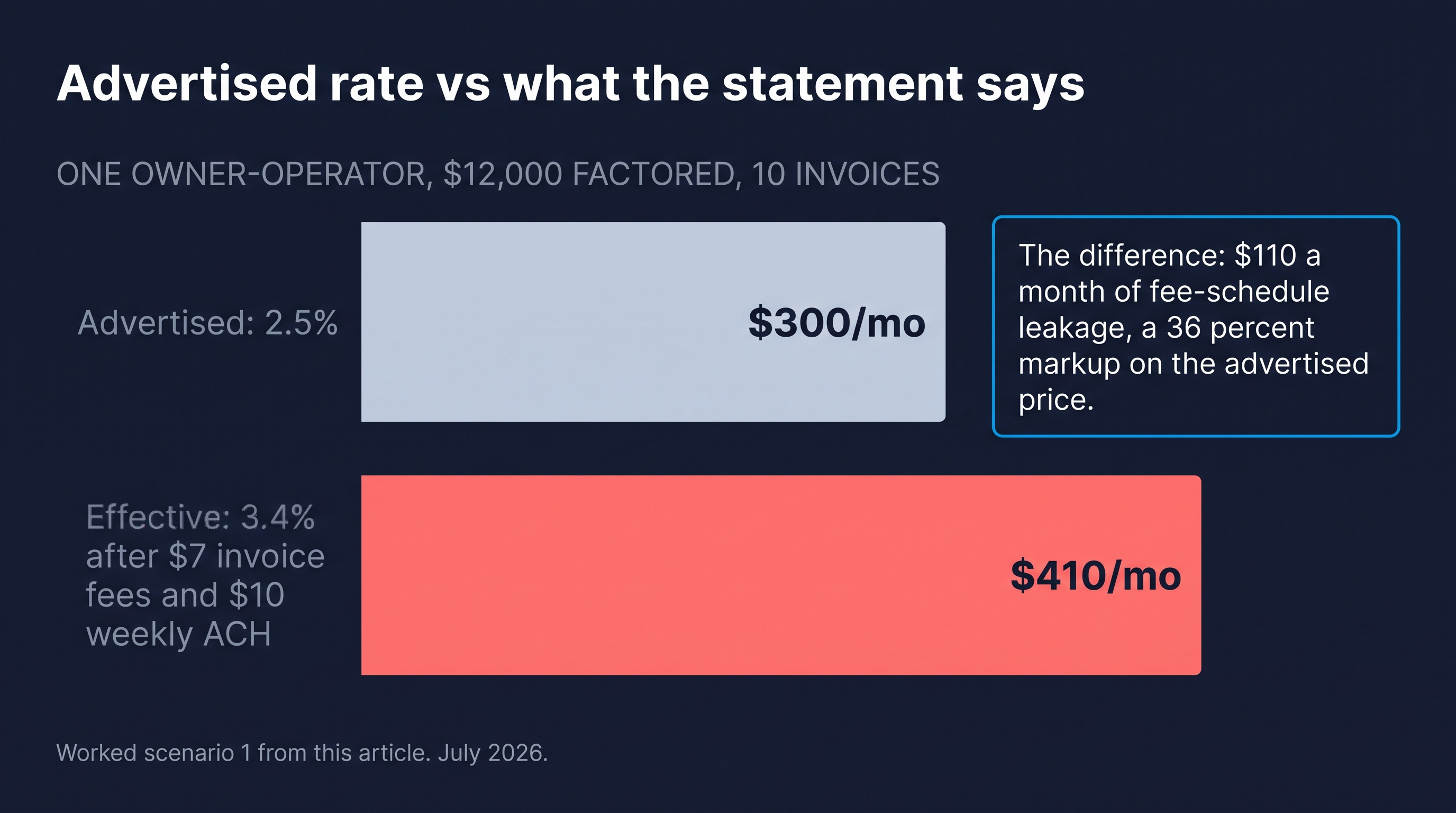
Scenario 1: solo owner-operator, $12,000 a month, 10 invoices. Advertised 2.5 percent = $300. Add $7 per-invoice fees ($70) and weekly $10 ACH transfers ($40): total $410. Effective rate: 3.4 percent. The fee schedule added 0.9 points, a 36 percent markup on the advertised price.
Scenario 2: three trucks, $45,000 a month, 30 invoices. Advertised 2 percent = $900. Same $7 invoice fee ($210), a $25 monthly account fee, wires twice ($50): total $1,185. Effective rate: 2.6 percent. Volume dilutes the add-ons but 0.6 points still leaked.
Scenario 3: seasonal carrier in a $10,000 winter month with a $20,000 minimum. Advertised 3 percent bills against the minimum: $600. Effective rate: 6 percent, double the sticker, in the thinnest month of the year. The minimum is the single most violent effective-rate multiplier in factoring.
The CFS factoring calculator computes effective rates interactively: enter volume, rate, and fees, and it does the division and the comparison for you.
Step 1: pull last month's factoring statement and total every charge: rate fees, invoice fees, transfer fees, account fees, anything with a dollar sign. Step 2: divide by the volume you factored. Step 3: compare against the rate you think you are paying, and mind the gap.
If the gap is more than a few tenths of a point, you have found negotiating material: fee schedules move in negotiations just like rates, per our negotiation scripts. If your contract has a minimum, run the math twice: once for a normal month and once for your slowest, because the second number is the one that decides whether the contract fits. Then run prospective quotes through the calculator before signing anything new.
Recompute your effective rate every quarter, not just at signup: fee schedules change and invoice sizes drift, and the number that was 3.1 in March can be 3.6 by September without a single letter from your factor.
The advertised rate is an ingredient; the effective rate is the meal. Compute yours from a real statement, compare quotes only on all-in numbers, and treat published flat pricing as the benchmark that keeps everyone honest. The rankings flag which companies' pricing survives the division.
All-in monthly cost between 2.5 and 3.5 percent of factored volume is the healthy band for owner-operators; fleet volume negotiates below it. Above 4 percent all-in deserves a renegotiation or a switch.
Fee stacking: per-invoice fees, ACH and wire charges, account fees, and minimums bill alongside the rate. Total the statement and divide by volume to see the true number.
At small invoice sizes, a lot: a $7 fee on 10 invoices at $12,000 monthly volume adds about 0.6 points before transfers. Small-invoice carriers should weight this line heaviest.
More than anything else: a $20,000 minimum in a $10,000 month doubles the effective rate to 6 percent. Seasonal carriers should avoid minimums entirely.
Regularly: a flat 3.25 percent with no add-ons beats a 1.99 percent rate wearing a $110 monthly fee schedule at typical solo volume. The division decides, not the billboard.
The effective rate is also the honest way to weigh fuel programs: a card saving $400 a month against a rate a quarter point higher is a net win at most volumes. Cost is one number only after everything is counted.
Nobody ever overpaid the advertised rate. The overpayment lives in the lines under it.
New articles for owner-operators, delivered twice a month.