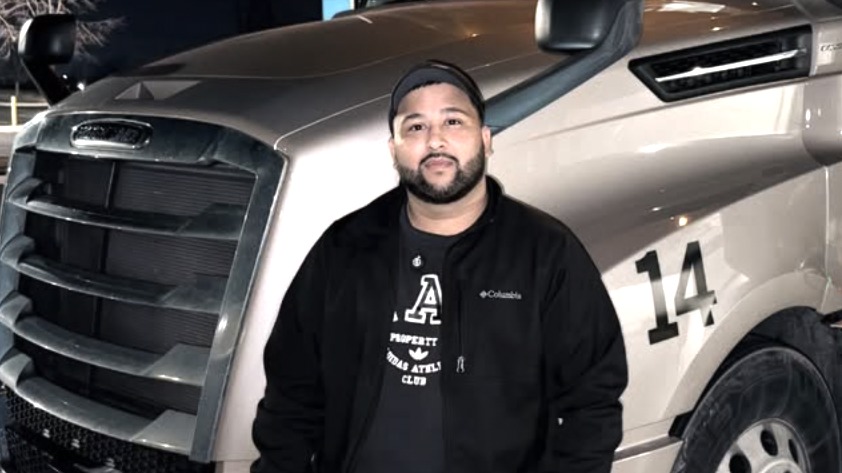
Sam Taylor has run his own box truck authority since 2021, starting with a single truck funded by DoorDash savings. Today: at least six owned trucks plus rentals, a four-truck dedicated OTR contract, and over $1.1 million in 2025 revenue.
In 2020, Sam Taylor was working at a bank and delivering DoorDash on the side, and some of his own family had told him, verbatim, that he was dumb for it. Quitting a stable job to deliver food, all to bankroll some box truck idea? Dumb.
Last year, that box truck idea grossed $1,118,002.
He built it in four years, from a $12,000 investment, with no college degree, no outside money, and a felony record that once made him unhirable at Target. But the unlock wasn't the trucks, and it wasn't luck. It was the week Sam realized the dispatcher booking his freight was feeding his truck leftovers, and decided to learn the most important job in his business himself. This is how Box Truck Bros got built.
Sam Taylor's path to trucking didn't start with trucking. It started with instability. He grew up in the DMV area, primarily Arlington, Virginia, with a single mother who, in his own words, "battled drug addiction since second grade." He spent time in foster homes and juvenile detention as a kid, and moved often enough to attend 13 different schools. At 15, when his mother told him she couldn't afford school shopping, he spent the summer working at a car wash to pay for it himself.
At 18, he caught a felony charge and did a year in county jail. When he got out, he tried to get back into school on a basketball scholarship, dropped out after a year, and spent his early twenties working odd jobs. The felony followed him into every application, even for entry-level retail jobs. Around 24, he went back to school to pursue a degree, and by roughly 2020 he was working at a bank.
The shift in his mindset started with DoorDash. He quit a $11-an-hour job at a preschool and started delivering food as an independent contractor, not because he expected it to be his long-term path, but because nobody was checking a background check to let him drive his own car on his own schedule. He kept at it for three to four years, banking what he could.
That savings became the $12,000 he used to start Box Truck Bros. He filed his LLC paperwork in November of that year, applied for interstate MC/DOT authority to keep his lane options open, and had his authority active by January. The first year on the books wasn't revenue. It was the investment itself.

Sam runs general freight in 26-foot dry van box trucks out of Virginia, hauling interstate rather than staying local, a deliberate choice, since interstate authority opens up far more lanes than intrastate-only registration. His fleet has grown to at least six owned trucks (a mix of International and Freightliner models, generally preferring a Cummins engine paired with an Allison transmission), supplemented by rented trucks he adds when he wants more capacity without taking on more financed debt.
He self-dispatches within a deliberate 5–700 mile radius, working 13+ states and steering clear of regions he's found consistently underpay: California, Florida, Oklahoma, Colorado, New Mexico, and Montana among them at various points. He targets roughly $2.30–$2.50 per loaded mile by staying disciplined about which lanes he'll run, rather than booking whatever load is available first.
Beyond his own trucks, he's landed a dedicated OTR contract running four trucks (two running over-the-road and two on contract) that he's described as worth close to seven figures on its own, with each truck grossing an estimated $250,000–$300,000 a year.
Cash flow at this scale is its own discipline. A rented truck costs $576 every week whether the brokers have paid yet or not, and broker payment terms routinely run 30 days or longer. That gap between hauling a load and getting paid for it is exactly why many carriers running mixed fleets factor their invoices; if that's the stage you're at, our rankings of the best freight factoring companies for trucking break down which ones pay same-day without long-term contracts. The OTR Solutions review covers the company we rank first for that job, and the factoring calculator prices the fee against a week of your own loads.

Sam targets $2.30 to $2.50 per loaded mile and stays out of six states he's found chronically underpay.
Sam's growth wasn't a straight line. 2021 was the investment year: $12,000 in, no real revenue to speak of yet. By 2022 he'd grossed $160,000. 2023 jumped to $400,000. By 2024 he'd crossed $1 million for the first time. In 2025, monthly revenue ran from a low of $43,350 in June to a high of $160,115 in October, closing the year at $1,118,002.
The clearest inflection inside that 2025 run happened between June and July. Revenue in June was the lowest month of the year. In July, it nearly tripled to $125,625, and every month from July through December stayed above $100,000. Sam has said only that he restructured the business and brought in a new team that June; whatever the mechanics, the four-truck dedicated contract structure carried the back half of the year. The more instructive inflection point in this story came years earlier, and we'll get to it after the levers.
2021: The $12,000 bet
Filed the LLC in November and interstate authority soon after, funded by years of DoorDash savings. The first year was investment, not revenue.
2022: First real year on the books
Grossed $160,000 running his own 26-foot box truck.
2023: More than doubled
Revenue jumped to $400,000 as self-dispatching took hold.
2024: Crossed $1 million
Broke seven figures for the first time.
2025: Restructured mid-year, closed at $1.12 million
A June restructuring nearly tripled monthly revenue by July and kept every month after above $100,000.
Today
At least six owned trucks, rented capacity, a four-truck dedicated OTR contract, and the Driving to Success driver pipeline.

Revenue grew every year from the $12,000 investment in 2021, crossing $1 million for the first time in 2024.
Four decisions did most of the work in taking Box Truck Bros from one truck to a seven-figure operation. The first was learning to dispatch his own freight instead of paying someone else a cut to do it worse. The second was rigid discipline about which lanes he'd actually run. The third was treating his fleet as a mix of owned and rented assets instead of financing every truck he wanted to add. The fourth was building his own pipeline of drivers, instead of competing for the same scarce pool everyone else was fishing in.
| Growth Lever | |
|---|---|
| 1 | Becoming His Own Dispatcher: Cut out the dispatcher's commission and put rate and lane decisions directly in his hands |
| 2 | Lane and Rate Discipline: Kept his per-mile average high by refusing to chase loads into chronically bad-paying regions |
| 3 | Mixing Rentals Into the Fleet: Let him add capacity without taking on more maintenance risk per truck |
| 4 | Building His Own Driver Pipeline: Solved the driver shortage by building a path into ownership instead of competing for hires |
When Sam started, like most new authorities, he worked with a third-party dispatcher, someone who'd find loads in exchange for a percentage of each one. It didn't take long for him to notice the math working against him: a dispatcher juggling several trucks at once couldn't prioritize his loads over anyone else's, and he was missing better-paying freight simply because his dispatcher was busy finding a load for a different truck.
Sam has said "It ain't the truck that make the money, it's the dispatcher," when talking about buying his sixth truck. His point isn't subtle: two carriers with identical trucks running identical miles can land wildly different revenue depending entirely on who's finding their freight and how well.
Sam hasn't been quiet about his frustration with paid dispatchers. He flagged weekly-rate dispatchers (as opposed to commission-based ones) as a red flag: "if you charge me a weekly rate, I don't trust that you are giving it your all." He also pointed out that a lot of dispatchers default to the same one or two load boards everyone else uses, which limits the rates they can actually find.
Once he started dispatching himself, Sam built a deliberate rule into how he scales: cap owned trucks at two to three per dispatcher before training or hiring an additional one. The logic is the same one that pushed him to self-dispatch in the first place: a dispatcher (even a good one, even himself) can only chase the best loads for so many trucks at once before quality drops.
If you're running one or two trucks and still leaning entirely on a paid dispatcher, the lesson here isn't necessarily "fire them tomorrow." It's that dispatching is a skill worth learning yourself, even if you keep someone else doing the day-to-day legwork once you understand what good looks like.

The vetting criteria Sam applies to dispatchers, drawn from his own experience running trucks under third-party dispatch.
"No one's gonna look out for your truck better than you."
Once Sam was dispatching himself, the next decision was where he'd actually run. He settled on a tight radius, roughly 5 to 700 miles per load, across 13+ states, and built a mental map of which regions consistently paid well and which didn't.
He's named California, Florida, Oklahoma, Colorado, New Mexico, and Montana as regions where rates were chronically bad at various points, not because freight doesn't move there, but because the lane economics didn't work in his favor. His advice to other operators: don't take a high-paying load into a bad-paying area, because you'll get stuck there with nothing but cheap freight to get back out.
Sam targets roughly $2.30–$2.50 per loaded mile, and he's open about the trade-off: the higher his rate, the fewer miles he runs per day, and the gross looks lower on paper even though the margin is often better. In a breakdown of one 28-day stretch, he grossed $29,725 and netted $13,257 after expenses, a number he attributes directly to staying selective about lanes rather than just running miles for the sake of running them.

The zoom-out here matters for any owner-operator: gross revenue is a vanity number if it comes from cheap freight in the wrong lanes. Sam's numbers work because he turned down loads that looked fine on the surface but would have stranded him somewhere with no good freight back out.
For most owner-operators, the instinct when business is good is to finance another truck. Sam did some of that. He's bought at least six trucks over the life of the business, including a $22,000 repossessed International he picked up at an asset-auction yard. But recurring DPF and emissions ("death system," as he calls it) problems on his owned trucks changed his calculus.
After a stretch of repeated breakdowns, Sam became wary of financing additional trucks outright. Truck rental rates were also climbing at the time (he mentioned quotes north of $900 a week from some providers) until he connected with another box-truck creator, "Trucking Out The Box," who plugged him into a rental account manager offering $576 a week at 12 cents per mile.
Rather than treating ownership and rental as competing strategies, Sam runs both simultaneously: owned trucks for the capacity he's confident in, rented trucks to flex up volume without adding another maintenance liability to his books. "Without them, I probably wouldn't be able to roll out the kind of plans that I really had," he said of the rental connection, calling it a "major plug."

If you're an owner-operator deciding whether to finance your next truck, Sam's experience is a useful gut check: ownership isn't automatically the better move just because it builds equity. A rental can be the better call when your existing fleet's maintenance risk is already high. Alex Nino solved the same equipment-risk problem from the other end, waiting out the 2024 down market and buying used at recession pricing.
By the time Sam wanted to scale past what he could drive and dispatch alone, he ran into the same problem most growing fleets do: good drivers are hard to find, and even harder to find for a brand-new authority with no track record.
Rather than competing for drivers on the open market, Sam built his own pipeline. He launched "Driving to Success," a program that transitions independent-contractor drivers into their own owner-operator authority. Box Truck Bros handles the new operator's LLC and authority paperwork, sets them up with a pre-aged authority, and provides mentorship and credit-repair help along the way.

Sam is direct about why the program exists. "I have a felony. I caught my first felony at the age of 18," he said when announcing it. "I seen firsthand how hard it was to get a job, and I'm talking about easy jobs, like Target, Best Buy." The program isn't framed as charity. It's framed as opportunity for people who, like him, have a hard time getting a foot in the door anywhere else. "It's not a job, it's an opportunity," is the motto he gave it.
This is the unscalable strategy worth calling out: vetting and mentoring individual drivers personally doesn't scale the way buying a tenth truck does. But it's also exactly why Sam has people willing to drive trucks they'll never go home to. His first hire under the program stayed on the road, by Sam's account, without returning home once for months at a stretch.
In a July 2026 video, Sam pulled back the curtain on exactly how his driver pay works. Every driver starts at 20% of the truck's weekly gross. Stick around three months and it bumps to 21%. Six months, 22%. A full year in, and you're at 23%. Then he stacks weekly bonuses on top: an extra $100 for grossing over $6,000, $200 for clearing $7,000, and $300 for anything over $8,000. The ladder rewards loyalty, the bonuses reward hustle, and together they give a good driver a reason to stay and a reason to push.
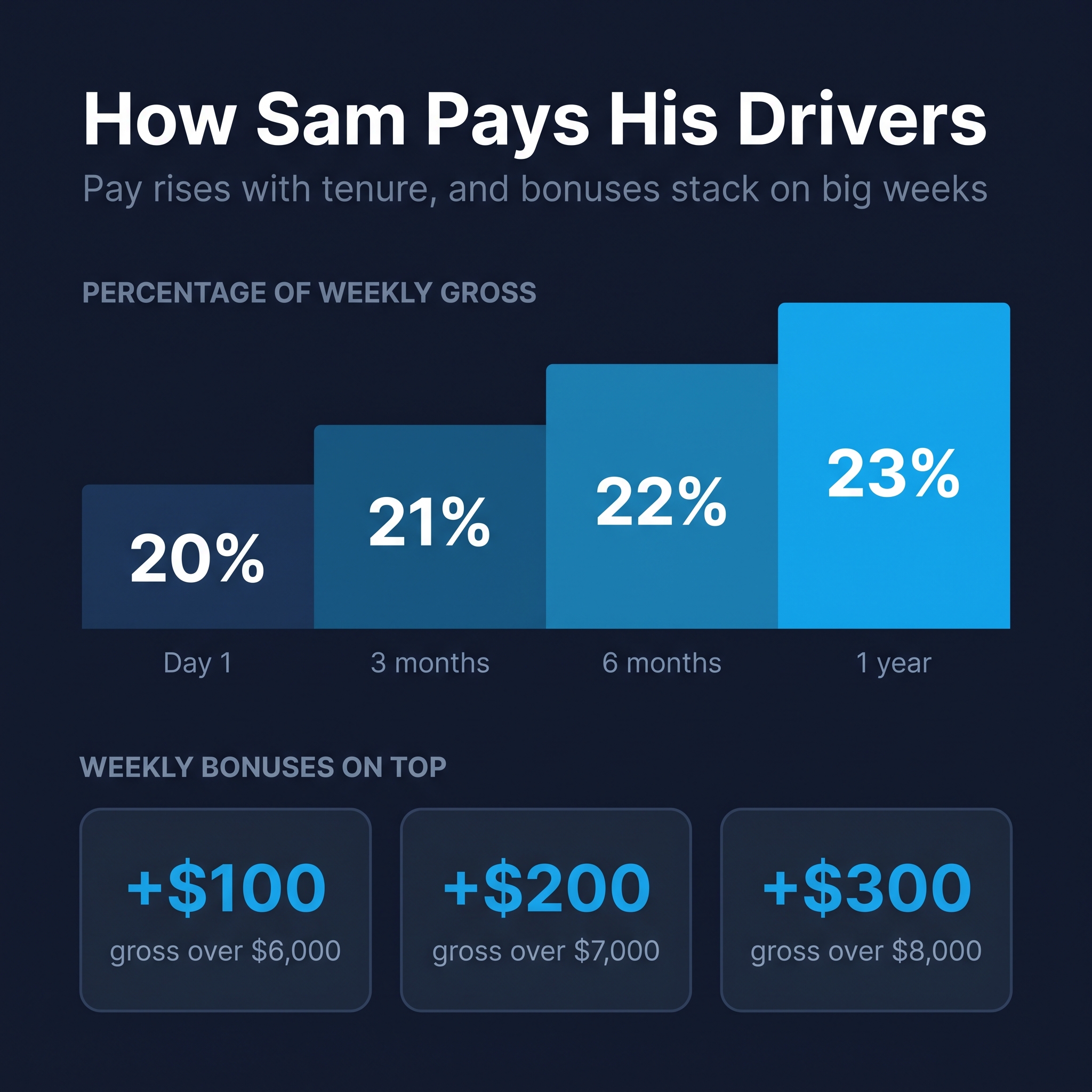
The video itself is just Sam on the phone with his drivers, running the week's numbers out loud. One driver grossed $7,400: at 22% plus the $200 bonus, that's $1,828 for the week. Another put up $10,240, a career high, and took home $2,655.20. His message to other fleet owners was blunt: "Take care of your drivers because they are the backbone of your company."
The hardest stretch of Box Truck Bros wasn't a slow freight market. It was the first three months of having an authority at all. Brokers and established dispatchers typically won't work with a brand-new MC number for roughly the first 90 days, which means the exact moment a new operator most needs revenue is the moment the industry is least willing to give them any. Sam's advice from living through it: file the paperwork early, because authority takes roughly 21 business days to activate once filed, and have savings set aside before going all-in so the freeze-out doesn't force bad decisions.

The other early stretch that nearly ended the business was platform dependency. In the early days, Sam and his brother, the other half of the Bros, ran Amazon Relay freight almost exclusively. The first week grossed about $3,000, but one late load at an unfamiliar warehouse (where check-in alone can eat the hour you needed to be early) dragged their on-time score below 90, and Amazon benched the account for six weeks. No appeals, no other freight lined up, no revenue. His brother went back to driving DoorDash while Sam sat at home waiting for the score to reset.
It happened three times. Eighteen total weeks of sitting still, by Sam's own count, because the whole operation was built on a single customer that could turn it off with an algorithm.
The load boards, broker relationships, and self-dispatching that power Box Truck Bros today exist partly because of that lesson: a trucking business with one freight source isn't a business, it's a subscription that can be cancelled on you.
About nine months into running his own authority, Sam asked his dispatch service about adding a second truck. The answer: they couldn't take it on. They already had too much work.
Then came three weeks that changed how he ran everything. Week one was bad, and he wrote it off: maybe it was just a bad week. Week two, in his own words: "All right, bro, what is going on?" By week three he was done. "Nah. We're not doing this."
The math behind the frustration was specific. He was hauling at around $1.60 a loaded mile on freight his dispatcher booked, watching the boards himself, and thinking a nine-month-old authority with his on-time record should be earning more. The dispatcher had a lot of trucks to feed, and Sam had figured out where his sat in the pecking order. "You're just kind of booking whatever," he said of the realization. "Here, take that."
"That's when I really was like, I gotta learn how to dispatch. Because no one's gonna look out for your truck better than you."
Within weeks of taking over his own dispatch, he booked $6,925 of freight in a single week.
Every lever above traces back to that decision. The lane discipline, the rate floor, the rule about how many trucks one dispatcher can handle: all of it started the week he stopped outsourcing the most important job in his business.
1
Sam built a rule for when to add dispatch help (two to three trucks per dispatcher) precisely because he understood the job himself first. If you don't know what a good rate looks like in your lanes, you're trusting a number you can't verify.
2
Sam's discipline about avoiding chronically bad-paying regions cost him loads that looked fine on paper, and kept his per-mile average in the $2.30–$2.50 range. A high gross number from cheap freight in the wrong lanes is optimizing for the wrong metric.
3
The single biggest jump in Sam's 2025 revenue came when his four-truck dedicated contract locked in recurring freight, not from adding equipment. A smaller number of guaranteed lanes can beat a bigger fleet running inconsistent spot freight.
4
Personally vetting and mentoring drivers one at a time isn't efficient. It's also how Sam built a driver relationship strong enough that his first hire stayed on the road for months without going home. The open market might not be where you find drivers you trust.

Monthly revenue nearly tripled after the June 2025 restructuring and stayed above $100K for the rest of the year.
Sam's public roadmap is short: keep adding drivers through Driving to Success, and keep adding trucks only as fast as his own dispatch capacity can absorb them. That's not a lack of ambition. It's the same rule that built the business. Rohit Handa is applying the same rule to his second truck: no purchase until it comes attached to a contract.
Zoom out and notice what his four levers have in common: none of them required money he didn't have. Learning to dispatch was free. Turning down bad lanes was free. Renting instead of financing lowered his risk instead of raising it. The $12,000 was the smallest part of this story. The expensive part, the part his family called dumb, was doing the unglamorous work, three bad weeks at a time, until he understood his own business better than anyone he could have paid to run it.
Sam Taylor is the owner-operator behind Box Truck Bros, a Virginia-based box truck operation running general freight in 26-foot dry van trucks across roughly 13+ states. He started the business in 2021 with a $12,000 investment saved from several years of driving for DoorDash, and has since grown to a fleet of at least six owned trucks, rented capacity, and a dedicated four-truck OTR contract. He also runs "Driving to Success," a program that helps independent-contractor drivers transition into their own owner-operator authority. You can find him on YouTube and Instagram at @theboxtruckbros / @boxtruckbros.
New articles for owner-operators, delivered twice a month.
OTR Solutions: Instant 24/7 funding, no contract, no hidden fees. 4.7/5 across 1,390+ carrier reviews.