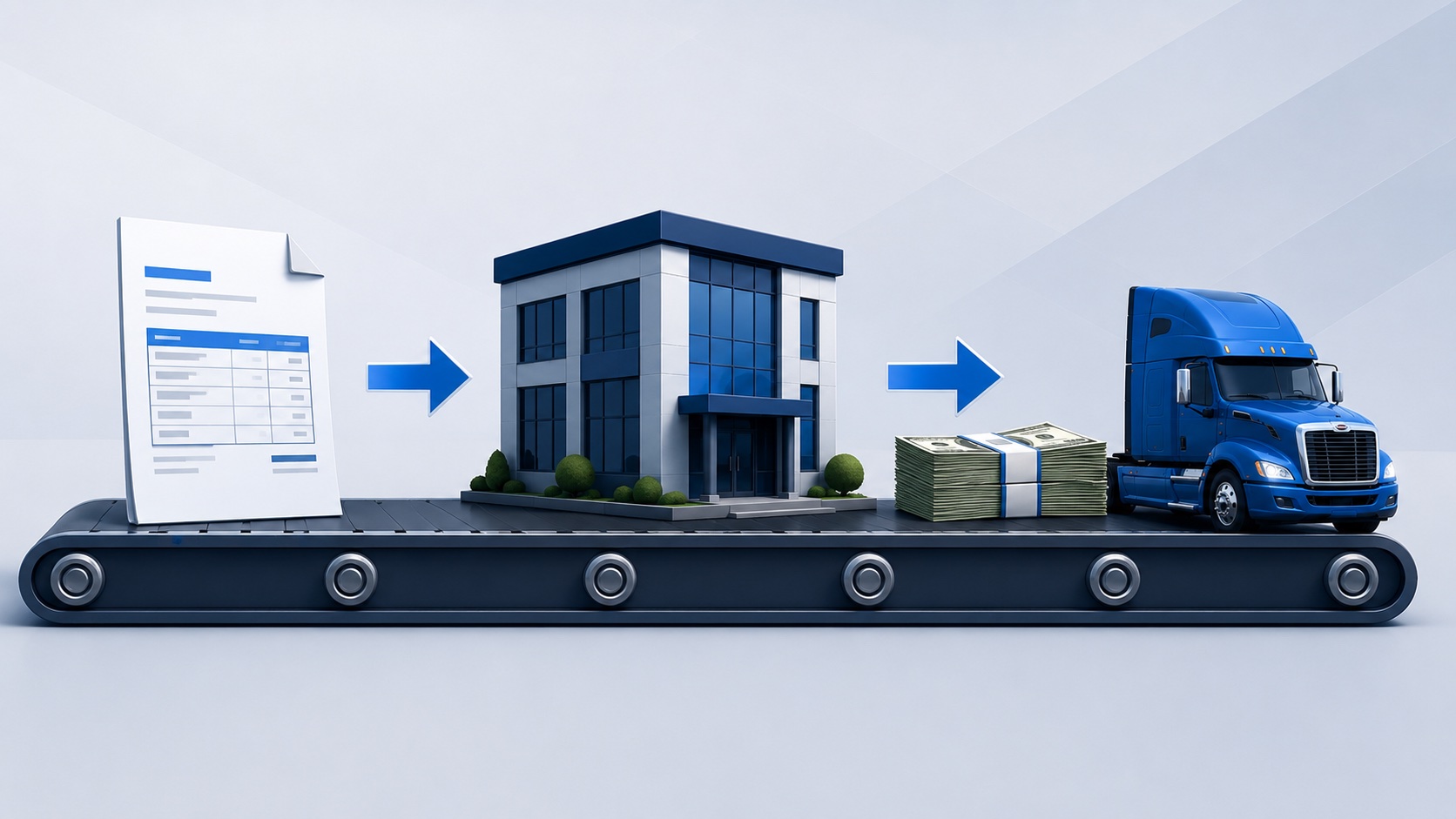
Here is the anatomy of a load that pays nobody. A shipper tenders freight to its broker. A second outfit, posing as a carrier, books that load, then turns around and re-posts it on a load board at a tempting rate. You book it, haul it, deliver clean, and invoice. The real broker already paid the impostor. The impostor is gone. Legally and practically, the carrier holding the delivered BOL is the one chasing money that left the industry two weeks ago.
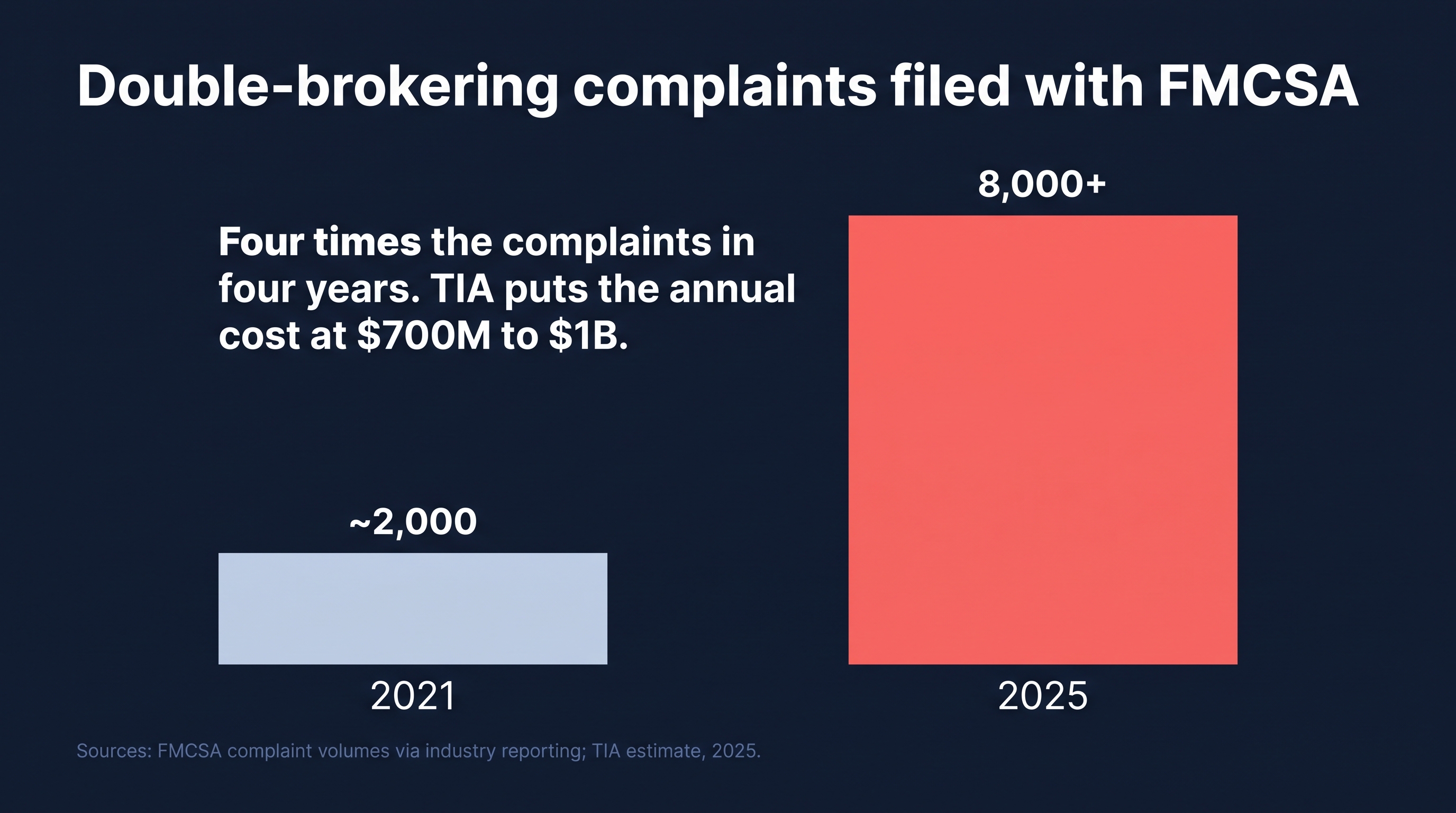
That is double brokering, and it has grown from nuisance to epidemic: TIA puts the annual cost at $700 million to $1 billion, and FMCSA fielded more than 8,000 complaints about it in 2025 alone, four times the 2021 count. This guide covers how the scheme actually works, the red flags in the order you will meet them, and the verification routine that filters nearly all of it in about a minute per load.
Double brokering is when a party that accepted a load, either as the contracted carrier or while posing as one, re-brokers that load to another carrier without the original broker's or shipper's authorization. The freight moves; the payment chain breaks. The hauling carrier's contract is with an entity that was never authorized to give it the load, and the original broker's obligation ran to the party it hired, not to you.
Distinguish it from co-brokering, which is legal: two licensed brokers agreeing, transparently and usually in writing with the shipper's knowledge, to split a load's brokerage. Everyone in a co-brokered chain knows the chain exists, and everyone holds broker authority. Double brokering is defined by the missing consent and the missing authority: someone in the middle is doing brokerage they were never authorized to do, in violation of their contracts, and often in violation of federal licensing requirements since brokerage without FMCSA broker authority is itself unlawful.
Is double brokering illegal? The honest answer: the fraud versions absolutely, and they are prosecuted as wire fraud and related crimes; the sloppier versions live in breach-of-contract territory. From the driver's seat the distinction barely matters, because either way the practical outcome lands on you: hauled freight, broken payment chain, and a counterparty who planned it that way.
Double brokering: unauthorized re-brokering of a load by a party who accepted it as a carrier or under false pretenses, breaking the payment chain. Co-brokering: authorized, disclosed cooperation between two licensed brokers. Consent and broker authority are the entire difference.
Three shapes account for most of it.
Identity theft of a legitimate carrier. Fraudsters hijack a real MC number, often via phished FMCSA login credentials or spoofed email domains one letter off from the real company, book freight as that carrier, re-post it, and route the payments to themselves. The real carrier discovers the problem when angry brokers start calling about loads it never touched.
The fake-carrier flip. A shell entity with thin or borrowed authority books loads with no intention of hauling anything, re-posts them at a markup or simply collects quick-pay from the original broker, and disappears before the chain unravels. Shells are cheap; the scheme repeats under a new number.
The vanishing middleman. A dispatch service or unlicensed "partner" inserts itself between you and the real broker, handles the paperwork, collects the payment, and stops answering. Less cinematic, same broken chain.
The surge has real numbers behind it: TIA logged a 65% jump in fraud reports in a single six-month window spanning late 2024 and early 2025, Truckstop's fraud reporting counted $455 million in reported freight-fraud losses in 2024, and enforcement has finally followed, with federal fraud prosecutions and FMCSA registration crackdowns, including the identity-verification overhaul built into its new Motus registration system. None of which pays the carrier who hauled last week's stolen load, which is why prevention is the whole game.
If the rate is well above lane average from a broker you have never worked with, the rate is the bait. Fraudsters do not compete on service; they overpay on paper because they never intend to pay at all.
Run this before booking, in order. The whole routine takes about a minute.
1. The rate is too good. First flag, strongest flag. Know your lane averages; treat a big premium from a stranger as a question, not a gift.
2. Look up the MC/USDOT on FMCSA's SAFER and licensing systems. Verify the broker's authority is active and, for brokers, that a surety bond (BMC-84) or trust (BMC-85) is on file. A "broker" whose authority is 3 weeks old, recently reinstated, or missing entirely ends the conversation.
3. Match the details. Email domain against the company's real website, phone number against the number FMCSA has on file, remit-to address against the W-9. Fraud lives in one-letter-off domains and "our accounting email changed this week."
4. Interrogate the load's history. The same load posted by multiple entities at different rates is a chain being built in public. Load boards' fraud-flagging and broker-vetting tools have improved; use them.
5. Watch for mid-load changes. New payment instructions after booking, a different name on the rate con than on the calls, pressure to skip the paperwork. Any of these mid-load is the moment to call the shipper's dock and ask who the broker of record actually is.
Trust the checklist over the vibe. The best fraud sounds friendly, responsive, and busy, exactly like a good broker having a good week.
Make the 60-second FMCSA lookup a reflex on every new counterparty: active authority, bond on file, contact details matching the government record. One minute per load is the cheapest fraud insurance in trucking.
Three institutions already stand between you and this scam; know what each actually covers.
The broker bond covers less than you hope. Every licensed broker posts $75,000 of financial security (the BMC-84 bond or BMC-85 trust). A legitimate claim for an unpaid load can recover from it, and filing is worth doing. But $75,000 is the total pot for all claimants against that broker, and a fraud operation's bond is usually exhausted, or the "broker" never really held one. The bond is a partial backstop against failure, not an insurance policy against fraud.
The NOA keeps the payment chain honest. If you factor, every broker you haul for receives a notice of assignment directing payment to your factor. A counterparty that resists an NOA, or asks you to route money around it, is waving a flag; the NOA process forces exactly the who-actually-pays-here conversation that fraud depends on skipping.
The factor's credit desk is your screening department. Before you haul, your factoring company decides whether it will buy that broker's invoice, because its own money is at risk if the broker does not pay. That check runs on data you cannot see: payment histories across thousands of carriers, fraud patterns, aging trends. One carrier we profiled learned this the expensive way; after eating $2,900 from a broker gone silent, his own post-mortem pointed at the vetting layer he had opted out of, a story told in full in what to do when a freight broker does not pay. Screening is the honest claim here, not insurance: a factor cannot un-steal a load, but a factor declining your broker before you haul is the cheapest no you will ever hear. It is also worth knowing which factors run strong credit desks, which is part of how we score our 2026 factoring rankings.
When your factor declines a broker, ask why before walking away from the load. Sometimes it is stale data. Usually it is payment behavior you cannot see from a load board profile. Either way you want the answer before the freight is on your trailer, not after.
Move fast; these claims age badly.
1. Freeze the paper. Rate con, emails, texts, call log, BOL, POD, every payment instruction you received. You are assembling proof of who represented what.
2. Find the real broker of record. Call the shipper's dock or traffic office and ask who tendered the load. That party's contract chain is where the money went.
3. Notify everyone in writing. The real broker, the shipper, and the entity that booked you. Real brokers sometimes pay the hauling carrier to keep the shipper relationship clean, especially with a clean POD in hand; ask directly.
4. File on the bond. Locate the booking entity's (and, where the facts support it, the real broker's) BMC-84 surety and file promptly; bonds pay first-come and exhaust fast.
5. Report it. FMCSA's National Consumer Complaint Database logs double-brokering complaints (those 8,000+ reports in 2025 are how the problem finally got enforcement attention), and wire-fraud-shaped cases belong with DOT OIG. Load boards also ban repeat offenders when carriers report.
6. Price the lesson honestly. If the loss traces to a skipped 60-second lookup or a broker your factor would have declined, the fix costs less than the loss did.
The fraudulent forms are, and get prosecuted as wire fraud; unauthorized re-brokering also violates FMCSA licensing rules and virtually every broker-carrier contract. Some messy cases are "only" breach of contract. In every version, the hauling carrier's payment chain is broken.
Consent and authority. Co-brokering is two licensed brokers splitting a load openly, with the shipper aware. Double brokering is re-brokering by a party with no authorization and often no broker authority, hidden from the parties paying for the freight.
File a complaint with FMCSA's National Consumer Complaint Database, notify the real broker of record and the shipper in writing, file on the booking entity's surety bond, and report the account to the load board where you found the load.
Sometimes, partially. The $75,000 BMC-84 bond backs legitimate unpaid-freight claims against that broker, but it is one pot for all claimants and fraud operations drain or fake it. File anyway, file fast, and treat the bond as partial recovery rather than protection.
As screening, yes; as insurance, no. A factor's credit desk vets every broker before you haul because its own money is on the line, and the NOA process hardens the payment chain. A factor cannot recover a load stolen by a fake broker, which is why the 60-second FMCSA check stays your habit either way.
TIA estimates double brokering costs the industry $700 million to $1 billion a year. FMCSA received over 8,000 double-brokering complaints in 2025, four times the 2021 count, and TIA logged a 65% surge in fraud reports in one recent six-month window.
Nobody double-brokers cheap freight. The bait is always a great rate.
New articles for owner-operators, delivered twice a month.