Somewhere between truck two and truck five, factoring changes shape. The fee stops being a personal expense and becomes a real line item: at $100,000 a month factored, every quarter point is $250. But your leverage changes shape too, because five trucks of steady volume is exactly what factoring companies compete for. This guide covers what 1-to-5-truck fleets should demand, which companies fit, and the renegotiation math most small fleets never run.
Three shifts. First, the fee scales but the work does not: a factor doing collections and credit checks across five trucks replaces a real chunk of back-office labor you would otherwise hire for. Second, minimums stop being poison: volume commitments that would trap a single truck are met effortlessly by five running steady, which unlocks companies and rates the solo operator should avoid. Third, you become negotiable: $80,000 to $125,000 a month of clean volume is the profile factors discount to win.
The mistake is keeping single-truck instincts at fleet size, or worse, fleet terms at single-truck size. Match the contract to the volume you actually run, not the volume you plan to run.
Factors price broker risk, not just volume: a five-truck fleet hauling for strong-credit brokers with clean paperwork can out-negotiate a bigger fleet with a messy book.
1. OTR Solutions (9.9/10). Fleets negotiate below the single-truck band, and the stack compounds at scale: five fuel cards averaging $0.51 a gallon, True Non-Recourse across every truck's broker mix, and 24/7 BOLT funding that keeps weekend freight liquid. Still month-to-month, which at fleet volume is negotiating leverage you keep forever. Full review.
2. Apex Capital (8.7/10). The service model fits fleets: a named rep who knows all five trucks, blynk 24/7 payments, unlimited free broker checks for your dispatcher, and the TCS card at about $0.47 a gallon. The 80 to 90 percent advance is the one line to price at volume: at $100,000 a month, a 90 versus 96 percent advance is $6,000 of day-one cash timing.
3. RTS Financial (6.4/10 overall, better here than anywhere). This is the segment where RTS's shape finally fits: steady fleet volume neutralizes the minimums, and the Pilot Flying J integration multiplied across five tanks is real money. Go in eyes open on the 12-month auto-renewing term and deposit; our OTR vs RTS comparison prices that trade.
At the upper end: eCapital's back-office support and up-to-100 advance start making sense near the top of this bracket if someone on your team reads fee schedules. The full rankings hold all seven scorecards.
Do not sign fleet minimums against best-month volume. Commit to your worst realistic month; growth makes generous commitments cheap, but shrinkage makes them expensive fast.
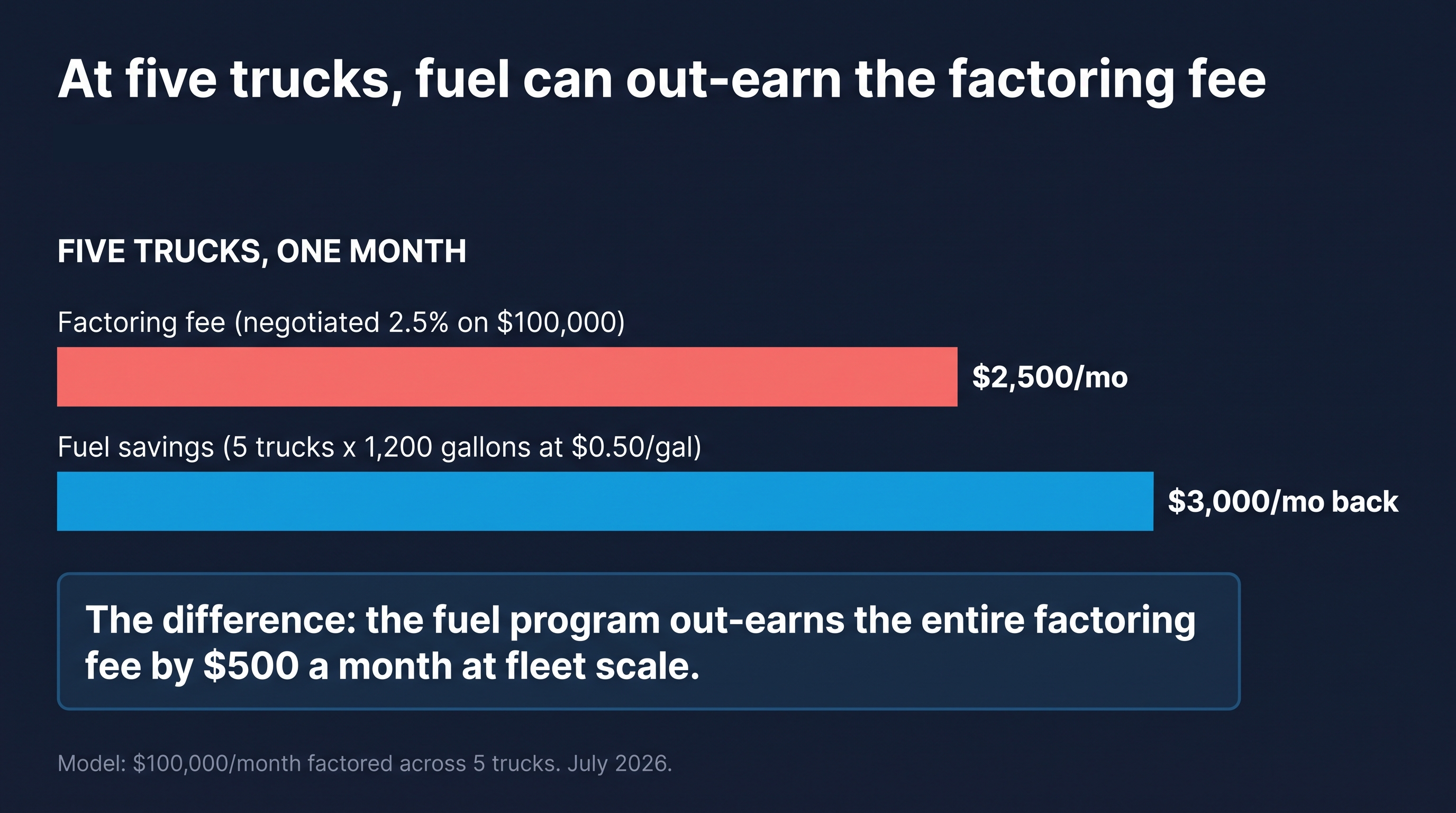
Fuel programs are rounding errors at one truck and structural at five. Five trucks burning 1,200 gallons each at a $0.50 average discount return about $3,000 a month, $36,000 a year. Hold that against your factoring fee: at $100,000 factored and a negotiated 2.5 percent, the fee is $2,500 a month. The fuel program can pay for the entire factoring relationship with change left over.
This is also the honest case for RTS in this segment: if your five trucks genuinely live on Pilot corridors, the deep-network math can beat a broad average. Count last month's actual gallons by chain before deciding; the calculator handles the fee side.
Ask for a written rate-review clause at signup: volume tiers and review dates in the agreement turn future negotiations from favors into obligations.
Factoring rates are not weather; they are opening offers. The industry pattern: 90 days of clean volume history is the first renegotiation window, and each truck you add is another. The ask is simple and works better in writing: here is our monthly volume, here is our clean-paperwork record, here is a competing same-week quote, and we would like the rate revisited.
What earns cuts: volume growth, low dispute rates, broker mixes with strong credit, and the credible ability to leave, which is why month-to-month carriers negotiate from strength and 12-month carriers negotiate from hope. Put a rate-review date in the agreement at signup; leverage you schedule is leverage you keep. Our switching guide covers the walk-away mechanics if the answer is no.
Run the renegotiation math before the ask: at $80,000 a month, a quarter point is $200 a month and $2,400 a year. Walking in with the dollar figure instead of the percentage changes the whole conversation.
Any fleet floating five trucks of expenses on 30-to-45-day broker terms is a factoring fit; the segment winners are the companies that reward volume without imprisoning it. OTR takes the overall package, Apex takes the service-first fleet, RTS earns its look on Pilot-corridor lanes, and everyone should renegotiate on a calendar. Start at the rankings.
Negotiated fleet rates commonly land between 1.5 and 2.5 percent at steady $80,000-plus monthly volume, below the 2.5 to 3.5 percent single-truck band. Same-week competing quotes are what move the number.
Less than for solo trucks: five trucks running steady clear typical minimums easily. They become dangerous again if you are planning to shrink, sell, or season down; match commitments to your worst realistic month.
RTS Financial has the deepest Pilot integration, and fleet volume neutralizes its minimums. Weigh it against the 12-month auto-renewing contract and deposit in our OTR vs RTS comparison.
After 90 days of clean history, after every truck you add, and any time you hold a competing same-week quote. Schedule reviews in the agreement so the conversation happens automatically.
Partially: collections, invoicing, and broker credit checks come with the fee. Most 1-to-5-truck fleets treat that as the hidden rebate that makes the math work.
Fleet fuel discounts multiply per driver: five trucks fueling on the same discounted network is often worth more than the next rate cut, and unlike a rate cut, nobody has to approve it.
At five trucks, the factoring rate is not a price you pay. It is a price you negotiate.
New articles for owner-operators, delivered twice a month.