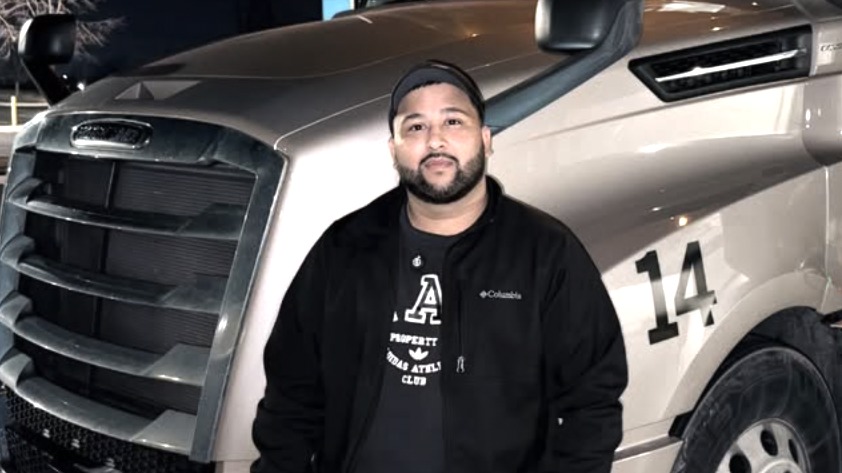
Newton has run his own authority since early 2021. He started with a single used box truck and no trucking experience of any kind. Today he operates two box trucks with drivers under Newton Ventures LLC, still runs Amazon Relay contracts himself when the numbers make sense, and mentors newer carriers who lease onto his aged authority. He describes Newton Ventures as a six-figure operation but has never published annual figures. Before trucking, he spent four years as a signed producer with Jermaine Dupri's So So Def, which is not a detail you hear in most carrier stories.
This story draws on Newton's own YouTube catalog of more than 700 videos, his 2026 appearance on FreightWaves' The Long Haul podcast, a 2024 Bobtail podcast episode, and Newton Ventures LLC's FMCSA registration records.
Victor Newton was standing behind his barber chair in Columbia, South Carolina, halfway through a $35 haircut, watching his phone. A load had just popped up on the Amazon Relay board: $500, one run.
He had been cutting hair for 28 years. He owned the shop. And the box truck business he had been running on the side for a matter of weeks was outbidding it in real time.
"I'm sitting there cutting a $35 head... I gotta make a decision... I threw the towel in with the Clippers," he later told the Bartelle's Money Talk podcast. He gave his clients one month's notice and never went back.
Five and a half years later, Newton is still in trucking. He runs box trucks under his own authority through Newton Ventures LLC out of the Charlotte, North Carolina area, has taken his small fleet as high as three trucks, paid one of them off completely, and built the Bigg Vic Tv YouTube channel past 100,000 subscribers teaching other drivers how the non-CDL box truck business actually works.
The starting point for all of it was a 2006 International with 500,000 miles on the dash, bought for $10,000 cash off Facebook Marketplace.
The truck was not the unlock, though. The unlock was how fast he moved, and how he handled the money once it started coming in.
Newton grew up in Bridgeport, Connecticut. At the end of high school he was weighing the military against barber college, and chose the clippers, partly because he had a girlfriend he did not want to leave. She is now his wife.
Barbering was the stable trade. Music was the dream. Newton spent years chasing it seriously, working as a signed producer with So So Def and Jermaine Dupri. His crew once opened for OutKast. The music paid in moments, "record label advances and royalty payouts," as he put it, but never became the living he wanted. So the barber chair stayed.
He built a full entrepreneurial life around that chair anyway: his own barber and beauty salon, Newton's Hair Studio One, opened in 2017; a photo and video production company on the side; even a stretch selling cars. By 2020 he was in Columbia, South Carolina, with nearly three decades of clientele.
Then COVID closed the shop, and Newton did what he always did with free time. He watched YouTube.
"I saw a guy the headline read box truck owner operator makes $20,000 in a month," he recalled on The Long Haul. "I said, wait a minute. Say what again? $20,000 with a truck?" The detail that hooked him: no CDL required for a truck under 26,000 pounds gross vehicle weight.
He had proof of concept sitting in his own chair. One of his barbering clients had quit his job to run Amazon Relay freight full time in a box truck, and showed Newton his weekly invoices during haircuts. "He was like, man, it's like taking candy from a baby," Newton remembered.
His wife ended the deliberation. "She said, stop talking about it. Just go ahead and get one."
In January 2021 he applied for his motor carrier authority, took a $13,085 personal loan from Navy Federal, and found a truck in Orlando: the 2006 International, a retired postal-service unit with half a million miles. The seller promised maintenance records that never materialized. Newton bought it anyway and drove it home hoping it would make it.
"I hope this truck makes it back home because I'm ready to get my business up and running," is how he described that drive.
His authority went active in February 2021. On February 24, 2021, the Amazon Relay approval email arrived, clearing him to move Amazon freight, and Newton Ventures was in business.
Newton runs 26-foot non-CDL box trucks, the class of truck you can operate without a commercial driver's license because it stays under 26,000 pounds gross vehicle weight.
For his first six months, the business was 100 percent Amazon Relay, booked out of Columbia to Atlanta, Raleigh, and Savannah. When a booking mistake damaged his Amazon performance score, he shifted to broker freight on DAT and Truckstop, dispatching himself, and discovered over-the-road running. Today the mix is Amazon Relay contracts, broker loads, and partial freight, run both local and OTR out of the Charlotte market.
The Amazon side has its own playbook now. Newton builds what he calls the triangle: a repeatable loop between nearby Amazon facilities that keeps a truck close to home. "There's always another Amazon facility nearby to get you closer to home," he told Amazon Relay's carrier blog in September 2026. "Figure out the triangle for your area, and you've got a repeatable route." He prefers two-stop, facility-to-facility runs because they protect his performance score, and he leans on Relay's Post A Truck feature, which lets him post his truck's location, hours, and rate floor and have Amazon match freight to it instead of refreshing a load board every morning. (His praise for Relay comes with the same caveat as his praise for his factoring company: he is a Relay partner and produces sponsored content for them.)
FMCSA records show Newton Ventures LLC with two power units and two drivers. Newton was up to three trucks at his peak, with himself dispatching. (For what the same box-truck model looks like at nine trucks, see Kobe King and KKing Trucking.) He still gets behind the wheel: in July 2026 he ran a two-week Amazon Relay contract stint in Nashville at $626 per day base pay because, in his words, "when the money doesn't make sense in my market, I go to another market and I go run it up up there."
On cash flow, Newton has factored with OTR Solutions since roughly the start of the business, about five years. He shopped several factoring companies at launch, was close to signing with a different one, and switched course when he understood the difference between rate and risk. He also runs their fuel card. One honest caveat that belongs in this section: Newton is an affiliate partner of OTR Solutions and has hosted their staff on his channel, so his public praise of them is both real customer experience and sponsored advocacy. The operational facts stand on their own, and we get into them below.
The other arm of the business is education: a self-paced course, a mentorship program that lets newer carriers lease onto his aged authority, and the YouTube channel that feeds both.
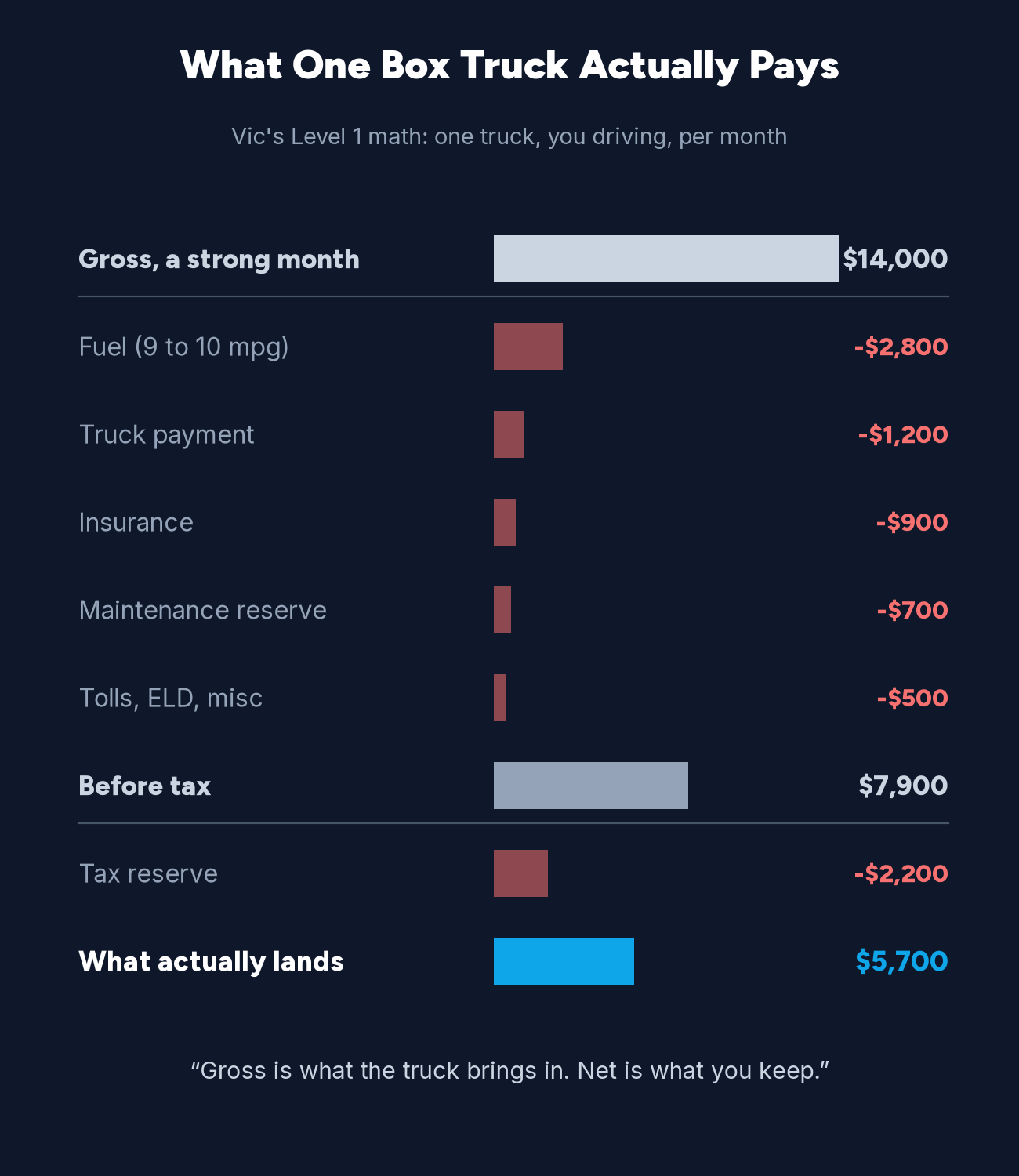
Newton's Level 1 math for one box truck with the owner driving.
Newton's growth was fast, then deliberately flat.
From a standing start in January 2021, he was moving freight by late February, full time by spring, and shopping for a second truck inside his first 90 days. "I'm actually in the process of looking for my second truck right now after only five weeks," he said in his fifth week in business. The second truck arrived around month six, financed with no money down. A third truck followed, and at his peak he was running three while dispatching them himself.
Then he shrank on purpose. He sold his first truck after a major repair, held at two trucks with drivers, and put his growth energy into contracts, mentorship, and keeping the trucks he had profitable. In May 2025 he made the final payment on his $37,000 second-generation truck after 36 months of never missing a payment.
Jan 2021: Files for his authority
28 years behind the chair. COVID closes the shop, a box truck video hooks him, and he applies for his MC number.
Early 2021: The $10,000 truck
Pays $10,000 for a 2006 International with 500,000 miles off Facebook Marketplace, on a $13,085 personal loan.
Feb 24, 2021: Cleared for Amazon Relay
First load pays $650. Full-time weeks soon hit $2,300, then $3,000.
Spring 2021: The $35 haircut
A $500 load pops up mid-haircut. He retires the clippers after 28 years.
Mid 2021: Forced over the road
A booking mistake tanks his Amazon score. He grosses $5,800 in his first OTR week, and truck two is financed with no money down.
2022 to 2023: Peak of three trucks
Three trucks meet the freight recession. A driver runs truck one dry: a $20,000 engine decision.
2023 to 2024: Sells truck one
Sells it for about $30,000, triple what he paid, and holds at two trucks with drivers.
May 2025: Paid in full
Final payment on his $37,000 truck. 36 months, zero missed payments.
Today
Two trucks, drivers on contracts, a two-week Nashville Relay stint in July 2026, and 100,000+ subscribers watching.
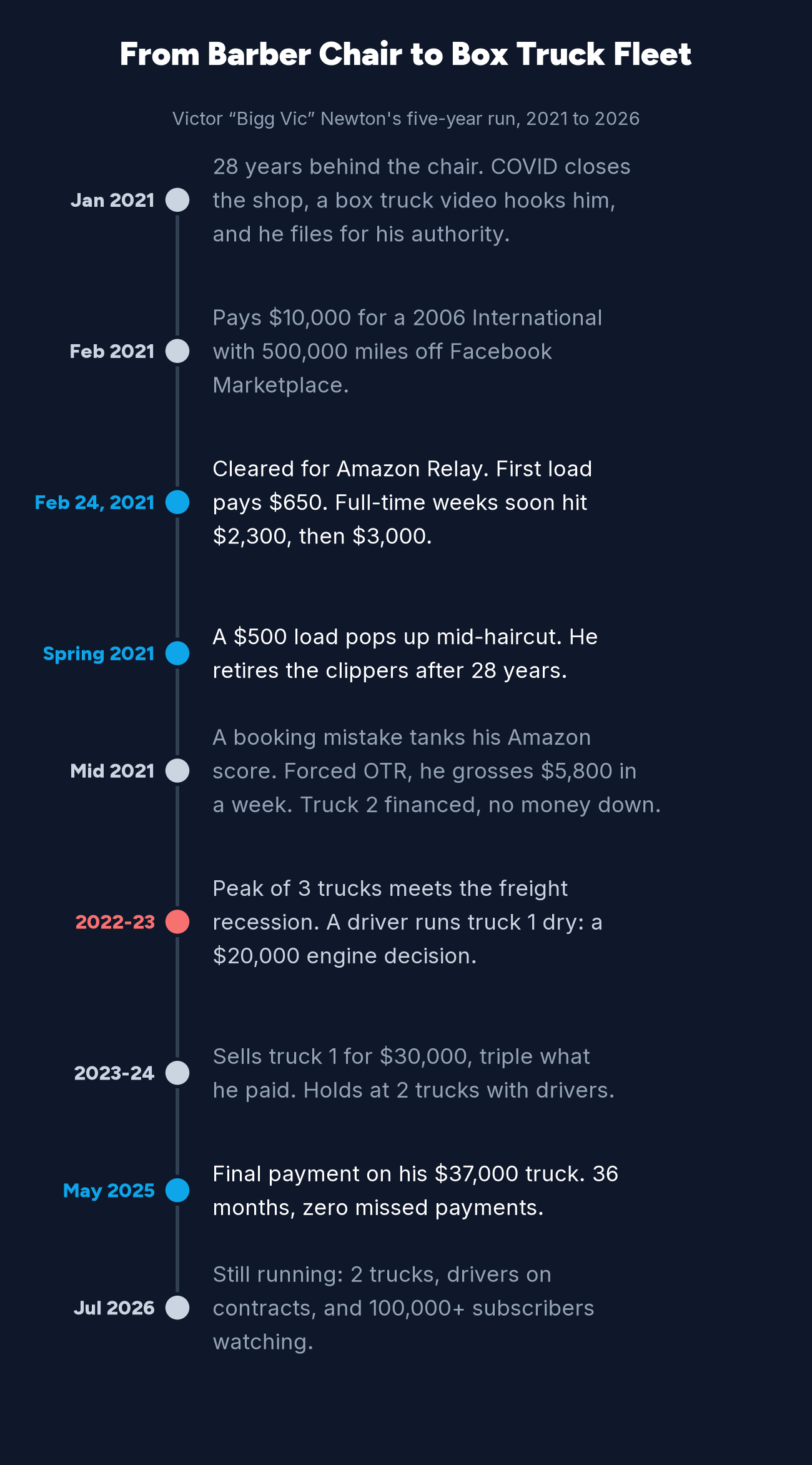
Five years from a $10,000 truck with 500,000 miles to a paid-off two-truck operation.
That shape, sprint then consolidate, was not an accident. Four decisions drove it.
| Growth Lever | |
|---|---|
| 1 | Speed into a proven lane: Got him earning in week one of a hot market instead of researching for six months |
| 2 | Cash flow architecture from day one: Weekly Amazon pay plus non-recourse factoring meant income never sat in broker payment terms |
| 3 | Truck-space utilization: Partial loads turned $1,800 runs into $3,500 runs going the same direction |
| 4 | The first truck bought the second: Loan paid off fast, business credit built, truck two financed with no money down |
Most people who discover the box truck business on YouTube spend months in what Newton calls analysis paralysis. He went from first video to active authority in about six weeks, and he treats that speed as the single most important decision he made.
"Speed beats perfection every time," he says. "I bought my first truck for $10,000 from the Facebook marketplace. It had 500,000 miles on it. I know it sounds crazy. I bought the wrong height truck. I was learning as I went, making mistakes. But you know what? I was moving freight while everyone else was still getting ready to get ready."
The speed mattered because the window mattered. In early 2021, Amazon Relay still accepted brand-new authorities, and COVID-era rates were exceptional. His first partial week brought in about $650 on a Columbia to Port Wentworth, Georgia run. His first full-time week did roughly $2,300, the next one close to $3,000. Inside his first 90 days, he booked a one-week over-the-road run and grossed $5,800, sleeping in the truck to keep costs down.
"It felt like someone had opened up a bank safe and said take as much as you can and when you're done come back tomorrow there'll be more here waiting for you," he said of that first OTR week.
Newton is blunt today that those numbers were a moment in time, not a baseline, and that the same window no longer exists. Amazon now requires authorities to be 180 days old. Rates reset hard in 2022. "It's trucking. It fluctuates. It goes up and down," he says.
But the principle he pulls from it is not about Amazon. It is that markets pay the people who show up while conditions are good, and conditions are only ever good temporarily. For a reader, the transferable move is compressing the gap between deciding and operating: get the authority filed, get the insurance quotes moving, and treat research as something you do while the 21-day FMCSA clock runs, not before you start it.
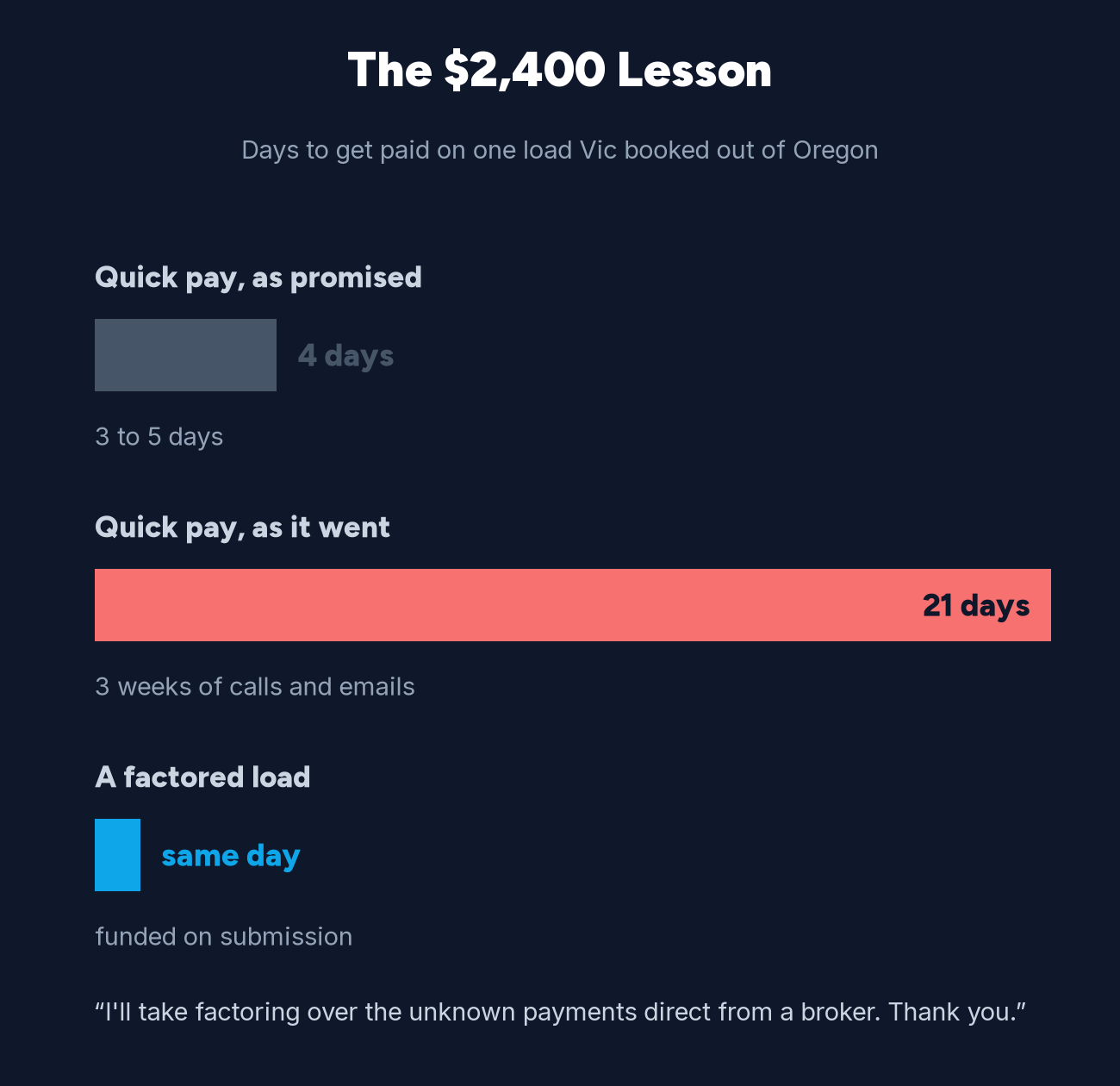
Days to get paid on the one load Newton ran outside his factoring arrangement, versus a factored load.
"Discipline weighs ounces. Regret weighs tons."
Newton started the business on borrowed money: $13,085 from his credit union, covering the truck, the insurance down payment of roughly $2,500 to $3,000, and the paperwork. There was no cushion behind it. (For what a launch costs today, see our startup cost breakdown.) Which meant payment timing was never an abstraction for him.
His first six months ran on Amazon Relay, which pays weekly. When the Amazon door closed, he moved to broker freight, and broker freight comes with 30-to-45-day payment terms. That is where factoring entered.
He almost got it wrong. When his DOT number posted, the sales calls flooded in, and Newton says he "assumed all factoring companies were created equal." He was in the middle of signing with one company when he started asking about what happens when a broker simply does not pay. The answer, chargebacks, is what sent him to a true non-recourse program instead. With recourse factoring, the factor advances you the invoice but charges it back if the broker defaults. Non-recourse means the factor eats that risk.
"That is one of the main reasons why I went with OTR Capital," he said about that time, referring to the company now called OTR Solutions. "I was probably in the middle of about to sign up with the factoring company... I'm glad that I did not sign with that company." Five years later he is still with them.
His warning to new carriers is about shiny rates: "A low rate equals no risk protection," as he put it in a 2025 video. The cheapest factoring quote usually signals recourse terms, chargebacks, and termination fees hiding in the fine print. Mateo the Freight Guy gives new van operators the same warning, with a checklist.
The one time he ran a load outside his factoring arrangement makes the case better than any pitch. He booked a load out of Oregon headed to Illinois, realized too late he could not factor it, and accepted the broker's quick pay offer of three to five days. The $2,400 payment took three weeks of calls and emails to collect. "I'll take factoring over the unknown payments direct from a broker. Thank you," he concluded.
The zoom-out: Newton treats getting paid as infrastructure, not an afterthought. Weekly pay cycles, whether from Amazon or a factor, are what let a one-truck operation reinvest instead of float brokers interest-free. If you are running on a loan with no reserves, the consistency of your pay cycle matters more than half a point of factoring rate. (If you are comparing programs, our factoring company rankings break down which companies are actually non-recourse.)
For his first stretch in business, Newton did what nearly every new box truck operator does: put one broker's load on the truck and rolled out, even when most of the box was empty.
The fix came from another operator. Newton brought a guest onto his channel who ran a 16-foot box truck, ten feet shorter than his own, and was making $7,000 to $9,000 a week running partial loads from California to the coast. "I said, wait a minute. You said what? In a 16-footer?" Newton recalled on The Long Haul. "It totally changed the perspective on how I looked at my 26 feet of space."
The mechanics he built from that are simple. When his driver books a load, the driver photographs the remaining space in the box and sends it in before leaving the area. Newton then works the phones to add a partial heading the same direction. "I'm taking a $1,800 load that I have on the truck and I want to add another 12 to 1300 more dollars on that truck going in the same direction," he explained. "I just turned a couple thousand dollars into almost $3,500 by making one more additional phone call."
His summary of the stakes: "That would take a $50,000 a year box truck to six figures."
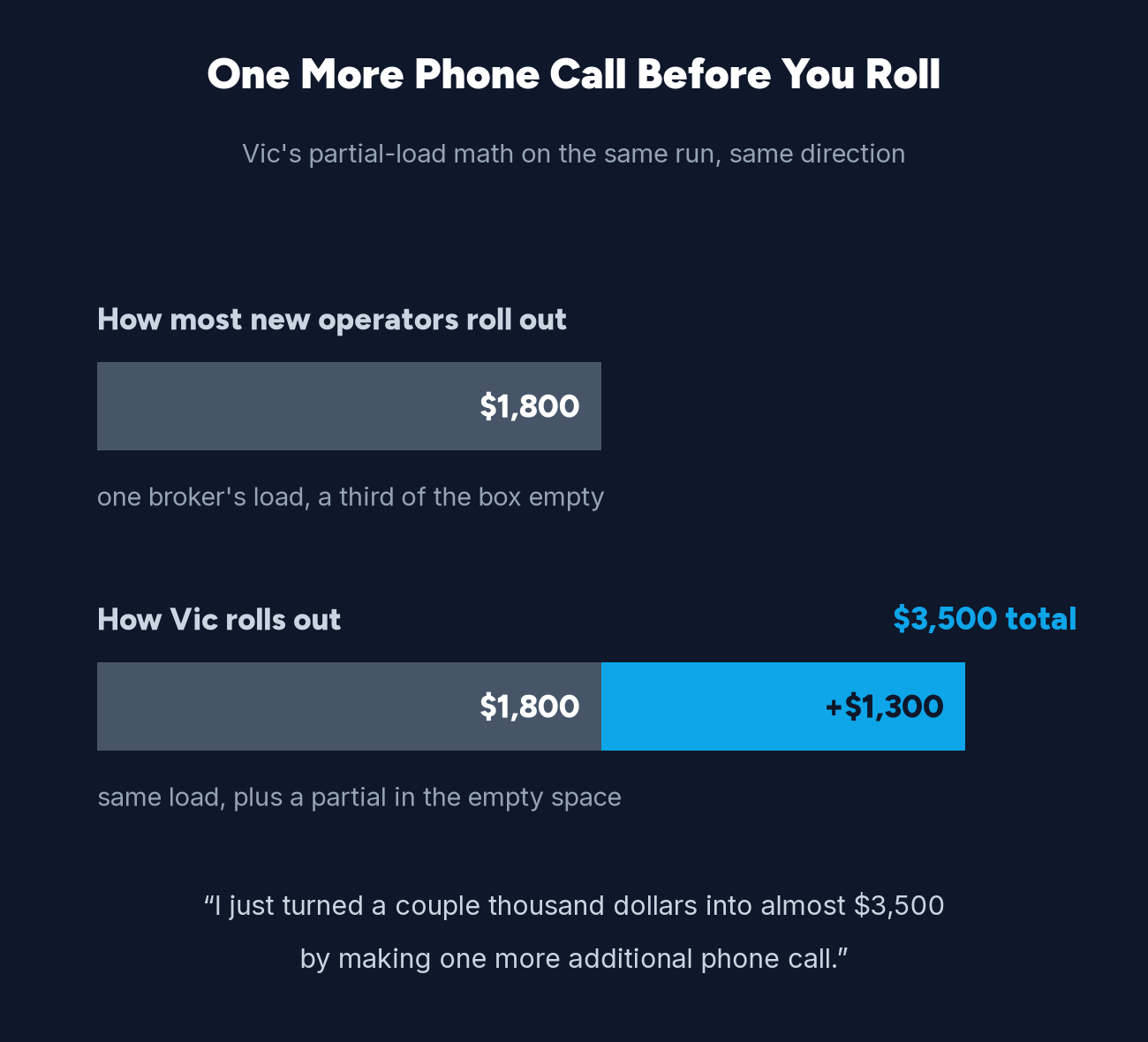
He pairs utilization with cost discipline on the other side of the ledger. After a CDL veteran talked him out of running 70 to 75 miles per hour, he started running 60 to 65 on cruise control and watched his fuel spend drop. Fuel, he points out, is the biggest cost you can actually control, through pedal discipline and station selection.
For the reader, the principle is that revenue per truck is a function of how much of the truck earns, not just how many loads you book. Before adding a second truck, most one-truck operations have 20 to 40 percent of their capacity riding around empty. Filling it costs a phone call. Stuart Arnold, the hotshot operator who calls himself Mr. Partial, built his whole $9,000-week system on the same idea.
Newton's fleet growth ran on a specific financial sequence, and he can narrate every step of it.
Step one: the $13,085 personal loan started the business. Step two: he paid that loan off out of truck income quickly. Step three: with the loan gone, personal credit strong, and business credit building, he financed his second truck about six months in with no money down. "That first truck ended up buying that second truck," he said. "The finance company looked at my situation, my credit was already strong. But the business credit was even stronger and so they did that with no money down."
He flew to Tennessee for truck two, bought from a dealership this time, and put his first driver in truck one, an Amazon Relay veteran who happened to be the same barbering client whose invoices had convinced him to start.
The discipline showed up again at the other end of the cycle. His second-generation truck cost $37,000, carried a payment around $975 a month, and he made every payment for 36 months until it was paid off in May 2025. "It's just been a blessing to not have missed not one single payment on that truck since I purchased that truck 36 months ago," he mentioned after paying it off.
The credit itself is a number he tracks. "When I came into this business, I think I might have been peaking around a 700 score," he said in August 2026. "After getting in this business, building up business credit, building up personal strong credit, I'm over 800."
Even his worst equipment event ended net positive. When a driver ran his first truck without oil and presented him with a $20,000 engine decision, he paid it, kept the truck earning, and eventually sold it for around $30,000, three times what he paid for it, into the inflated used-truck market. "I made my money back," he said.
The zoom-out here is about sequencing, not trucks. Newton never stacked debt on debt. Each obligation was retired or de-risked before the next one was added, which is why a slow 2022 and 2023 market shrank his fleet but never took him out. If your growth plan requires every month to be a good month, it is not a plan. It is a bet. Box Truck Bros took a different route to the same place, mixing rented trucks into an owned fleet so a breakdown never had to become a balance-sheet event.
Newton's channel exists in large part because of what went wrong, and he tells it like it is.
The truck itself was a string of avoidable mistakes. He bought it without a mechanic's inspection, on the seller's word about maintenance records that did not exist. The box was too short for standard pallets, which meant six months of breaking freight down by hand to load it. "Nobody told me that you need at least 96, 97 clearance going into the back of that truck," he said. He now tells every new buyer to hire a local diesel mechanic before wiring money.
Navigation nearly ended things early. Running a trucker GPS app on his phone, he was routed toward a 12-foot-1 bridge with a 12-foot-7 box. He caught it, backed up traffic, made an illegal U-turn through a church parking lot, and bought a $300 dedicated trucker GPS at a Loves the same day. "I will never do that again. It's embarrassing."
One tap on a screen cut off his best freight. He booked a 53-foot load by mistake on Amazon Relay, and his performance score dropped hard enough to choke off the freight that had carried his first six months. It forced the pivot to load boards and OTR running that ultimately grew the business, but he did not choose the timing.
Drivers are the hardest part of scaling. Beyond the no-oil engine failure, he tells the story of a driver who was running his Amazon contracts well, flew home to visit his mother, and simply vanished for a week and a half. "After this week, he definitely going to be fired... I got to go put somebody else behind that wheel." On The Long Haul, dealing with "drivers who didn't work out" is one of the first costs of the business he names.
And the market humbled everyone. Newton's early days showing $5,800 weeks helped pull a wave of new operators into box trucks near the top of the market. He is direct about the fact that those rates were a moment, and that the people who copied his start without his timing had a much harder road. It is a big part of why his content today leans on cost-per-mile math instead of income screenshots.
Your worst mistakes are usually purchasable insurance you skipped. A pre-purchase inspection, a $300 trucker GPS, a minute of double-checking a load's trailer size. Every one of Newton's expensive early lessons had a cheap prevention he knew about afterward. New operators should budget for prevention the way they budget for fuel.
The moment Newton points to is not the first big week. It is the haircut.
By late winter 2021 he was running Amazon loads on weekends and evenings while still cutting hair. Then came the day a $500 load popped up on the Relay board while he stood over a $35 head, and he had to let it go because he was holding clippers.
Twenty-eight years in one trade, standing in the shop he owned, and the phone in his pocket was outbidding the chair by more than ten to one, in real time.
"I gotta make a decision," he remembered thinking. "I'm already ready to retire. I've already been doing this thing 28 years. I bought this truck so that I can eventually move into this full time. And I threw the towel in with the Clippers." He gave his clients one month's notice.
What makes the moment more than a career change is what he walked away from. This was not escaping a job he hated. It was leaving a clientele built over decades, in a shop with his name on it, for a five-week-old business and a truck with half a million miles. "I wasn't a truck driver, right? I was a businessman, period," is how he frames the bet. The trade he made was not barbering for driving. It was a capped trade for an uncapped one.
1
Newton's whole first year was built on an Amazon Relay policy and a rate environment that no longer exist. He got in because he compressed research into weeks, not months. Whatever lane you are evaluating, the conditions that make it attractive are temporary by definition. Speed is not recklessness if the downside is capped and known.
2
Newton nearly signed with the cheapest caller and instead chose true non-recourse factoring, which meant broker defaults were never his problem. His one quick-pay experiment cost him three weeks of chasing $2,400. Ask any factor you are considering exactly what happens when the broker does not pay, and read the chargeback and termination clauses before the rate. Our freight factoring glossary covers the terms to look for.
3
A photograph of the empty space in the box and one more phone call per load took Newton's runs from $1,800 to roughly $3,500. Utilization is the cheapest growth capital in trucking. If your equipment regularly runs with a third of its capacity empty, you do not have a fleet-size problem yet.
4
Loan, payoff, business credit, then zero-down financing. Newton never carried two fragile obligations at once, and a 36-month perfect payment record turned lenders into allies. The test before adding equipment: does the plan survive an average month, not a good one?
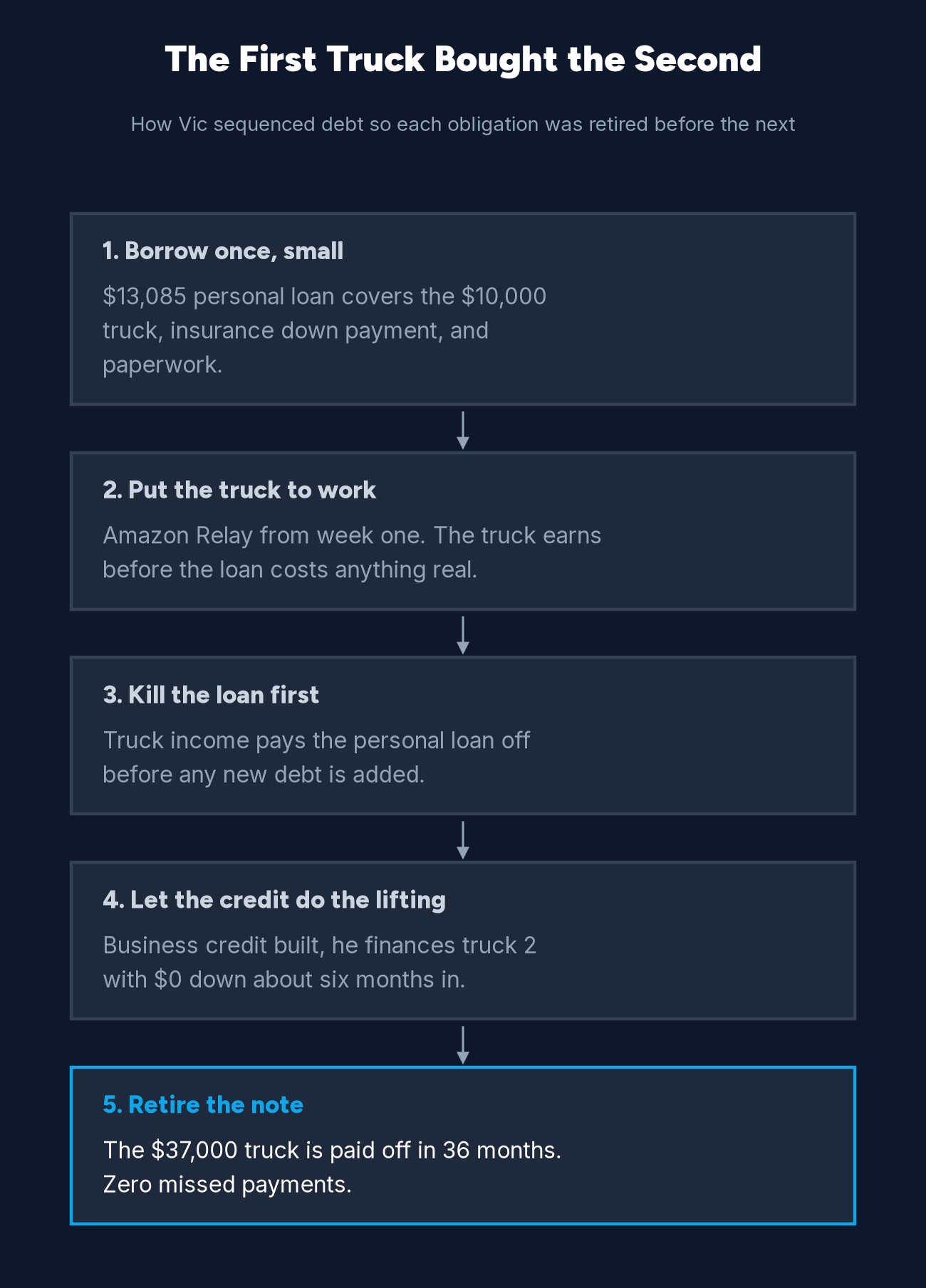
How Newton sequenced debt so each obligation was retired before the next one was added.
Newton is not chasing truck count. As of mid-2025 he was hiring two drivers to keep both trucks on contracts, and the change he has made since is in the freight, not the fleet. His current truck runs refrigerated Amazon Relay loads. "I love the reefer side because it pays well. It's more of a premium specialty lane vs. dry freight," he told Amazon Relay's carrier blog in September 2026. "So, I'll never buy a dry box truck again, especially since reefer trailer maintenance costs about the same."
The bigger ambition is still on the list. In May 2025 he said, "I do have a semi in my sights. I got at least one power unit in my sight right now," and in September 2026 he described a CDL and a sleeper cab as a short-term goal. As of this writing, he has not made that purchase.
Meanwhile he keeps proving the model personally. In July 2026 he took a two-week Amazon Relay contract in Nashville himself, at $626 a day base with fuel covered, because the numbers beat his home market that week.
The longer arc is the teaching business. His mentorship students lease onto his authority to skip the new-authority penalty, and he says some have grown well past him in fleet size. He seems at peace with that. "I still believe that with the right mindset a person can literally, still to this day, start with that one and absolutely change their families' life," he said on The Long Haul. "Cuz I did it."
Victor "Bigg Vic" Newton is a non-CDL box truck owner-operator based in Pineville, North Carolina, just outside Charlotte. He operates two 26-foot box trucks under Newton Ventures LLC (USDOT 3559030, MC-1194664), running Amazon Relay contracts, broker freight, and partial loads in the Southeast and over the road. A Bridgeport, Connecticut native, he spent 28 years as a barber and four years as a signed producer with So So Def before starting his trucking company in early 2021. He has factored with OTR Solutions since the start of the business. He documents the business and teaches new carriers on his YouTube channel, Bigg Vic Tv, which has more than 100,000 subscribers.
New articles for owner-operators, delivered twice a month.
OTR Solutions: Instant 24/7 funding, no contract, no hidden fees. 4.7/5 across 1,390+ carrier reviews.