Sammy Lloyd has been trucking since 2000 and running his own authority since January 2017. He built Lloyd Trucking LLC out of Ringgold, Georgia into a fully paid-off one-truck operation, documented every stage on his MakeCents YouTube channel (61,000+ subscribers), and wrote load-board strategy posts for DAT along the way.
This story draws on Sammy's own YouTube catalog, more than 600 videos spanning 2016 to 2026, including his 41-minute account of the collapse, plus his FMCSA registration records.
A couple of days before Christmas 2025, Sammy Lloyd drove his Kenworth W900L to a hotel parking lot to hand the keys to a buyer named Anthony. He had rebuilt her engine on camera, stretched her frame, named her Ellie Mae. She was his forever truck, and now she was somebody else's.
Two years earlier, Sammy was semi-retired at 45. His truck and trailer were paid off. His credit score peaked at 814. His one-truck company, Lloyd Trucking, grossed about $252,000 in 2023 while he stayed home three weeks out of four, cherry-picking trade show freight.
Then came a lost contract, a $120,000 IRS bill, and a second-truck gamble that bled cash for 18 months.
He refused to file bankruptcy.
This is the story of how a 25-year trucker built a debt-free operation, watched it nearly collapse, and decided the only way out was the same way in: book loads, catch gears, keep rolling.
Sammy's trucking career started with beer. Around 2000, at 21, he was riding as a helper on a Budweiser delivery route in North Georgia when someone pointed out that a CDL and his own route would pay about $10,000 more a year. He got the license.
Nine months later he tried going over-the-road. It nearly ended his career before it started. Three months at Covenant, three months at Rosedale, and he couldn't cover his bills. "They were starving me," he said of that stretch. He came home.
The job that changed everything was the least glamorous one on the board: overnight yard spotter at a Mohawk Industries shipping yard in the carpet mill country around Dalton, Georgia. Eleven at night to seven in the morning, 12 to 20 trailers a night, backing into doors like door 23, the one every driver on that yard dreaded.
He remembers his second or third night, sitting in the break room, watching the other spotters put in a takeout order. "I never had any money then. I was always broke, always busting my butt just to make enough money to pay what little bills I had." To a broke 22-year-old, ordering Waffle House at work felt like wealth.
"That's when my life changed. That's when my life turned around," he says of the spotter yard. He learned to back a truck into anything, moved up to local driving, and spent the next decade getting better and getting paid.
By 2013 he was an owner-operator, first leased to carriers like Landstar and Roadrunner. Leasing paid, but the math always favored the person who owned the authority. In late 2016 he walked into a dealership in his own hometown of Ringgold and started shopping.
In January 2017, Lloyd Trucking LLC was born.
Lloyd Trucking is a one-truck, one-man dry van operation out of Ringgold, Georgia, in the Chattanooga metro. FMCSA records show one power unit, one driver, and 92,765 miles run in 2024.
Sammy is his own entire back office. He self-dispatches 100 percent of his freight off the DAT load board, where he has been finding loads "since day one of my authority." He negotiates his own rates, targets $2 to $3 a mile, and knows his lanes across the Southeast and Midwest cold. During his semi-retired stretch he specialized in show freight: trade show and convention loads, including a Super Bowl production load for Fox Sports.
The startup math tells you everything about how he operates. He formed the authority with about $40,000 in the bank and deliberately spent only $25,000 of it: a 2014 Kenworth W900L with 428,000 miles for $79,000 ($10,000 down, financed through Farm Bureau at about 5.6 percent), a Great Dane dry van, and his permits. "Not one day have I had $50,000 in my checking account," he tells drivers who think they need a fortune to start.
For cash flow, he has factored his invoices since 2018, currently through Triumph, whose fuel card he says saves him around a dollar a gallon. Factoring means selling your invoice to a funding company that pays you now and collects from the broker later, and for a one-man operation it doubles as an entire billing department. If you are weighing that trade for your own truck, our rankings of the best freight factoring companies for trucking break down rates, contracts, and same-day funding side by side. More on that below, because it is one of his levers.
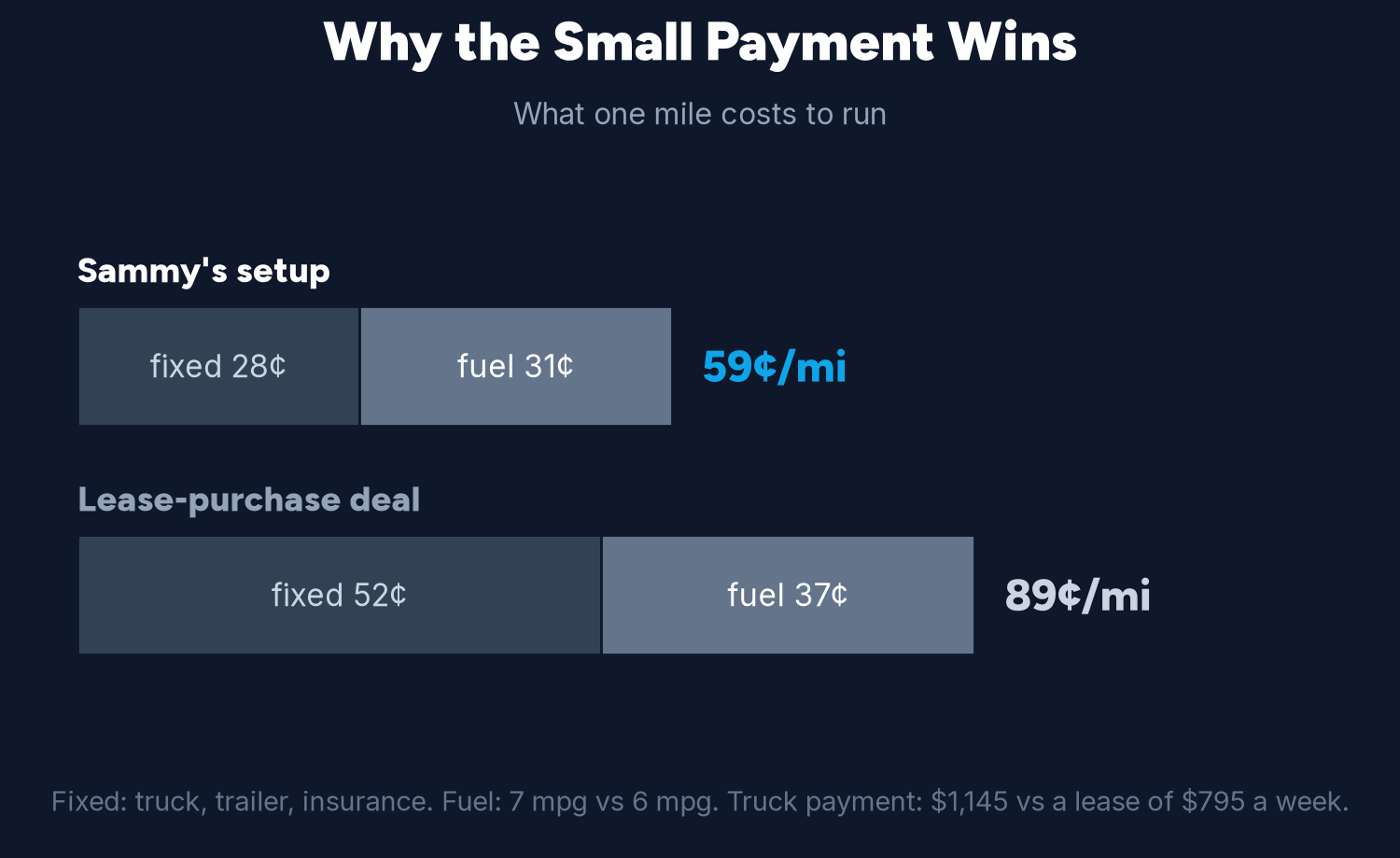
Sammy's cost to run a mile vs a lease-purchase deal
Sammy's chart does not look like a growth curve. It looks like a mountain with a cliff on the far side.
Twenty-two years of climbing: CDL in 2000, owner-operator in 2013, his own authority in January 2017. Then the summit. On December 13, 2022, he called Farm Bureau and paid off the truck and the trailer in full, five years after starting. He calls equipment payoff "the number one goal of an owner operator."
What followed was the reward: 2023, semi-retired at 45, home three weeks a month, running maybe 30,000 miles all year, and still grossing about $252,000. Life was good. "I was semi-retired. I was home months at a time."
And then, in barely 18 months, almost all of it came apart.
2000: A CDL at 21
A Budweiser route, then the Mohawk spotter yard that changed everything.
2013: Owner-operator
Leased on to carriers like Landstar and Roadrunner.
Jan 2017: Lloyd Trucking LLC
Starts his authority with $40,000 saved and spends only $25,000 of it.
Dec 2022: Paid in full
Calls the bank and pays off the truck and trailer, five years in.
2023: Semi-retired at 45
About $252,000 grossed, home three weeks a month, credit score 814.
2023 to 2024: The stack
A lost contract, a $120,000 IRS bill, and a second-truck money pit.
2025: The bottom
His driver quits in July. Credit falls from 814 to about 450 in three months.
Dec 2025: Victoria
Sells his dream W900 and goes back to full-time trucking in a Peterbilt named for the victory he needed.
Today
Rebuilding: keep the truck loaded, catch up every creditor, and earn the semi-retirement back.
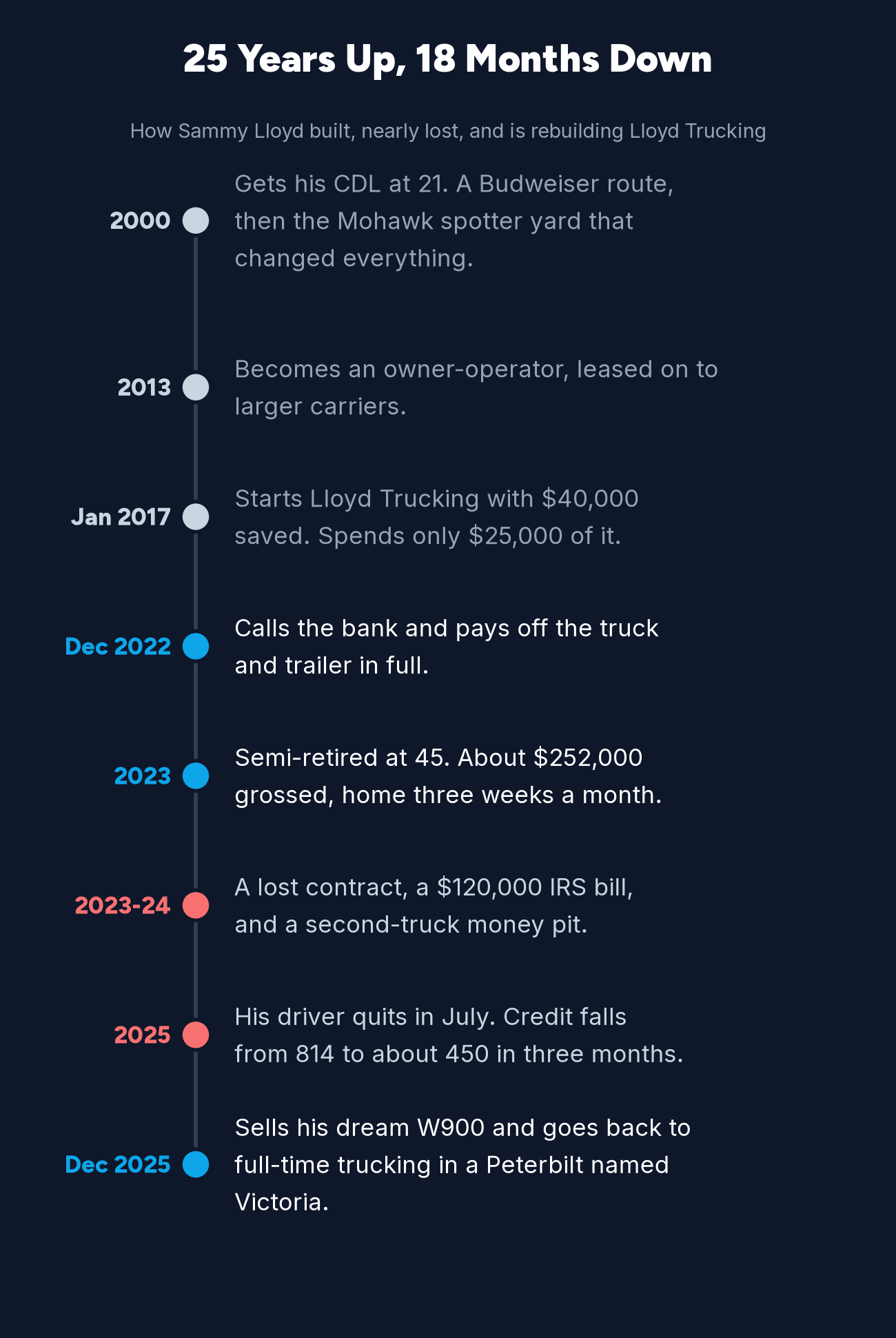
Twenty-five years of building, eighteen months of collapse, one road back.
Before the collapse and the comeback, it is worth understanding how a spotter with no savings built an operation strong enough to survive what hit it. Four disciplines did the work. Keep the payments small. Drive like fuel is the enemy. Get paid now, not in 60 days. And bank the difference like a business, not a paycheck.
| Growth Lever | |
|---|---|
| 1 | Keep the Monthly Obligation Low: A $1,145 truck payment instead of $3,000 gave him room to survive any bad month |
| 2 | The $10,000 Raise in the Fuel Pedal: Driving slower cut his fuel cost per mile by 13 cents |
| 3 | Factoring as a One-Man Back Office: Same-week pay plus zero invoice chasing for the cost of a part-time bookkeeper |
| 4 | Pay Yourself First, Then Build the Wall: A $20,000 nest egg target and $80,000 in credit lines. The wall is what saved him |
If Sammy has one commandment, this is it. "Keep your monthly obligation low, low, low, low," he preaches. "This right here will make you or break you."
The proof is his own cost sheet. While other new owner-operators signed up for $3,000-a-month payments on late-model trucks, Sammy bought a nice truck cheap: the 2014 W900L, a genuine head-turner with a Cummins ISX15 and an 18-speed, for $1,145 a month. His owned trailer ran $321. Even with new-authority insurance north of $1,200 a month, his entire fixed overhead was about $2,761 a month in his early authority years, roughly 28 cents a mile at 10,000 miles a month.
His logic is about bad months, not good ones. "It's easier to come up with a $1,100 payment in the latter days versus a $3,000 truck payment," he explains. A low obligation means a slow freight market, a breakdown, or a month at home does not put the business underwater.
He ran the comparison on camera against a lease-purchase program he once drove under: about $5,188 a month in fixed costs before fuel, roughly double his own. The lease driver nets around 33 cents a mile. Sammy's advice to anyone stuck in one is blunt: use it as a stepping stone. "Get in, hit it hard, get out."
If you are shopping for your first truck, this is the copyable part. The truck that makes you money is not the newest one you qualify for. It is the one whose payment you can make in your worst month. Bethany Hunt built her entire first-truck plan on another operator's worst months, which is the same rule applied in advance.
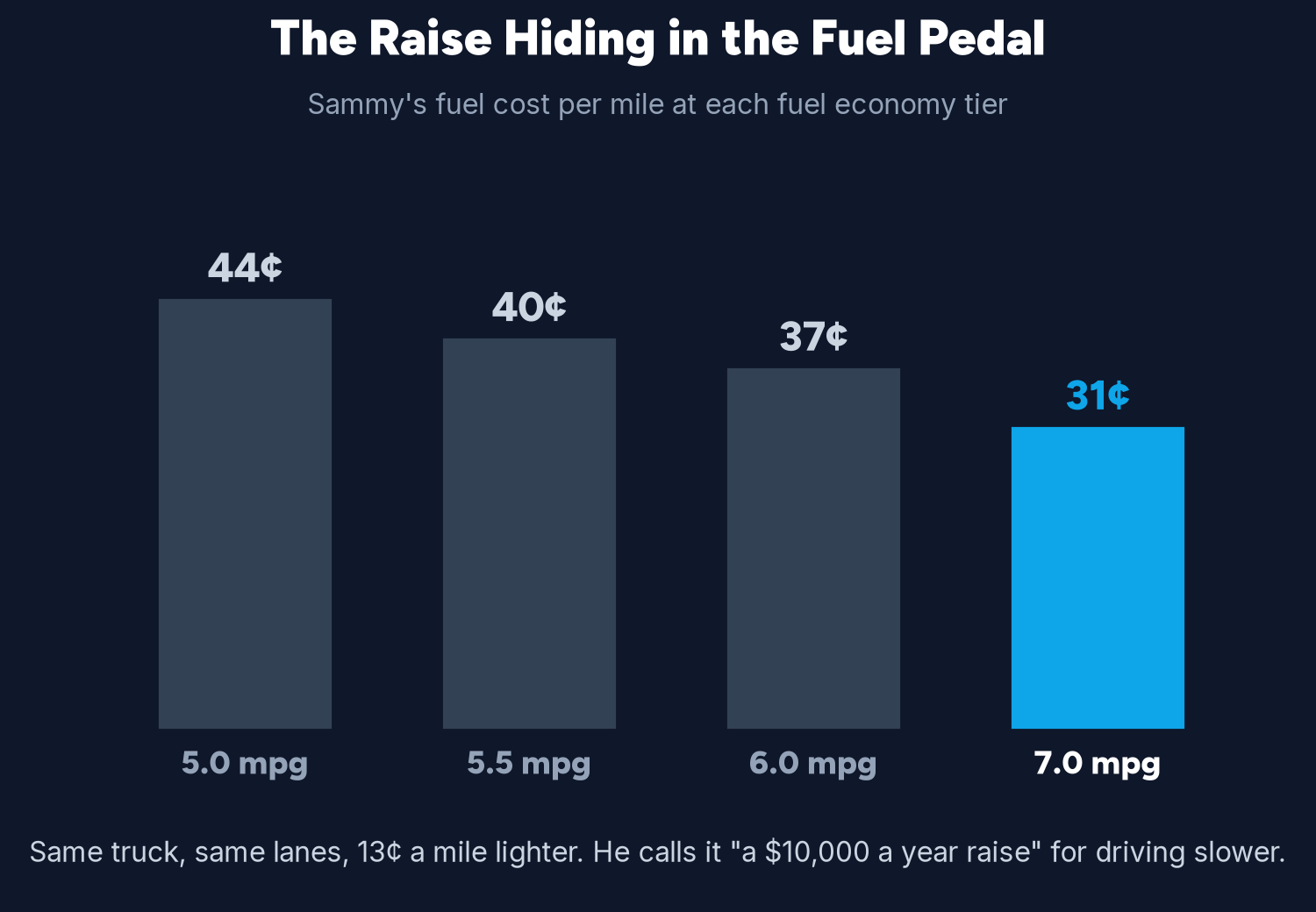
Fuel cost per mile at each MPG tier
"You got to have a body and an able truck. Get busy. You'll come out the other side."
The second discipline costs nothing to adopt: slow down.
Sammy broke down his fuel math on camera in tiers. At 5 miles per gallon, fuel costs about 44 cents a mile. At 7 miles per gallon, it drops to 31 cents. Same truck, same lanes, different right foot. "This is why, if you drive slow, you can give yourself a $10,000 a year raise. Just do the numbers."
He practices what he preaches to an almost obsessive degree, tracking every tank. In the W900L, a square-nosed classic he affectionately called "a brick," he still worked his way above 7 miles per gallon on light loads. He knowingly paid a premium of about $200 a week to run a hood truck at all, a passion cost he could afford precisely because everything else was cheap.
The postscript proved his own point. When the collapse forced him out of the W900L and into an aerodynamic Peterbilt 579, his first month of fuel savings alone was $1,800. He now sees 8 to 9 miles per gallon on good runs.
Fuel is the biggest variable cost in trucking, and it is the only one entirely in the driver's hands. Haul out your last three fuel receipts and do Sammy's tier math on your own truck. The raise is probably sitting there.
Sammy has been factoring or quick-paying his loads since his earliest authority days, and his reasoning is the cleanest explanation of small-carrier cash flow we have heard.
Start with the math of waiting. Brokers pay on net-30, net-60, sometimes net-90 terms. Run four loads a week for four weeks and you can have 16 unpaid invoices with $6,000 to $8,000 of your own money tied up in fuel before the first check lands. "I don't have that kind of money," he said. "I'm just a one-man operation. I need my money now." Compare that with Rohit Handa, who keeps enough cash in reserve to wait out net-30 terms and skip the fee entirely; same math, different balance sheet.
Then there is the part nobody prices in: the chasing. Sixteen open invoices means every day someone owes you money, and every day you are the collections department. "Quick pay for me, or even factoring for me, is a no-brainer."
Sammy's reframe is the one worth stealing. His factoring and quick-pay fees ran him around $350 to $400 a month in his first year. His response: "If I was to hire an accountant or a bookkeeper or accounts receivable and payable person, good luck on finding that for $400 a month." One invoicing workflow for every broker, no chasing, money in the account the same week, and the fee is a tax write-off.
He also learned to use quick-pay fees as leverage, negotiating factoring rates down by pointing at the 1.5 to 2 percent brokers charge for the same speed.
Sammy factors through Triumph, and Triumph is not a CFS partner; his advice stands on its own. If you are running one truck and deciding whether factoring makes sense, or which company fits your operation, our rankings of the best freight factoring companies for trucking break down rates, contracts, and same-day funding options side by side. Run your own invoice volume through our factoring cost calculator to see what the fee actually comes to.
The fourth lever is the one that separates operators who survive from operators who earn. "Making too much money without knowing how to budget it is more dangerous than not knowing how to create revenue," Sammy says, and he means it literally: revenue with no budget ends in a tax bill you cannot pay. He would know. More on that shortly.
His weekly system, which he laid out line by line on camera in his early authority years, is almost boring. Target $3,600 a week in revenue. About $800 goes to fuel. The first $1,000 pays the house: mortgage, family, groceries. The remaining $1,800 goes to the business account and does not get touched. After the truck, trailer, and insurance were paid monthly, that system banked around $5,200 a month, about $62,000 a year, on top of his own salary.
The banked money had a job. Build a $10,000 maintenance nest egg, then push it to $20,000. On top of that, he maintained about $80,000 in personal unsecured credit lines, opened when times were good and left alone. "Take care of the downfall first and the upfall falls into place," he says. In trucking, the downfall is always maintenance.
Here is the uncomfortable truth the next section proves: the wall did not prevent his crisis. It is the only reason the crisis did not end in bankruptcy. Maurice Bey runs a version of the same weekly system, and his first year as an owner was the first year the tax money was actually there.
The collapse did not come from freight rates. It came in a stack, one weight at a time.
The contract. In mid-2023, a client reneged on a contract and forced a renegotiation Sammy cannot legally discuss in detail. "Upon signing that new contract, I kissed away a hundred thousand dollars a year." Gone, in one signature.
The IRS. The boom years of 2020 through 2022 had been very good, and with the equipment paid off he had almost nothing to deduct. "Write-offs are gold," he says now. He owed about $60,000 in back taxes, and his quarter-million-dollar 2023 added roughly $60,000 more. By March 2024 the total was about $120,000.
The gamble. Rather than drain his own cash for the IRS, he reached for the leverage playbook: create "good debt" that pays the bill. In December 2023 he bought a second truck, hired a driver he trusted, a meticulous friend named Stony, and built him a generous deal: 30 percent of the truck's gross, on-time bonuses, quarterly safety bonuses, and the truck itself signed over after four years.
The truck needed to gross $14,000 a month at 7 miles per gallon for the math to work. Instead it became a money pit: nearly $26,000 in debt just to get it on the road, then batteries, coolant lines, a roadside DPF failure, and finally a $35,000 engine rebuild in February 2025 that ate a month of revenue. Profit ran $4,000 to $6,000 a month and every dollar went straight back into the hole. "It was a mistake buying this truck. And my closest friend told me, 'Don't do it.'"
The irony is that Sammy had already written the warning himself. A year earlier, explaining why he had never grown a fleet, he told his audience: "I'm pretty good at making one truck payment."
The bottom. In July 2025, Stony told him he needed out of the truck. Sammy laughed, because there was nothing left to do. "It's just laughable. I'm like, 'God, how much more? You're breaking me.'"
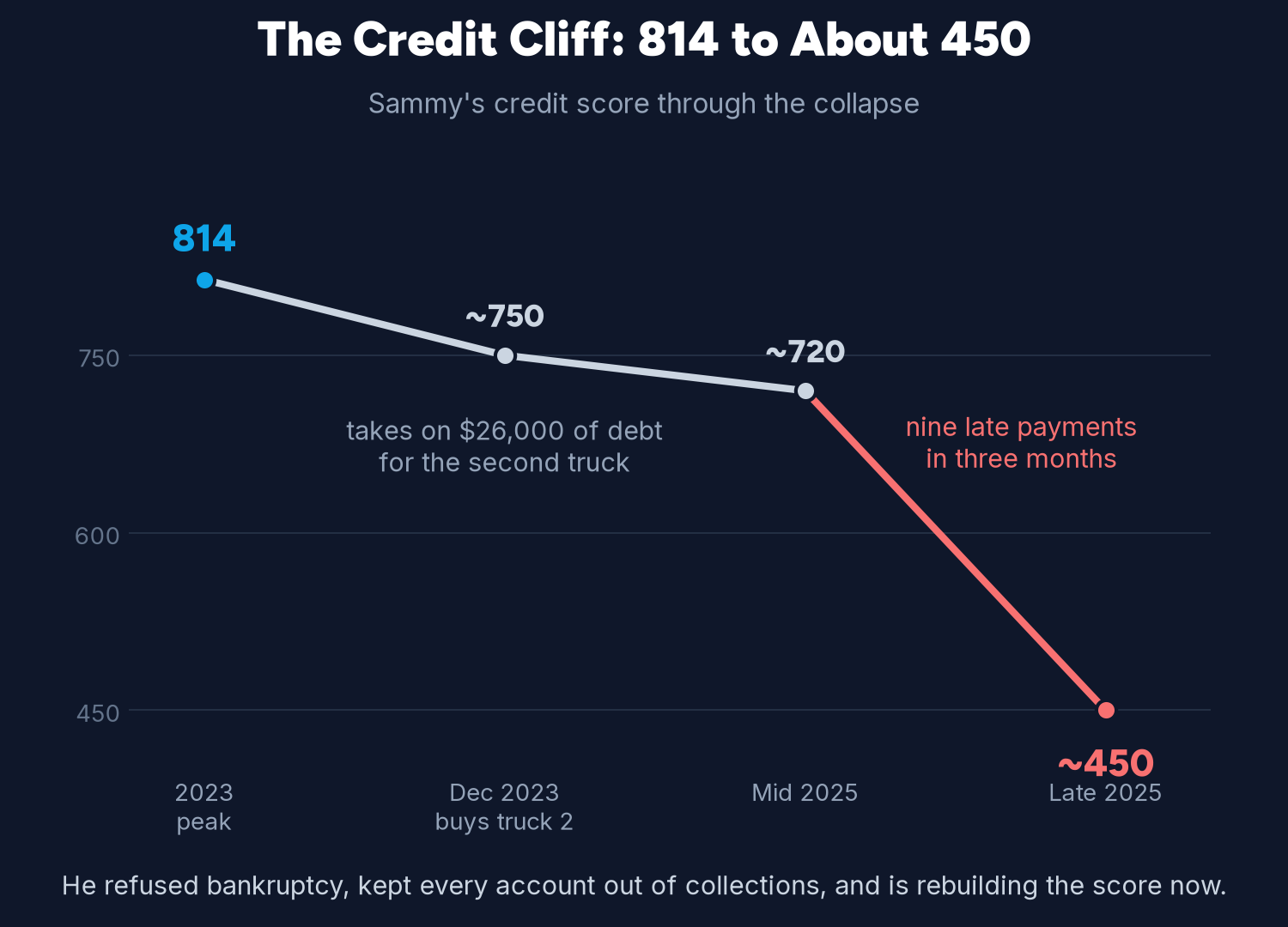
His credit score, 814 at the peak, fell to roughly 450 in three months. Nine payments ran 30 days late, six of them 60. "It was so hard that even my lenders, the banks, they gave up on me." One Chase collections agent listened to him promise he would make it right, and then did something he still talks about: "A Chase bill collector sit there and had a prayer for me over the phone."
The night Stony quit, Sammy hung up the phone mid-conversation. "It hit me like a ton of bricks," he said. He is a fix-it guy, so he did what fix-it guys do: ran every scenario he had.
Put a new driver in the truck? His insurance would never approve one fast enough, and he could not survive the call he kept imagining, a stranger broken down in Oklahoma with a blown turbo he had no money to fix. "I've had enough. I can't take on no more stress. At this point, man, I'm broken."
File bankruptcy and walk away? It would have been the easy way out, and he says so. But bankruptcy would erase the future he had spent 25 years building toward. Not an option.
That left one scenario. "Something told me, said, 'You got to have a body and an able truck. Get busy. You'll come out the other side.' And I had to trust my faith on that."
So the semi-retired man went back to work. Full time, non-stop, more time on the road in one year than the previous five combined, by his wife's count. He sold Ellie Mae, the dream truck, to a longtime subscriber starting his own flatbed authority; the money order "relieved about 60 percent of the pressure." He climbed into the Peterbilt 579 that used to be Stony's and made it his.
"I named her Victoria cuz Victoria stands for victory and I knew I needed a victory."
1
Sammy survived 2022's rate crash, a lost six-figure contract, and a $35,000 engine rebuild because his fixed overhead was about half of what a lease-purchase driver carries. If your truck payment only works in a good month, you do not have a payment plan. You have a bet.
2
The $20,000 nest egg target and the $80,000 in credit lines did not stop the collapse, but they are why it ended in a comeback instead of a bankruptcy filing. Open credit when your numbers are strong and leave it alone. Nobody extends credit to the version of you that needs it.
3
Sammy's $120,000 IRS debt did not come from failure. It came from success with no write-offs and no money set aside. If you are having a great year with paid-off equipment, your tax bill is quietly having one too. Set aside a percentage of every settlement and treat it like a truck payment you cannot skip.
4
A one-truck operation cannot float 16 open invoices on net-60 terms. Sammy's math prices factoring honestly: a few hundred dollars a month for same-week cash, one invoicing workflow, and zero chasing, cheaper than any bookkeeper you could hire. If waiting on brokers is what is capping your growth, fix that first.
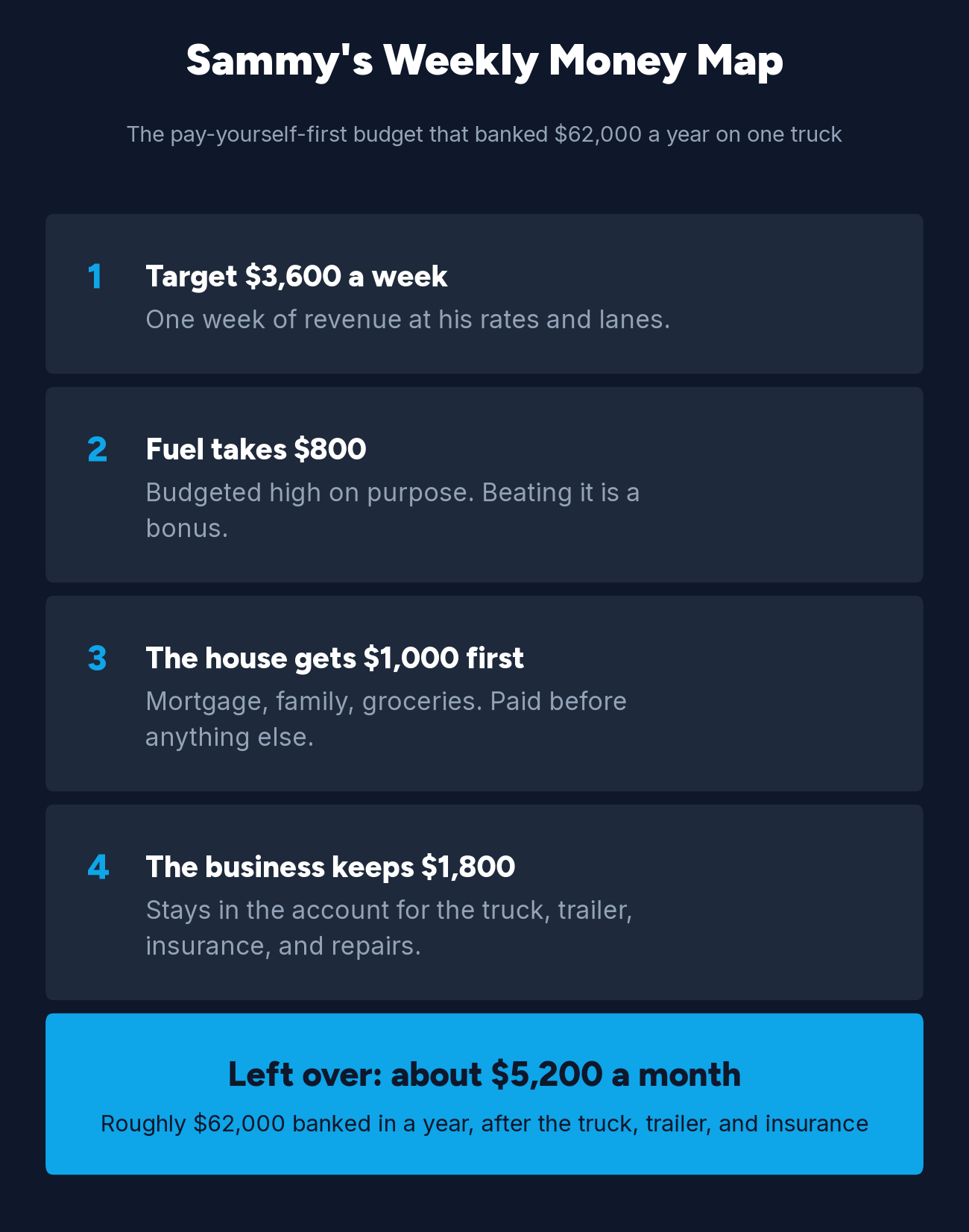
The weekly budget that banked about $62,000 a year on one truck.
The comeback is underway, not complete. Sammy describes himself as "not on the plateau yet, but getting there." The plan has not changed since the night it formed: keep the Peterbilt loaded, keep the fuel bill low, catch up every creditor, rebuild the credit score, and work his way back to the semi-retirement he already earned once. He calls it getting back to work on his fortune. He is not the only operator in our series to climb down a rung on purpose: Tay McClure went from his own authority back to a company seat in 2024 and calls it a position, not a verdict.
The channel that documented the rise now documents the rebuild, and that is the point. He made the collapse video, he says, because "seeing is believing," and somebody in their own hard season needed to watch a man come out the other side.
Twenty-five years ago he was the broke kid in a Mohawk break room who could not afford the Waffle House order. That kid built a debt-free company once. He knows the way.
"Winners never quit. Quitters never win."
Sammy Lloyd is the owner-operator behind Lloyd Trucking LLC, a single-truck dry van operation based in Ringgold, Georgia. He got his CDL in 2000, became an owner-operator in 2013, and has run his own authority since January 2017, self-dispatching spot market freight across the Southeast and Midwest. He documents the business on YouTube as MakeCents (@MakeCentsTrucking, 61,000+ subscribers), where his sign-off doubles as his philosophy: "If it don't make sense, it don't make dollars."
New articles for owner-operators, delivered twice a month.
OTR Solutions: Instant 24/7 funding, no contract, no hidden fees. 4.7/5 across 1,390+ carrier reviews.