The per diem rate for truck drivers is $80 per full day away from home for travel in the continental United States, set by IRS Notice 2025-54 and effective October 1, 2025. Drivers subject to DOT hours-of-service regulations deduct 80% of it, no meal receipts required.
That makes per diem the easiest legitimate deduction in trucking and, somehow, still the most fumbled one. Drivers who cannot legally claim it try to; drivers who can claim it forget partial days, lose track of nights out, or skip it entirely because it sounds like paperwork. This guide settles who qualifies, what the current numbers are, and what the deduction is actually worth in dollars at tax time, in plain words. One disclaimer up front: this is general information, not tax advice; confirm your specifics with a tax professional who knows trucking.
Per diem, "per day," is the IRS-set flat allowance for meals and incidental expenses while traveling away from home for work. Instead of saving every truck-stop receipt and deducting actual meal costs, an eligible driver claims the flat daily rate for every qualifying day, and the log book does the proving.
The current numbers, per IRS Notice 2025-54, effective for travel from October 1, 2025 through September 30, 2026: $80 per full day within the continental US (CONUS), $86 per full day outside it (OCONUS), which covers Canada runs. These are the special transportation-industry rates, a simplified flat rate the IRS maintains specifically because transportation workers cross too many localities for the city-by-city federal tables to make sense.
Three mechanics finish the picture. The allowance covers meals and incidental expenses only, never lodging: a motel night is a separate, receipt-substantiated deduction. Partial days, the day you leave home and the day you return, count at 75% of the rate, or $60 per partial day at the current CONUS figure. And the deduction is 80%, not 100%: workers subject to DOT hours-of-service rules get 80% of the per diem as the deductible amount, a better deal than the 50% meal-deduction limit most other business travelers live with.
Special transportation industry per diem: the IRS flat daily allowance ($80 CONUS / $86 OCONUS under Notice 2025-54) for meals and incidentals, available to workers who travel in the transportation industry. It replaces meal-receipt tracking; lodging is separate and always receipt-based.
Two tests, and both have to pass.
Test one: you sleep away from home. The travel must take you away from your tax home long enough to require rest, which in practice means nights in the sleeper or a motel on the road. An OTR or regional driver with overnight runs qualifies on every qualifying day; a local driver who ends every shift in their own bed never does, no matter how long the shift. The "away from home overnight" line is the whole test, and it is why per diem is fundamentally an over-the-road benefit.
Test two: you file as a business, not an employee. Owner-operators under their own authority and lease operators receiving a 1099 deduct per diem on Schedule C against business income. W-2 company drivers cannot claim it. The Tax Cuts and Jobs Act eliminated unreimbursed employee expense deductions in 2018, and Congress has since made that elimination permanent, so no year-end form resurrects it for employees. The legal workaround lives on the employer's side: company per diem plans, where the carrier pays part of the driver's compensation as a nontaxable per diem reimbursement. If you drive company and your carrier offers a plan, that is the version of this benefit available to you, with its own tradeoffs (it can lower the wage base used for things like 401(k) matches and loan qualification), and it is the carrier's paperwork rather than yours.
Also subject to the DOT hours-of-service requirement: the 80% rate applies to drivers governed by HOS rules, which is essentially every CDL interstate driver reading this. Where the deduction lands, Schedule C, also happens to be where the rest of the owner-operator tax picture lives, from the startup costs covered in our cost to start guide to factoring fees, which are themselves a deductible business expense.
Sleeping in your own bed kills the day. Per diem requires being away from your tax home overnight, so local runs never qualify, and a W-2 company driver cannot claim the deduction at all; that door closed in 2018 and Congress made it permanent. Employer per diem plans are the company-driver alternative.
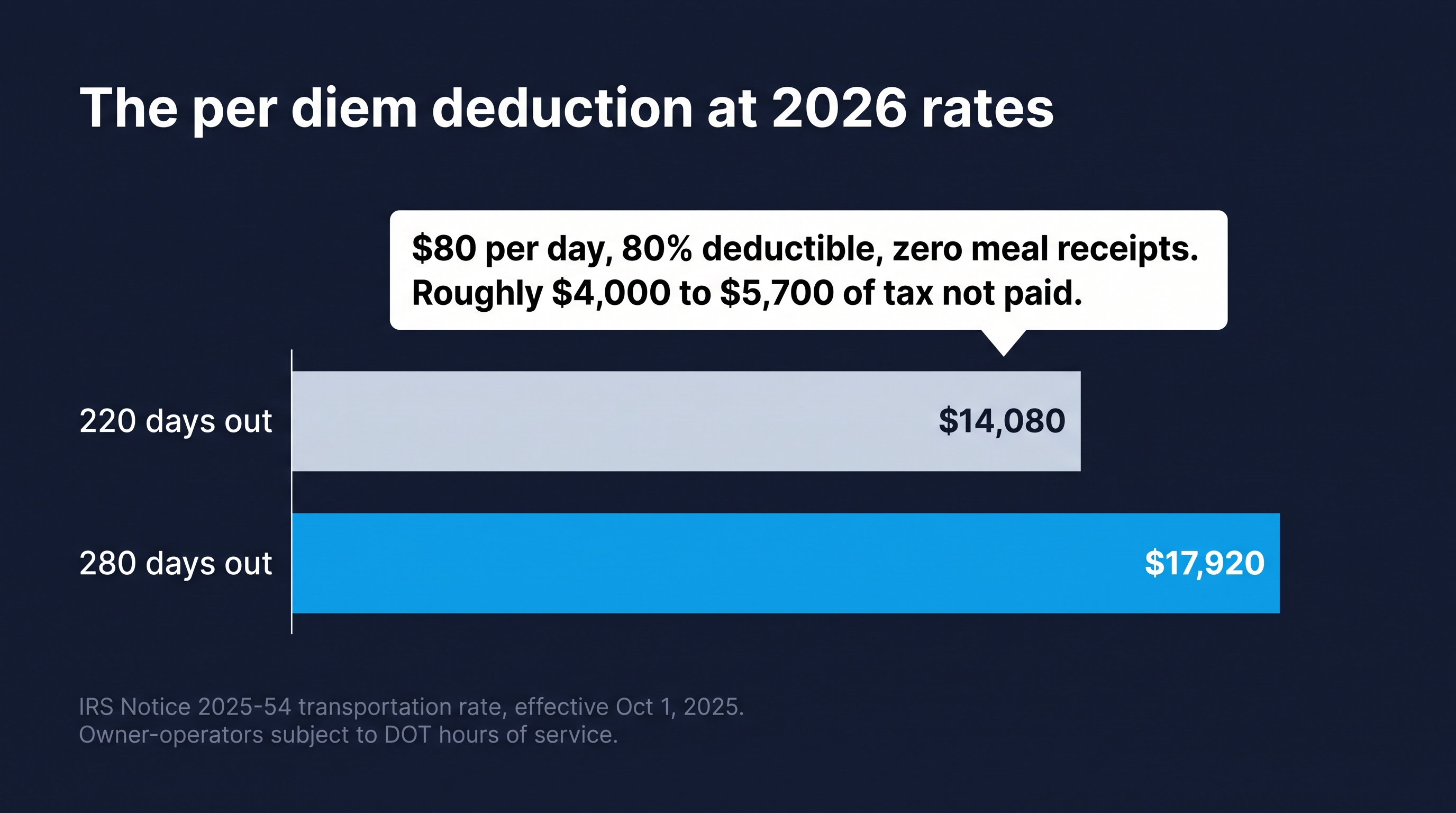
Take a hard-running owner-operator with 280 qualifying days: 270 full days plus 20 partial days at 75% (call it 265 full-day equivalents, but run the clean version first). At 280 full days: 280 x $80 = $22,400 of per diem, deductible at 80% = $17,920 off taxable income.
What does an $17,920 deduction save in actual tax? An owner-operator in the 22% federal bracket also pays self-employment tax of about 15.3% on most of that income; net of the SE-tax deduction interplay, each deductible dollar is worth roughly 30-something cents. Call it about $4,900 to $5,700 of real tax not paid, from a deduction that requires zero receipts, only the log you already keep. A moderate schedule of 220 days out runs 220 x $80 x 80% = $14,080 deducted, roughly $3,900 to $4,500 saved.
Now weigh the alternative: deducting actual meal costs, receipt by receipt, at the 50% general business-meal limit. A driver would need to spend and document about $180 a day in meals for actuals to beat the flat $80 at 80%. Nobody eats $180 a day at a Pilot. For essentially every OTR driver, per diem wins, and it wins with less paperwork.
Two per diem days deserve their own math. Partial days at 75% are $60 each, and forgetting them across 40 departure-and-return days a year quietly deletes a $1,900 deduction. And OCONUS days at $86 add up for regular Canada runners; the border crossing is worth six extra dollars a day.
280 days out x $80 x 80% deductible = a $17,920 deduction, roughly $4,900 to $5,700 of tax an owner-operator does not pay, substantiated by the ELD log they were already required to keep.
Per diem's substantiation rules are almost custom-built for truckers, because the proof is the log you already keep.
The log book is the evidence. Your ELD records establish where you were and when, which is exactly what the IRS needs to verify days away from home. Export the year's logs at tax time and the substantiation is done; a simple calendar of nights out, kept alongside, makes your preparer's job trivial.
Count three day-types correctly. Full days away: 100% of the rate. Departure and return days: 75%. Days that end at home: zero. A one-page tally by month is the whole workflow.
Keep lodging separate. Motel nights are real-receipt deductions on top of per diem; the flat rate never absorbs them.
Do not double dip. Claim per diem or actual meal receipts for the year, not both, and if a carrier or customer reimburses meals on some loads, those days come out of your claim.
At filing time the per diem lands on Schedule C with the rest of the business: truck costs, insurance, and yes, factoring fees, which are an ordinary deductible expense of running the operation, the same one weighed in our is factoring worth it breakdown. A trucking-literate tax preparer will know the transportation rates on sight; if yours has to look up whether you qualify for 80%, that is a signal worth acting on.
Your ELD already proves your nights out. Export the year once at tax time, keep a one-page monthly tally of full days, partial days, and Canada days, and the biggest no-receipt deduction in trucking substantiates itself.
The card version: $80 per full CONUS day, $86 OCONUS, 75% on departure and return days, 80% of the total is deductible, owner-operators and lease operators only, log book is the proof, lodging separate, rates refresh every October 1.
$80 per full day of travel within the continental US and $86 outside it, under IRS Notice 2025-54, effective October 1, 2025 through September 30, 2026. Drivers subject to DOT hours-of-service rules deduct 80% of the allowance.
No. W-2 drivers lost the unreimbursed employee expense deduction in 2018 and Congress has made the change permanent. The company-driver route is an employer-paid per diem plan, where part of pay arrives as nontaxable reimbursement; that is the carrier's program to offer, not a deduction you claim.
No, that is the point of the flat rate: it replaces meal and incidental receipts entirely. You do need proof of your travel days, which your ELD log provides, and you do still need receipts for lodging, which per diem never covers.
The day you leave home and the day you return each count at 75% of the rate, $60 at the current CONUS figure. Across a year of weekly departures and returns, partial days alone are worth well over a thousand dollars of deduction, so tally them.
Almost always. Actual meal costs deduct at only 50% for most filers, so beating the flat $80-at-80% would take about $180 a day of documented eating. The flat rate pays more for zero receipt-keeping, which is why virtually every eligible driver uses it.
Rates refresh every October 1 when the IRS issues the year's transportation-industry notice, and state tax treatment can differ from federal. This page tracks the federal rate; your tax professional gets the final word on your return.
Every night in the sleeper is a receipt the IRS already accepts.
New articles for owner-operators, delivered twice a month.