Every factoring mistake on this list is rational in the moment. The contract looked standard, the 1 percent rate looked cheap, the broker seemed fine on the phone. We know they are mistakes because we can price them: in termination fees paid, invoices charged back, and months of fees on money that was never slow. Here are the seven that cost new carriers real dollars, each with its price tag and its five-minute prevention.
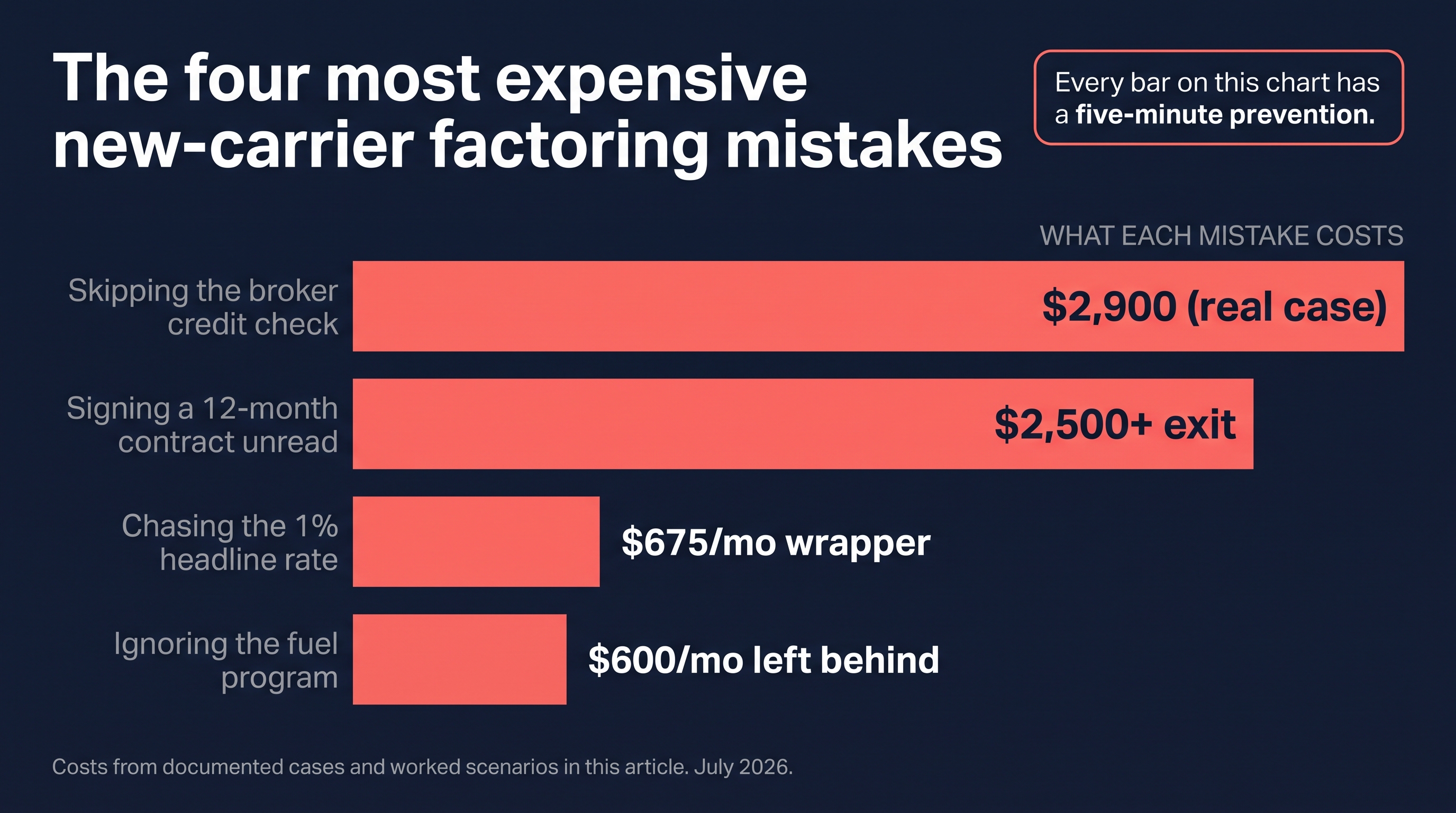
The classic. A new carrier signs a 12-month auto-renewing agreement because the rate looked good, then meets the exit: termination fees that run to $2,500 at some majors, release letters that take weeks or months, and renewal windows that re-arm the whole trap annually. Prevention: month-to-month options exist at the top of our rankings; a new business should not sign promises about month eight. Read the red-flags guide before any signature.
Our price tag comes from a real story: an owner-operator we profiled hauled three loads for an unvetted broker and spent months chasing $2,900 that never fully arrived. Every major factor offers free broker credit checks; the mistake is not lacking the tool, it is not clicking it. Prevention: check every new broker, every time, before the truck moves. Thirty seconds against a four-figure tail risk is the best trade in trucking.
The renewal window is the mistake that repeats: calendar it with two reminders the day you sign, and cancel in writing with proof of delivery if you ever choose to leave.
The 1 percent billboard against the 3.25 percent flat fee looks like a $675 monthly win at $30,000 volume. Then the wrapper arrives: deposits, invoice fees, minimums, and termination clauses that the flat fee never had. Our effective-rate teardown shows advertised rates gaining a point once fees stack. Prevention: compare only complete written fee schedules, divided into an all-in number. The billboard is an ingredient, not a price.
A shipper who pays reliably in 7 days does not need a factor; factoring that $3,000 invoice spends $90 accelerating money that was nearly there. Across a year of mixed customers, undifferentiated factoring quietly burns hundreds. Prevention: where your contract allows selectivity, factor the 40-day money and leave the 7-day money alone.
Build the thirty-second habit: new broker, credit check, then book. It is the single highest-value click in a new carrier's day, and it is free everywhere that matters.
Auto-renewing contracts carry cancellation windows, commonly 30 to 60 days before the term ends. Miss it by a day and the agreement re-arms for another year, with the same termination fees guarding the exit. The cost is not a fee; it is twelve more months of a contract you had already decided to leave. Prevention: calendar the window the day you sign, with two reminders, and send any cancellation in writing with proof of delivery.
Instant funding is a paperwork product: a legible rate confirmation and a signed BOL, every load. New carriers learn this the slow way, when the money that was supposed to arrive in minutes sits in verification for days during the exact weeks cash is tightest. Prevention: our invoice template and checklist is the whole fix; scan flat, sign everything, match the rate con to the penny.
Most of these mistakes are structural, not personal: pick a month-to-month factor with written all-in pricing and half the list becomes impossible to commit.
New carriers evaluate factors on rate and skip the fuel card, leaving the single largest offset on the table. At 1,200 gallons a month, cards averaging around $0.50 a gallon return roughly $600, most of a typical solo factoring fee, and programs like OTR's Fuel Credit remove the deposit wall that usually locks new authorities out. Prevention: price every factor as rate minus fuel value at your actual gallons. The new-authority guide ranks who does this best.
The pattern across all seven: every mistake is a five-minute prevention against a four-figure consequence, and every prevention is boring. Factoring rewards boring.
Reread your factoring agreement once a year even when nothing feels wrong: amendments arrive by email, fee schedules get updated, and the contract you remember is rarely the contract you have.
New carriers do not lose money to factoring; they lose it to defaults: default contracts, default rates, default habits. Read before signing, check before hauling, divide before comparing, and calendar before forgetting. Do those four things and factoring becomes what it should be: the boring, reliable cash-flow layer under a growing business. Start with the 2026 rankings and our pillar guide.
Signing a long auto-renewing contract unread: exit costs run to $2,500 in termination fees plus months of release-letter delays, and missed renewal windows re-arm it annually.
Yes: broker failure is the loss that ends new carriers, the checks are free at every major factor, and our profiled example cost $2,900 in unpaid invoices.
Verification: blurry BOLs, missing signatures, or totals that do not match the rate confirmation route invoices to manual review. Clean paperwork is what instant means.
Only the slow ones, where your contract allows selectivity: paying 3 percent to accelerate money that arrives in a week is the quietest leak in new-carrier budgets.
Choose a month-to-month factor with published or clearly written all-in pricing, free credit checks, and a real fuel program, then build the paperwork habit. The rankings shortlist does the first half for you.
The mistakes compound in order: an unread contract hides the renewal window, the headline rate hides the fees, and each one makes the next more expensive. Fixing the first one, reading before signing, prevents most of the list.
Factoring rewards boring. Every expensive mistake on this list was somebody being interesting.
New articles for owner-operators, delivered twice a month.