A trucking invoice has one job: get paid without a phone call. Most late payments are not villainy; they are a missing load number, an unsigned BOL, or a rate that does not match the confirmation, sitting in a broker's exception queue while your fuel bill runs on schedule. This page gives you the complete invoice structure to copy, the checklist brokers and factors verify against, and the honest math on when an invoice is better sold to a factor than waited on at all.
Copy this structure into your invoicing tool or spreadsheet. Header: your company name, MC and DOT numbers, remit-to address, invoice number, and invoice date. Bill-to: the broker or shipper's legal name and billing address exactly as written on the rate confirmation. Load block: load or PRO number, rate confirmation number, pickup and delivery dates, origin and destination cities. Charges: linehaul, fuel surcharge if separate, detention or accessorials with backup, and the total, matching the rate confirmation to the penny. Terms: payment terms and any quick-pay election.
The two lines carriers forget: the invoice number (brokers file by it; no number means no file) and the rate-con reference (the first thing every payables clerk matches). An invoice missing either is a phone call waiting to happen.
Number invoices sequentially and never reuse a number, even for corrections: issue a new invoice referencing the old one. Duplicate numbers are how payments vanish into exception queues.
The invoice is the cover letter; the attachments are the evidence. Every submission should carry: the signed rate confirmation, the signed BOL or POD with legible signatures and dates, and backup for every accessorial (detention timestamps, lumper receipts). Scan flat, straight, and readable; a blurry BOL is functionally a missing BOL.
This is the same checklist factoring companies verify before funding, which is not a coincidence: a factor's verification team is a professionalized payables clerk. Paperwork that funds instantly at a factor is paperwork that pays cleanly at a broker, and sloppy paperwork is the number one reason instant funding is not instant, at every factor we have reviewed. Our requirements guide lists what factors ask for at setup.
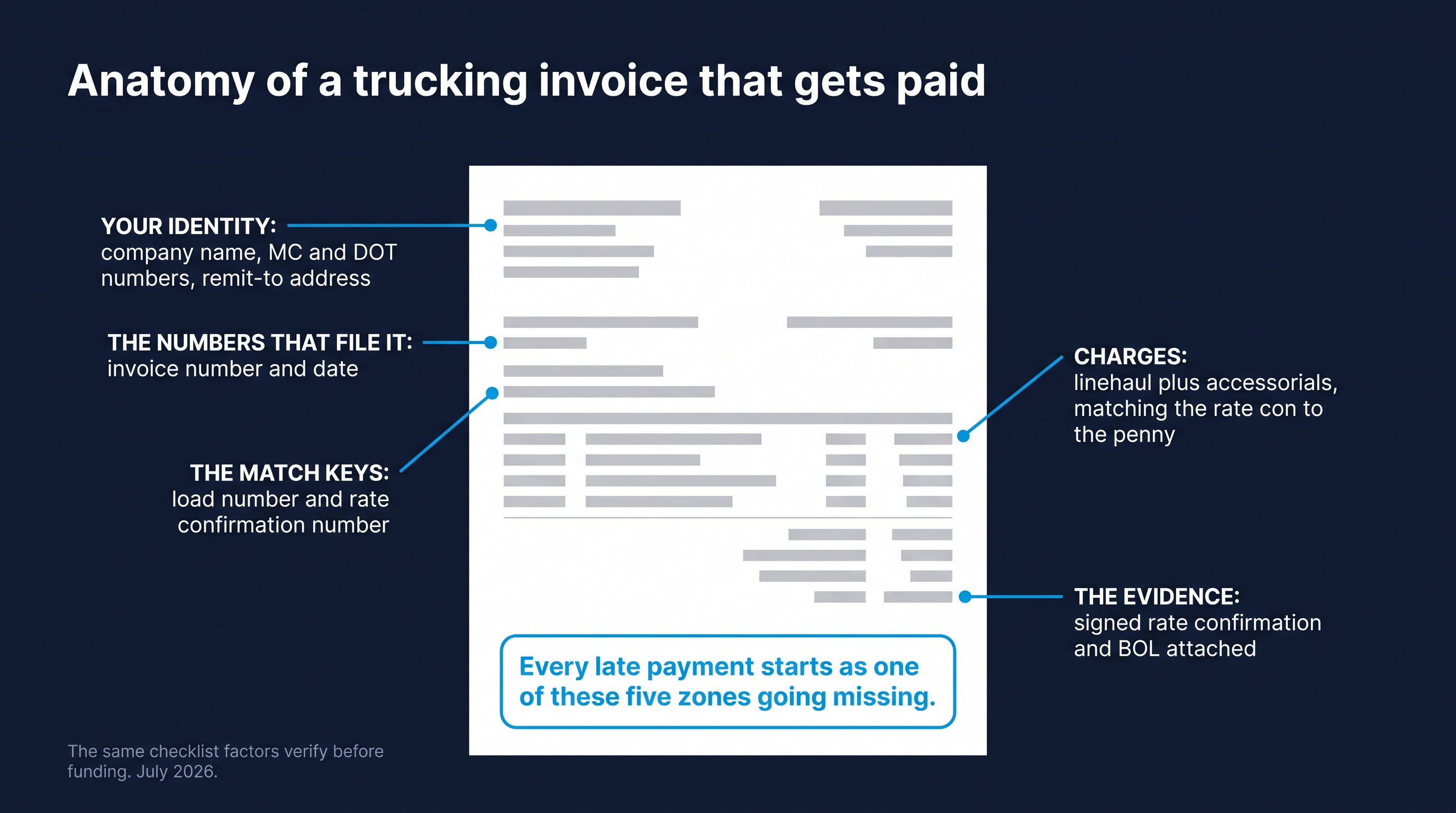
Accessorials without backup are the most-disputed line on trucking invoices: detention needs in/out timestamps and lumper fees need receipts, attached at submission, not after the argument starts.
When you factor, one block changes: the remit-to becomes your factoring company's payment address, per the Notice of Assignment. The NOA tells the broker legally that payment on your invoices goes to the factor; your factor files it with each broker, and your invoice should match it.
Practical rules: never mix remit-to addresses across factored and unfactored invoices to the same broker without checking your agreement (all-invoices-per-broker rules are common), and never instruct a broker to pay you directly on an assigned invoice; that creates exactly the mess it sounds like. Our NOA guide covers the mechanics and the exit paperwork.
When you factor, invoicing mostly disappears as a chore: you submit the rate con and BOL, and the factor generates, sends, and collects the invoice. It is the hidden labor rebate in the fee.
A perfect invoice still pays on the broker's calendar: commonly 30 to 45 days. The decision math is simple: if the cost of waiting, in turned-down loads, cash-price fuel, or late fees, exceeds roughly 3 percent of the invoice, selling it wins. A $3,000 invoice factored at 3 percent costs $90; one missed $2,500 load because fuel money was parked in receivables costs a multiple of that.
The template above is exactly what a factor needs to fund same-day: here is the full mechanics walkthrough, and the rankings compare who funds it fastest. Invoicing well and factoring well are the same skill wearing two hats.
Send the invoice the day you deliver, every time: payment clocks start at receipt, not delivery, and a Friday load invoiced Monday just gifted the broker a free weekend of your money.
An invoice that matches the rate con, carries its attachments, and names its load number gets paid without a phone call, by a broker in 30 days or a factor in minutes. Copy the template, run the checklist on every submission, and let the paperwork be the boring part of your business. For the money side of the same documents, start at the factoring pillar guide.
Your company and MC/DOT identifiers, invoice number and date, the broker's exact billing details, load and rate-con numbers, dates and lane, itemized charges matching the confirmation, and payment terms, with the signed rate con and BOL attached.
Most delays are exception-queue problems: missing load numbers, unsigned BOLs, or totals that do not match the rate confirmation. Clean submissions with attachments skip the queue.
The Notice of Assignment: the legal notice that a factoring company owns payment rights on your invoices, changing the remit-to address. See our NOA guide.
When waiting costs more than the roughly 3 percent fee: a $90 fee on a $3,000 invoice beats one missed load or a month of cash-price fuel. Slow payers get factored; fast payers get patience.
Yes: verification teams match the invoice against the rate confirmation and BOL before releasing funds. The same checklist that satisfies them satisfies broker payables.
Keep the invoicing muscle even after you factor: quick-pay shippers, detention rebills, and any freight you choose not to factor still need clean invoices from you. The template stays in the toolbox.
The best invoice is the one nobody ever has to call you about.
New articles for owner-operators, delivered twice a month.