It is 4 a.m. at a grocery distribution center, and a crew you have never met wants $350 before a single pallet moves off your trailer. Pay or sit. Every reefer and dry van driver who touches food-service freight learns this ritual fast.
That $350 is a lumper fee, and here is the part too many carriers get wrong: in most cases it is not your expense. Federal law puts required unloading costs on the shipper or receiver, and a clean paper trail turns that dock payment into a reimbursement instead of a loss. This guide covers what lumper fees are, what the law actually says, and the step-by-step routine that gets your money back every time.
A lumper fee is a payment to third-party laborers, called lumpers, who unload freight from your trailer at a receiving facility. The fee typically runs $25 to $500 per load, with most jobs landing between $150 and $400 depending on pallet count, sorting and restacking requirements, and the facility.
Lumpers exist because of how big receiving operations run. Grocery chains, food-service distributors, and high-volume warehouses unload dozens of trucks a day, and many outsource that labor to unloading services that work their docks full time. The facility gets a crew that knows its layout and its pace; the warehouse keeps its own payroll off the dock. The driver gets the bill, at least at first.
You will meet lumpers mostly in refrigerated and food-service freight: grocery DCs, produce houses, big-box distribution centers. Flatbed and most industrial dry van freight rarely sees them. If your lanes touch food, lumper fees are not an occasional surprise; they are a recurring line item to build into how you run.
Lumper: a third-party worker, not employed by the carrier or usually the warehouse itself, who unloads freight at a receiving facility for a fee. The fee is a reimbursable accessorial charge in most brokered freight when properly documented.
Federal law is unusually clear here. Under 49 USC 14103, when a shipper or receiver requires that a truck be loaded or unloaded by someone other than the driver, the shipper or receiver is responsible for compensating that labor. The same statute makes it unlawful to coerce a driver into hiring and paying for unloading help against their will. Congress wrote that law because dock crews shaking down drivers used to be an open racket.
Practically, the money still usually leaves your pocket first. The lumper crew wants payment at the dock, so the driver pays, and the carrier bills it back. The law makes the cost ultimately land on the shipper or receiver; in brokered freight, that flows through your rate confirmation as a reimbursable line the broker repays.
So the question that decides whether you eat the fee is asked before pickup, not at the dock: does the rate con address lumper reimbursement? Most food-service rate cons state that lumper fees are reimbursable with a valid receipt. If the rate con is silent and you know the receiver, a grocery DC at 4 a.m. is not a maybe, get it added in writing before you load. A dispatcher who says "we always cover lumpers" is offering a phone promise; the rate con is the contract, the same rule that governs every accessorial charge.
Where you genuinely eat it: paying cash without getting a receipt, hiring unload help nobody required, or hauling for a rate agreement that explicitly rolls unloading into the linehaul.
Pay a lumper in cash without an itemized receipt and the fee becomes yours. No receipt means no reimbursement, no matter what the rate con promised. The receipt must show the service performed and the amount; photograph it before you leave the dock.
The reimbursement routine takes five minutes per load once it is habit.
1. Confirm on the rate con before pickup. Look for the lumper line. If the load is grocery or food-service and the rate con is silent, ask for written confirmation that lumper fees are reimbursable with receipt.
2. Call the broker from the dock before paying. Most brokers want the call: they will either pay the lumper service directly with a fleet check code or authorize you to pay. Paying without authorization gives the broker's accounting team a reason to slow-walk you.
3. Pay by a traceable method when you pay. Fleet check (EFS, Comchek, T-Chek), factor advance, or card beats cash. Traceable payment plus receipt is a claim nobody can argue with.
4. Photograph the itemized receipt immediately. Amount, service performed, facility, date. The law entitles you to a receipt showing exactly what was charged; a crew that refuses to itemize is a red flag worth reporting to the broker on the spot.
5. Bill it on the load invoice. Add the lumper line to the same invoice as the linehaul, receipt attached. Same-invoice billing is what lets your factoring company fund it with the load; a lumper billed separately two weeks later is the receivable most likely to die of neglect.
6. Chase it on the same clock as the linehaul. A reimbursable lumper unpaid past terms is a short, polite, weekly email with the receipt reattached.
Bill the lumper on the load invoice, not a separate one. Same-invoice billing gets it funded with your linehaul advance and puts it inside the broker's normal payment run instead of in their exception pile.
The law solves who ultimately pays. It does not solve the 4 a.m. problem: the crew wants money now, and reimbursement arrives on broker time. That gap is your cash flow, and if you run three or four lumper loads a week, it is hundreds of dollars of your money permanently floating between docks and broker remittances.
This is where factoring earns its fee beyond the basic advance covered in what freight factoring is. Most trucking-focused factors offer lumper advances: you request the amount from the truck, the money hits your fuel card or account in minutes, you pay the crew, and the advance nets out of your settlement when the invoice funds. OTR Solutions, our top-ranked factor, runs lumper advances through its mobile app alongside fuel advances; exact limits and any per-advance fee are quoted at signup, so ask for them in writing when you compare offers.
If food-service freight is your lane, weigh a factor's advance program as seriously as its rate. A quarter-point of rate is $2.50 on a $1,000 invoice; a lumper program that keeps $250 a week of your cash out of the float is a bigger number for a lot of carriers. Our 2026 factoring rankings compare the majors on exactly these working-capital features, not just the headline percentage.
One question before signing with any factor: how do lumper advances work, what is the limit, what does each advance cost, and does repayment net out of the same load's settlement? Get the answer in writing next to the rate quote.
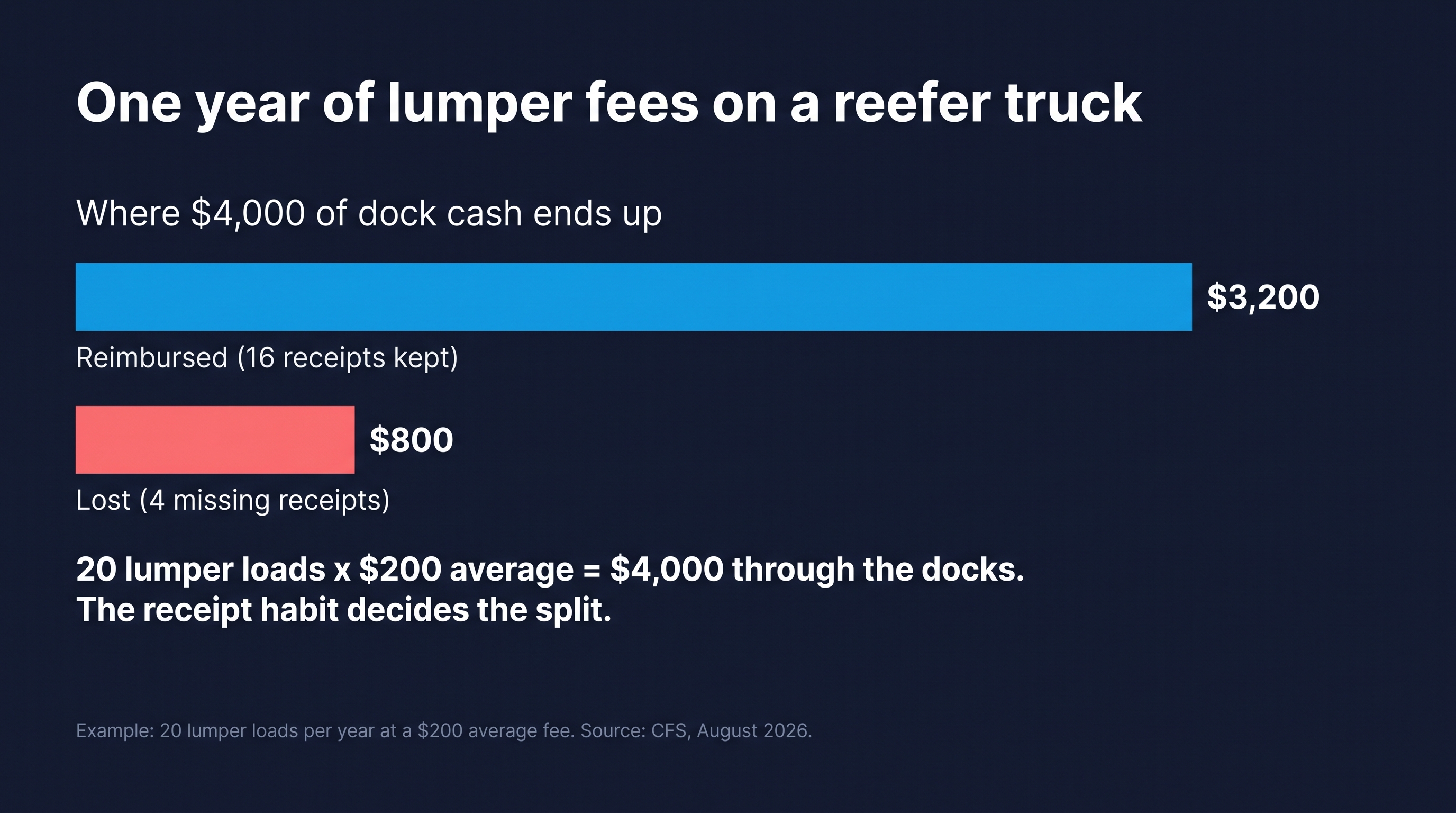
Run one reefer truck through the math. Twenty lumper loads a year at an average $200 is $4,000 of your cash crossing docks annually. Document all twenty and it costs you nothing but float. Lose the receipt on four of them and you donated $800. Pay them all from your own account and wait on net-30 brokers, and you have a permanent $300 to $400 of working capital parked in other people's warehouses, exactly the net-30 cash-flow problem in miniature.
The playbook is short: confirm on the rate con, pay traceably, photograph the receipt, bill it with the load, advance it through your factor when the timing pinches. Lumper fees only cost carriers money when the paperwork breaks.
A lumper is a third-party worker who unloads trailers at receiving facilities, most commonly grocery and food-service warehouses. The lumper fee is the charge for that labor, typically $25 to $500 per load with most between $150 and $400.
Yes, lumper services themselves are legal. What is illegal under 49 USC 14103 is coercing a driver into hiring and paying for unloading help, and the law makes the shipper or receiver responsible for unloading costs they require. You are also entitled to an itemized receipt.
The driver usually pays at the dock, but the cost legally belongs to the shipper or receiver. In brokered freight the carrier bills the broker for reimbursement under the rate con. The driver only truly eats the fee when documentation fails or the rate agreement rolled unloading into the linehaul.
Billed on the load invoice, the reimbursement arrives with the linehaul payment, typically the broker's normal 30-day cycle, or same-day if you factor the invoice. Billed separately and late, it can drift for weeks, which is why same-invoice billing is the rule.
Effectively yes, through a lumper advance: cash to your card at the dock, netted out of the load's settlement. Most trucking factors offer it; limits and fees vary by company, so compare programs in our factoring rankings and get terms in writing.
Most lumper fees land between $150 and $400 per load, and federal law has made them the receiver's responsibility since Congress wrote 49 USC 14103. A reefer truck running twenty lumper loads a year moves about $4,000 through dock crews; the receipt habit is the difference between that being float and being loss.
A lumper fee without a receipt is a donation.
New articles for owner-operators, delivered twice a month.