Getting an MC number costs exactly $300, paid to FMCSA through its Motus registration portal, and takes about four to six weeks from application to active operating authority. That is the whole government price. Every website quoting you $500, $900, or $1,500 to "get your MC number" is charging you a markup to fill out a form the government designed for you to fill out yourself.
This guide walks the real sequence: what an MC number is (and what is changing about it), the step-by-step application through Motus, the two filings that actually switch your authority on, and the honest all-in cost of going from nothing to legally hauling freight, including the parts the filing-service ads skip.
An MC number is your interstate operating authority: FMCSA's grant of permission to haul freight for hire across state lines. It is the credential that makes you a carrier rather than a truck owner. Your USDOT number identifies your company for safety oversight; the MC number authorizes the for-hire business itself. If you are fuzzy on that split, our DOT number vs MC number guide untangles it in full, including who needs which. The short version: leased-on drivers operate under their carrier's authority and do not need their own MC number; independent for-hire interstate carriers do.
Now the 2026 wrinkle. FMCSA has proposed retiring MC numbers entirely and making the USDOT number the single federal identifier, with letter suffixes marking each authority type: a property carrier would show as USDOT 1234567C, a broker as 1234567B. Per FMCSA's own modernization FAQs, that change is a proposal awaiting a future Notice of Proposed Rulemaking, it did not take effect when the new Motus registration system launched, and existing MC numbers will not be replaced. Translation for anyone applying today: you apply the same way, you pay the same $300, and you receive an MC number, with the suffix system arriving whenever the rulemaking finishes. Nothing about the proposal is a reason to wait.
Operating authority (MC number): FMCSA's registration authorizing a company to transport regulated freight for hire in interstate commerce. Distinct from the USDOT number, which identifies the company for safety monitoring. FMCSA has proposed folding authority types into USDOT-number suffixes, pending a future rulemaking; MC numbers are still issued today.
Since May 2026, all registration runs through Motus, FMCSA's replacement for the old URS portal. The application itself is an afternoon of work.
Step 1: Set up your business first. Form the LLC or corporation, get the EIN from the IRS (free, ten minutes online). Applying under a business entity rather than your personal name is standard practice and keeps the authority attached to the company you are building. Where authority fits in the larger launch sequence, budget and all, is covered in our cost to start a trucking company guide.
Step 2: Create your Motus account at motus.dot.gov. The system requires identity verification for the person filing, part of FMCSA's fraud crackdown. Have your driver's license and business details ready.
Step 3: Complete the combined USDOT and authority application. Motus walks you through company details, operation type (for-hire property carrier for most readers), cargo classes, and vehicle info. If you do not yet have a USDOT number, the application issues one as part of the same flow.
Step 4: Pay the $300 through Pay.gov. Per authority type, non-refundable, card or bank draft. This is the only money FMCSA itself collects for the application.
Step 5: Note your numbers and start the clock. You get a USDOT number immediately and an MC docket number shortly after; neither is active yet. What happens next, the protest window and your two required filings, is where new carriers actually stall, so it gets its own section.
Do it yourself before paying anyone to do it for you. Filing services charge $400 to $900 for this exact sequence, and the legitimate ones mostly re-type your answers into the same portal. The exception worth paying for is a compliance service that bundles ongoing obligations (UCR, drug-and-alcohol consortium, IFTA setup), and even then you should know what the $300 form looks like first.
FMCSA charges $300. Everyone charging more is selling you the form. Third-party sites buy ads against "MC number" searches and look official; the real portal is motus.dot.gov and payment runs through Pay.gov. If a site's URL does not end in .gov, you are on a reseller.
The $300 application starts a process; three things finish it.
The BMC-91/91X insurance filing. FMCSA will not activate a property carrier without proof of public liability coverage on file, filed electronically by your insurer, not by you. This is the step to start earliest, because getting insured is slower and vastly more expensive than getting the number: first-year new-authority premiums typically run $12,000 to $20,000 or more for liability, cargo, and physical damage, because you have no safety history for an underwriter to price. Shop it before you file the application; a carrier who cannot place insurance has bought a $300 number that never activates. The premium relief is real but slow: typically 15 to 25% at the one-year mark, better again at 24 and 36 months.
The BOC-3 process agent designation. A blanket process agent company (typically $20 to $40, often free the first year through your insurer or factor) files the form designating someone to receive legal papers on your behalf in every state. Five-minute task; authority cannot activate without it.
The protest period. After your application is published in the FMCSA Register, there is a roughly 18-to-21-day window for the public to protest the grant. For a normal freight carrier nobody protests; the clock still runs. File the insurance and BOC-3 during this window, not after it, and activation is not held up at the finish line.
Add it up and four to six weeks from application to active authority is the realistic timeline. And one more date goes on the calendar the day you activate: every new carrier enters the New Entrant program and gets a safety audit within the first 12 months. It is not part of getting the number, but it is the first appointment the number makes for you.
Get insurance quotes before you file the $300 application. Insurance is the biggest check and the slowest step, and underwriters quote faster when your authority application is imminent rather than aging. File FMCSA, then insurance and BOC-3 inside the protest window, and the whole sequence lands in 4 to 6 weeks.
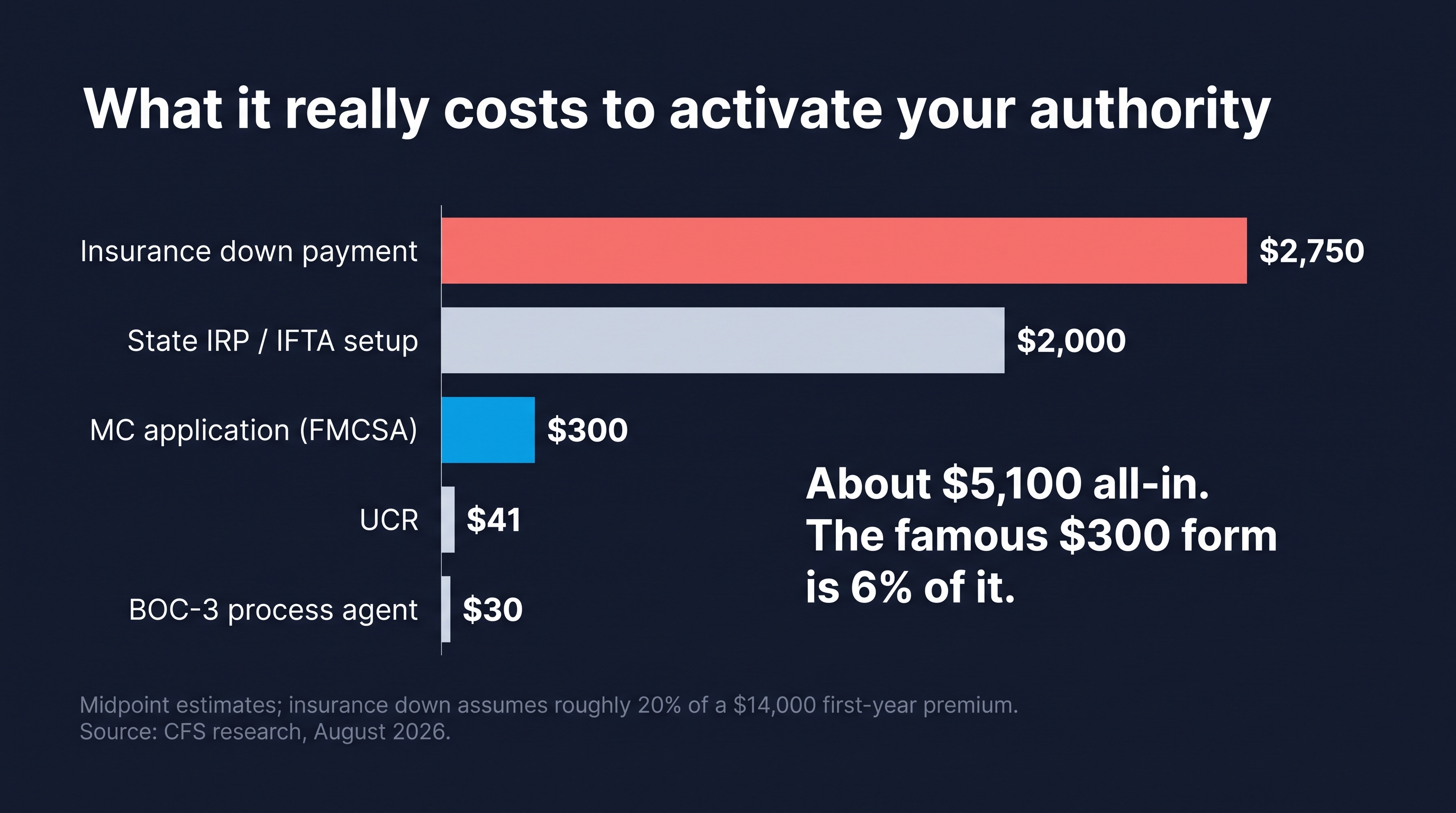
Here is the honest all-in table, with the $300 in context.
The application is $300. The BOC-3 is $20 to $40. Unified Carrier Registration (UCR) runs about $37 to $41 a year for a small fleet at the current bracket. State-side basics like an IRP plate and IFTA setup vary by state but commonly land between $1,500 and $2,500 for one truck. Then the number that dwarfs the table: the insurance down payment. On a $14,000 first-year premium, expect roughly 15 to 25% down, call it $2,000 to $3,500, before a wheel turns. Realistic cash to go from nothing to legally operational, before the truck itself: roughly $4,000 to $6,500, of which the famous MC number is $300.
Then the part no government form warns you about. Your authority activates, you book your first brokered load, and you discover that fresh MC numbers get paid on the slowest terms in the industry while diesel bills daily. Many brokers also hold new authorities at arm's length for their first weeks or months, which thins the load board for you exactly when cash is tightest. This squeeze, and the tools built for it, is covered in depth in our freight factoring for new authorities guide; the short version is that factoring approval runs on your brokers' credit rather than your company's age, which makes it one of the few funding tools that works on day one, as explained in what freight factoring is. When you get to that decision, our 2026 factoring rankings compare the companies that actually serve new authorities well.
Broker wariness of fresh MC numbers fades with age and clean inspections, typically within the first 90 days. Plan the first quarter's cash assuming slower pay and a thinner load board than the averages suggest, and the surprise becomes a budget line instead of an emergency.
Week zero: entity, EIN, insurance quotes in motion. Week one: Motus application filed, $300 paid, USDOT and MC numbers issued inactive. Weeks one to three: protest window runs while your insurer files the BMC-91 and your process agent files the BOC-3. Weeks four to six: authority activates, UCR and state registrations wrap, and you are legal to haul. Somewhere in the first twelve months: the New Entrant safety audit.
The FMCSA application fee is $300 per authority type, non-refundable, paid through Pay.gov. All-in to an operational authority, including BOC-3, UCR, state registrations, and an insurance down payment, realistic cash is roughly $4,000 to $6,500 before the truck.
The number itself is issued within days of applying, but it activates only after insurance and BOC-3 filings plus a roughly 18-to-21-day protest period. Four to six weeks from application to active authority is typical when the filings go in early.
You can apply without owning one, but your authority cannot activate without insurance, and insurers write policies on specific equipment. Practically, you need the truck identified by the time the BMC-91 files.
No. Leased-on drivers operate under the carrier's authority. You need your own MC number when you run under your own authority and book your own freight; the DOT vs MC guide covers the dividing line.
It has proposed to, replacing them with USDOT-number suffixes, but per FMCSA's modernization FAQs the change awaits a future rulemaking and did not launch with the Motus system. MC numbers are still issued today and existing ones are not being replaced.
Yes, routinely, because approval is based on your brokers' credit rather than your company's age. It is one of the few day-one funding tools for a fresh MC; see factoring for new authorities.
$300 is FMCSA's entire fee for an MC authority application. First-year insurance for that same new authority typically runs $12,000 to $20,000 or more. The form everyone worries about is 2% of the real cost of activating it.
The government charges $300 for an MC number. Everyone charging you more is selling you the form.
New articles for owner-operators, delivered twice a month.