Hour three at a dock that promised a 45-minute unload. The receiver is not sorry, the broker is not answering, and your day's second load just became tomorrow's problem. The only question that matters right now: is this time costing you money, or earning it?
That is detention pay, the accessorial that compensates you when a facility holds your truck past its free time. It is the largest waiting-time cost in trucking and the worst-collected: ATRI's research found drivers detained on 39.3% of all stops, at a cost of $11,000 to $19,000 per driver per year. This guide covers what detention pays in 2026, what the law does and does not require, the layover fee that takes over when a delay eats the whole night, and the documentation habit that separates carriers who bill detention from carriers who vent about it.
Detention pay is an hourly fee a carrier charges when a shipper or receiver holds the truck at a facility beyond the agreed free time, the grace period built into the appointment, which is two hours at most facilities. Free time expires, the meter starts, and every hour after that is billable at whatever rate the rate confirmation sets.
Two cousins get confused with it. Layover pay is a flat fee, typically $150 to $300 a night for standard freight and $500 or more for specialized, charged when a delay pushes your unload to the next day entirely; detention bills the hours, layover bills the lost night. Demurrage is the equivalent concept for equipment like containers and rail cars sitting too long, a term you mostly meet in port and intermodal work. On a normal truckload lane, detention and layover are the two that belong in your rate con, and they are both members of the larger accessorial charges family.
Why it exists is simple economics: a truck earns nothing standing still, and your operating clock keeps running while the dock dawdles. Detention shifts part of that cost back to the party causing it, which is also the only mechanism that gives a facility any reason to move faster.
Detention: hourly pay for time held at a dock past free time. Layover: a flat overnight fee when the delay costs you the night, typically $150 to $300. TONU: a flat fee when a dispatched load cancels. Three different clauses; a strong rate con names all three.
No. There is no federal regulation that requires a shipper, receiver, or broker to pay carrier detention. FMCSA has studied the problem for years, and its own Inspector General research linked detention to measurably higher crash risk, because a driver who loses three hours at a dock is a driver racing the hours-of-service clock for the rest of the day. The agency has collected detention data and published research, but studying is not mandating: as of today, no rule sets a detention rate or requires one.
That legal vacuum is exactly why the rate con matters so much. Detention is pure contract money. If your rate confirmation specifies two hours free and $75 an hour after, you hold an enforceable claim, and the conversation with the broker is about arithmetic. If the rate con is silent, you are requesting a courtesy from a party with no obligation, and courtesy pays worse every year of a soft market.
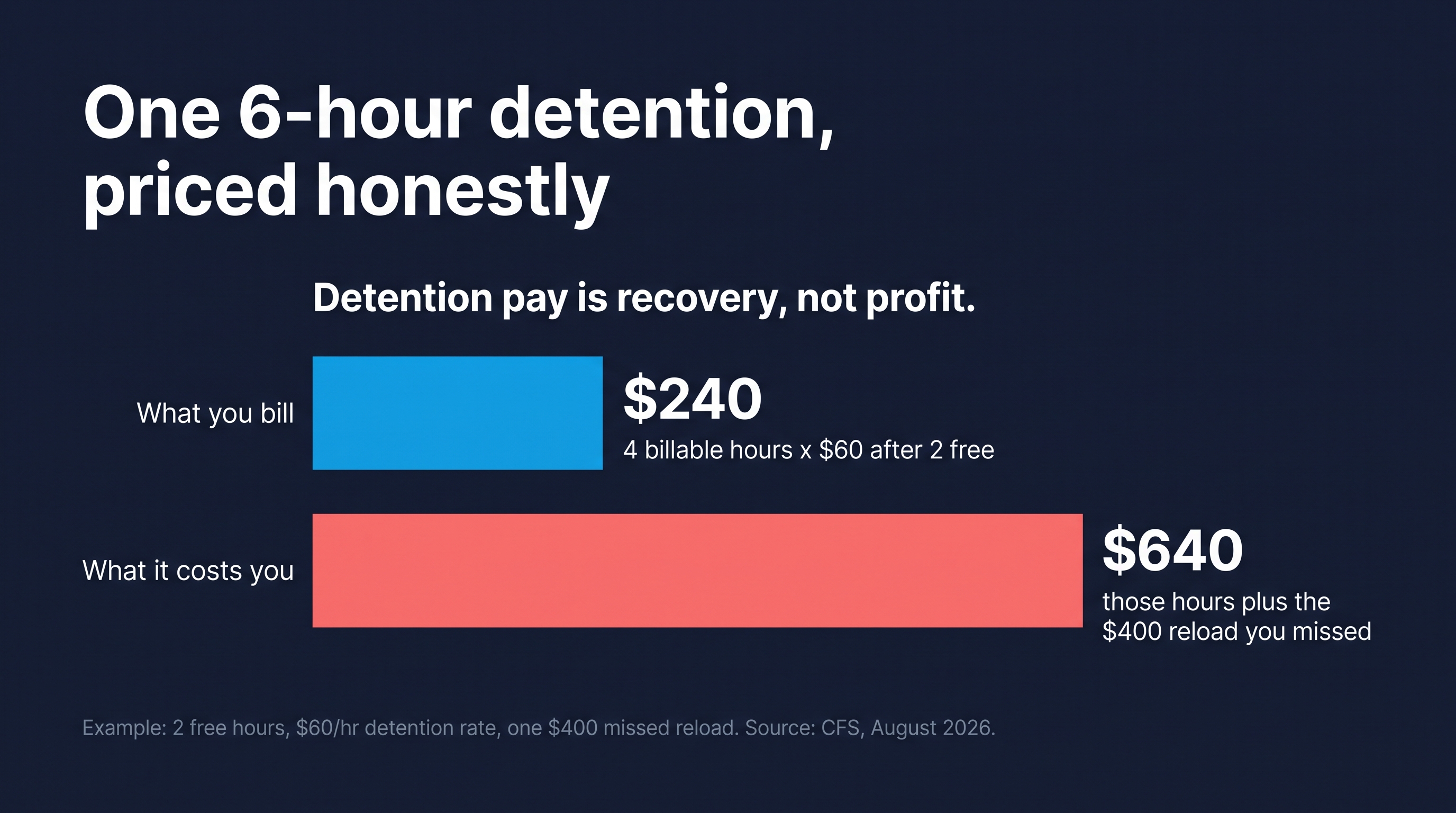
The hours-of-service angle deserves one more beat, because it is the hidden cost that dwarfs the hourly fee. Your 14-hour driving window does not pause while a receiver sits on your trailer. Three dead hours at a dock is three hours of earning capacity deleted from your day, which is how a $150 detention check can stand in for a $400 load you no longer have time to run. Detention pay is compensation, not profit.
If detention terms are not in writing before pickup, you are negotiating after the fact with zero leverage. Verbal promises from dispatch do not survive contact with a broker's accounting department. Free time, hourly rate, and layover terms belong on the rate con, every load.
The market convention: two hours of free time at pickup and again at delivery (some contracts run three), then $50 to $100 per hour for dry van freight, with the soft end of the market quoting $25 and firm contracts at $100. Reefers, tankers, and flatbeds with tarping commonly bill up to $125 per hour, because the equipment and the driver both cost more per idle hour.
Now do the math the way a broker's accounting team will. Six hours at a receiver with two free and $60 an hour on the rate con is a $240 detention line. Real, worth billing, and still not the whole story, because those four billable hours also burned a third of your driving window. If the delay killed a $400 reload, the facility cost you $640 and paid you $240. That gap is why the smartest carriers treat detention pay as partial recovery and chronic-detention facilities as a routing decision.
What should your personal floor be? Price your hour honestly: run your revenue and cost numbers through our freight factoring calculator and you will know what an idle hour actually costs your operation, which turns "is $60 an hour fair?" from a feeling into arithmetic.
Industry scale, for ammunition in that negotiation: ATRI's detention research measured $3.6 billion in direct expenses and $11.5 billion in lost productivity in a single year, 135.9 million hours gone, detention on 39.3% of stops. Nobody at the table can pretend your two free hours are a theoretical courtesy.
ATRI measured 135.9 million hours lost to detention in one year: $3.6 billion in direct costs, $11.5 billion in lost productivity, detention on 39.3% of all stops, and $11,000 to $19,000 per driver per year. The dock's problem is reliably the carrier's bill.
Detention claims die from missing paper, not broker malice. The playbook:
1. Set the terms before pickup. Free time, hourly rate, layover fee, on the rate con. No terms, no claim; this is the step that is actually the negotiation.
2. Timestamp arrival the moment you check in. ELD screenshot, geotagged photo of the gate or guard shack, the facility's own check-in record where one exists. You are building the "in" half of in-and-out.
3. Notify the broker in writing the minute free time expires. Not when you leave, the minute it expires: still at the door, free time ended 1:00 PM, detention accruing per rate con. A notice sent from the dock is a live event the broker can verify with one call; a claim raised at invoicing is a story.
4. Timestamp departure and get the BOL signed with times. Out-time on the paperwork wherever the facility allows; screenshot the ELD again regardless.
5. Bill detention on the load invoice. Named as the rate con names it, hours and rate shown, screenshots attached. Same-invoice billing also matters for funding: factors advance the load invoice, and a detention line on it typically funds with the linehaul, while a straggler detention invoice sent a week later mostly waits on the broker's mercy, or worse, gets treated as unfundable.
6. Chase on a weekly clock. Short, polite, documented, relentless. And keep a private ledger of facilities that detain you; a receiver that costs you three hours every visit is not bad luck, it is a rate problem or a routing problem.
The ELD is your witness. Screenshot arrival and departure before you pull out of the lot, and send the free-time-expired message while the trailer is still at the door. Real-time documentation is the entire difference between billing detention and describing it.
Detention hits your wallet twice. The first hit is the wait at the dock. The second is the wait for the money: detention lines get scrutinized harder and paid slower than linehaul, stacked on top of broker terms that already run net-30 or longer. A carrier who earned detention in March and gets paid in May has loaned the facility's inefficiency to the broker interest-free.
Billing detention on the factored load invoice compresses most of that second wait to a day, which is one of the quieter arguments for factoring while margins are thin. And when a broker simply stops paying, detention included, that is a different problem with its own playbook: what to do when a freight broker does not pay.
Two free hours at most facilities, occasionally three by contract. The clock starts at your scheduled appointment or documented check-in, whichever the rate con specifies, and detention accrues per hour once free time expires.
$50 to $100 per hour for dry van freight in 2026, with reefer, tanker, and tarped flatbed work commonly up to $125. The soft end of the market quotes $25; your rate con sets your actual number.
No. No federal regulation mandates carrier detention pay; FMCSA has researched the problem but not set a rule. Detention is contract money created by your rate confirmation, which is why the terms belong in writing before every pickup.
A flat fee, typically $150 to $300 a night for standard freight, charged when a delay pushes your load to the next day. Detention bills the hours; layover bills the lost night. Specialized freight layovers can run $500 or more.
On the same invoice as the load: the detention line named as the rate con names it, hours and rate shown, ELD timestamps and any facility records attached, following a written notice sent when free time expired. The full documentation routine is in our accessorial charges guide.
Track which facilities detain you. A receiver that costs three hours every visit is not bad luck; it is data. Chronic-detention stops either pay a higher rate, accept firm detention terms, or lose the lane. That ledger is worth more than any single detention check.
Free time is only free for the receiver.
New articles for owner-operators, delivered twice a month.