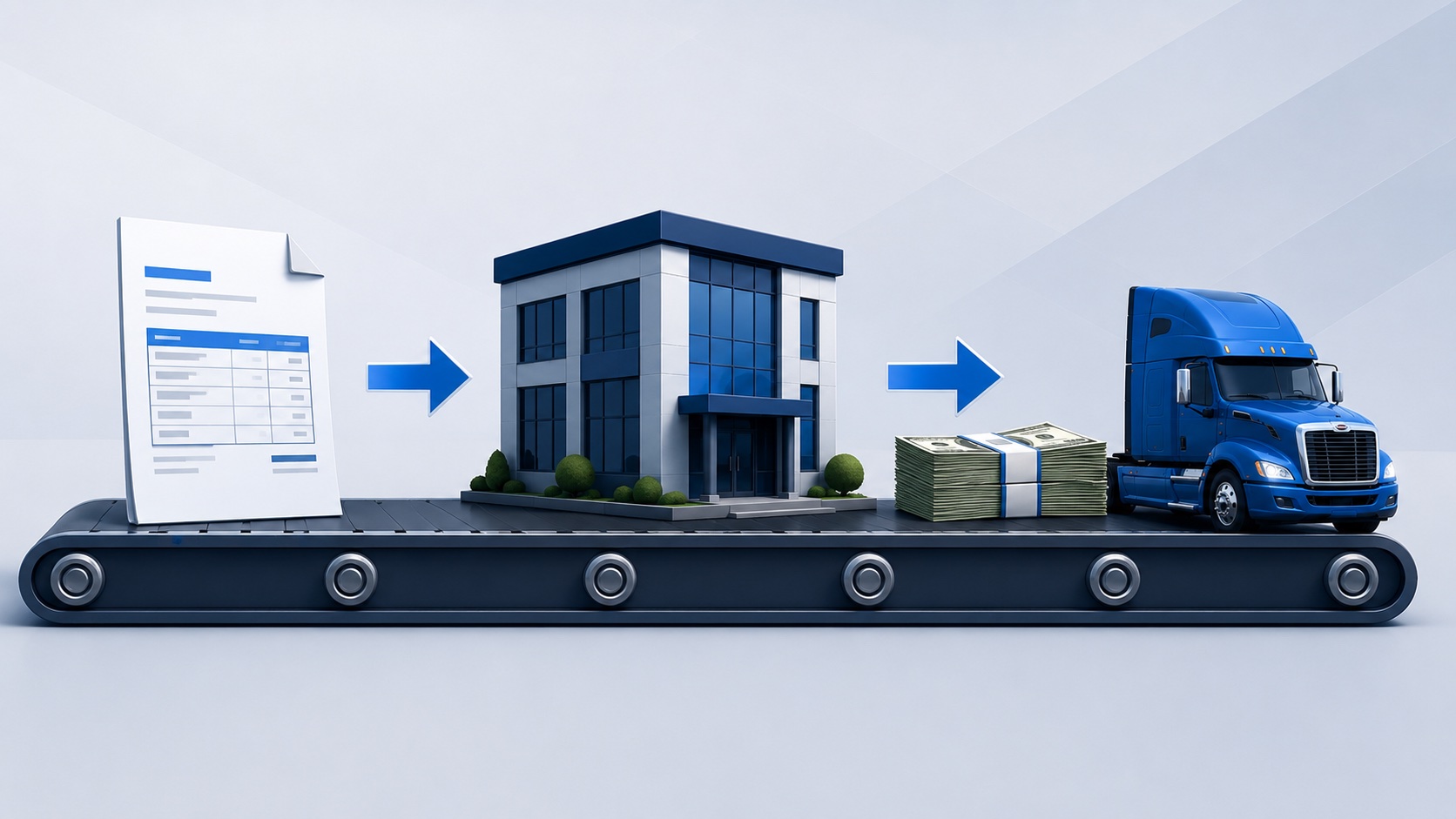
Non-recourse factoring is the seatbelt of trucking finance: you pay a little extra every month hoping you never find out what it was for. Then a broker files bankruptcy owing you $8,000, and the difference between recourse and non-recourse stops being a vocabulary quiz. This guide names the companies that actually sell no-chargeback protection in 2026, prices the premium in dollars, and tells you honestly who should skip it.
Non-recourse factoring means the factoring company absorbs the loss when a broker fails to pay for credit reasons, instead of charging the invoice back to you. That is the whole product: broker bankruptcy, insolvency, or simple non-payment stops being your problem.
Here is the industry's dirty little asterisk: most non-recourse programs are not that. Standard contracts carve out broker insolvency, the exact scenario you bought protection for, or quietly convert to recourse after 60 or 90 days. When we say a company below offers real protection, we mean the coverage survives the fine print. Our recourse vs non-recourse guide covers the mechanics in full; this page is about who to actually call.
Chargeback: when a factoring company takes back the money it advanced you because the broker never paid. Recourse contracts allow it; true non-recourse contracts do not, for credit failures.
1. OTR Solutions sets the standard the rest get measured against. True Non-Recourse means no chargebacks even if the broker goes bankrupt or never pays past 90 days, and it pairs with instant 24/7 funding and month-to-month terms. It is a big part of why OTR holds the #1 spot on our rankings; the full OTR review prices the whole package.
2. Riviera Finance has been a full non-recourse specialist since 1969. Every account is non-recourse; it is not an upsell, it is the product. The trade is a slower stack: same-day funding on business days, no 24/7 rail.
3. Apex Capital offers a real non-recourse program you choose at signup, backed by the best service record we track and month-to-month terms. Confirm in writing which program your quote covers.
Also real, with homework: eCapital and Triumph both offer non-recourse options; both are quote-dependent, so get the coverage terms and the carve-outs in writing. Thunder Funding, which we have reviewed but not yet scored, builds broker-insolvency protection in by default on its 90-day contracts.
Some contracts convert non-recourse to recourse after 60 or 90 days of broker non-payment, which quietly deletes the protection when you need it most. Ask specifically what happens at day 91.
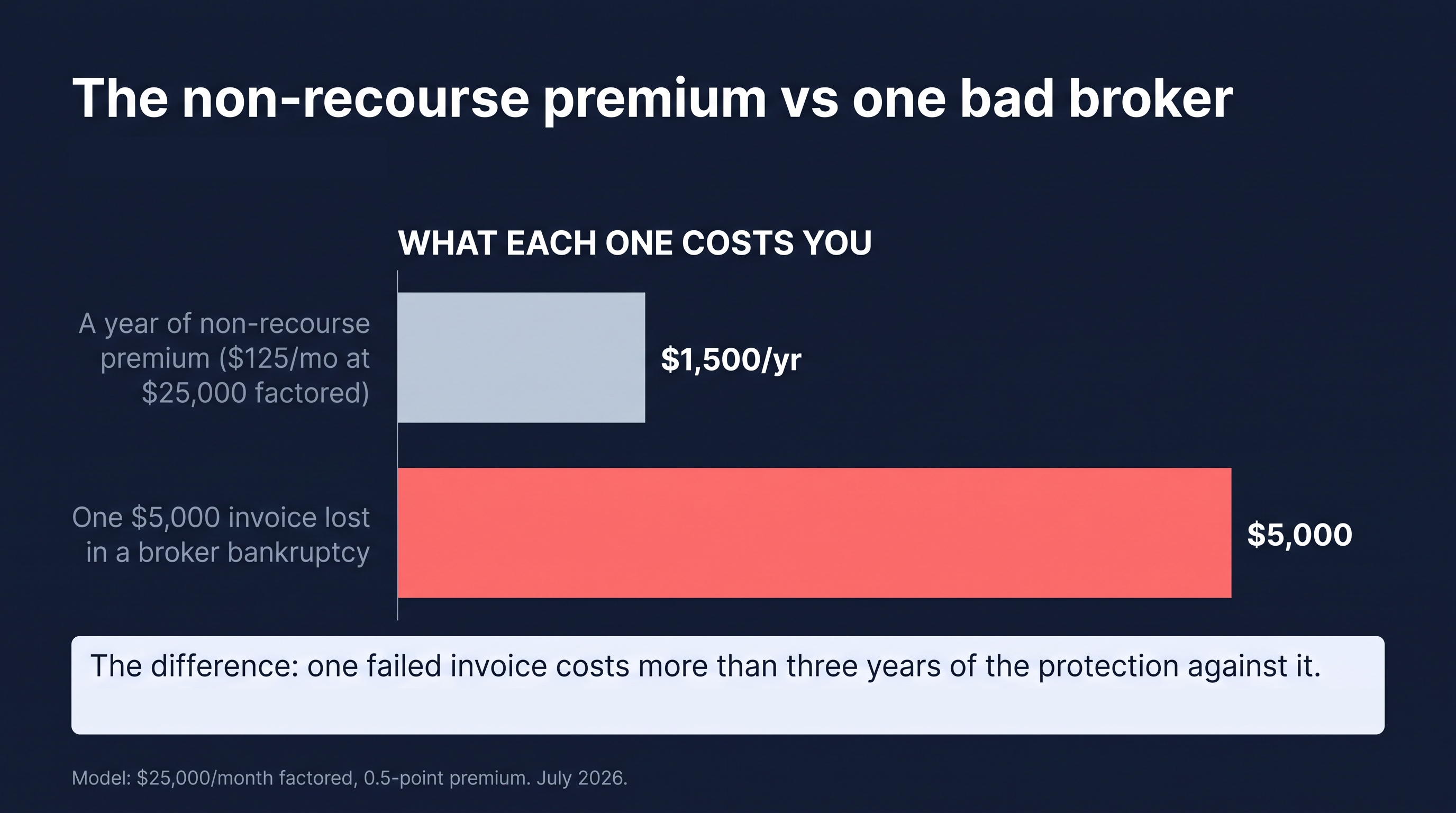
The premium typically runs half a point to a full point above recourse pricing. On $25,000 a month factored, half a point is $125 a month, $1,500 a year. That is the number to hold in one hand.
In the other hand, hold one bad broker. A single $5,000 invoice that dies in a broker bankruptcy erases more than three years of that premium in one afternoon, and broker failures cluster in exactly the freight markets where you have the least cushion. One of the owner-operators we profiled spent three months chasing $2,900 from a broker who simply stopped paying; that story is the premium's sales pitch. Price it like insurance: against your broker mix, not your optimism.
Ask every factor the same one-line question: if the broker files bankruptcy 95 days after delivery, who eats this invoice? The answer, in writing, is the whole comparison.
Every non-recourse program on this page insures broker credit failure, not your paperwork. If the load arrived damaged, the BOL is missing a signature, or the broker disputes the rate, that invoice is your problem at OTR, Riviera, Apex, and everyone else. No factor sells protection against your own filing cabinet.
The practical read: non-recourse plus clean paperwork is close to bulletproof. Non-recourse plus sloppy paperwork is a premium you are wasting. Scan your rate confirmations, get signatures on everything, and the protection does what you bought it for.
Price the premium against your broker mix, not your fear: count how many new-to-you brokers you hauled for last quarter. If it is more than a third of your loads, buy the protection. If your top five brokers are years-old relationships, credit checks may cover you.
Pay for it if: you run spot-market freight for brokers you have never met, you are a new authority where one failed invoice can end the business, or your margins cannot absorb a four-figure clawback. The premium is small against the tail risk.
Skip it if: you haul for a handful of long-standing brokers or shippers with years of clean payment history, and you run credit checks anyway. Recourse factoring with free broker credit checks (Bobtail's model) manages the same risk with discipline instead of insurance.
Either way, run the numbers through our factoring calculator with both quotes in hand.
Usually yes for spot-market owner-operators: one truck has no cushion for a $5,000 clawback, and the premium runs about $125 a month at typical volume. Established carriers with vetted repeat customers can reasonably skip it.
True Non-Recourse is OTR Solutions' name for coverage with no chargebacks even in broker bankruptcy or 90-day non-payment. Many generic non-recourse programs carve those exact scenarios out, which is why the contract language matters more than the label.
No. Disputes, shortages, and paperwork problems stay your responsibility at every factoring company. Non-recourse covers the broker's credit failure only.
Recourse, by roughly 0.5 to 1 percentage point. Whether the discount is worth carrying the credit risk yourself depends entirely on your broker mix.
Riviera Finance and Thunder Funding build it into their standard product rather than selling it as an upgrade. The cost is inside the base rate either way; nothing in factoring is free, just differently labeled.
Chargebacks do not arrive on your schedule: they land as deductions from your next funding, which is why one failed invoice can wreck an otherwise good week. Factor that timing into how much protection you want.
Non-recourse is the only factoring feature you buy hoping to waste your money on it.
New articles for owner-operators, delivered twice a month.