Monthly minimums are the factoring industry's quietest tax on being human. Take two weeks of home time, lose a customer, hit a slow February, and a minimum-volume clause charges you fees on freight you never hauled. For seasonal carriers, part-timers, and anyone who factors selectively, the no-minimum companies are not a preference. They are the only shape that fits. Here is who genuinely qualifies in 2026, who hides minimums in the fee schedule, and what the trap costs in dollars.
A minimum-volume clause obligates you to factor a set dollar amount each month, or pay fees as if you had. Run $12,000 through a contract with a $20,000 minimum at 3 percent, and the factor can bill fees on the missing $8,000: about $240 for freight that never existed.
The clause exists to guarantee the factor's revenue against your variability, which is precisely backwards for a small carrier: your variability is the thing you need the contract to survive. Minimums also compound with 12-month terms, because the slow months that trigger fees are the same months you cannot afford an exit penalty. Our contract red-flags guide shows the exact clause language to look for.
Minimum-volume clause: contract language obligating you to factor a set dollar amount monthly or pay fees on the shortfall. Also appears as minimum fee guarantees or volume commitments.
Per our verified rankings data, four companies clear the bar cleanly.
1. OTR Solutions: no monthly minimums, no volume commitments, month-to-month, and 24/7 instant funding. The full review covers the whole stack.
2. Bobtail: no minimums plus true per-broker selectivity, a published flat fee, and a 90-day risk-free cancel. The natural fit for carriers who factor some customers and not others.
3. Apex Capital: no monthly minimum volume fees, month-to-month terms, and the industry's best-liked service. Note the all-invoices-per-broker rule: you pick which brokers to factor, not which loads within a broker.
4. Love's Financial: month-to-month with no minimums per our rankings data; business-hours funding is the trade.
Read the fine print at: RTS Financial (monthly minimums plus a 12-month term), WEX Fleet One (volume-based pricing that functions as a commitment), and eCapital (a 3-month minimum term and a fee schedule that rewards careful reading). The rankings table marks minimums for all seven.
Per-invoice fee floors are minimums in disguise: a $10 floor on a $300 invoice is a 3.3 percent surcharge before the rate even applies. Small-invoice carriers should read that line twice.
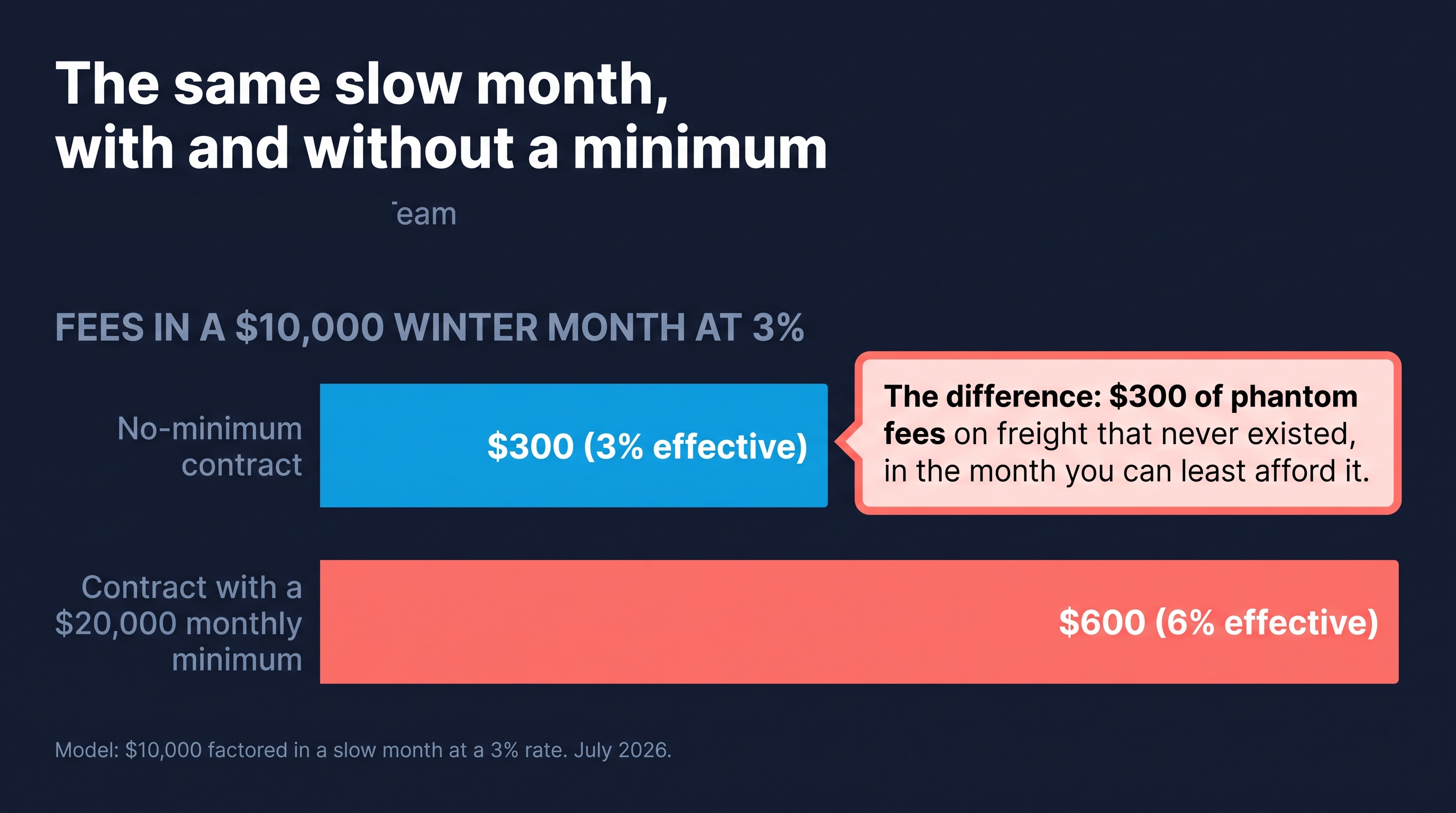
Model a seasonal carrier who runs $25,000 a month from March through October, then $10,000 through winter. On a contract with a $20,000 monthly minimum at 3 percent, each winter month bills as if $20,000 moved: $600 in fees on $10,000 of actual freight, an effective rate of 6 percent in exactly the months margin is thinnest. Four winter months of that is $1,200 paid on phantom volume.
The no-minimum version of the same winter: $300 a month, 3 percent, no penalty for the season being the season. Same carrier, same freight, $1,200 apart. That is the entire argument, and it is why our spot vs contract factoring guide keeps pointing seasonal operators the same direction.
Seasonal carriers: renegotiate in your strong season, not your weak one. A factor watching $30,000 months says yes to things a factor watching $9,000 months will not.
The clause travels in a pack. Check for its friends: termination fees (a no-minimum contract you cannot leave still owns you), deposits (money of yours that returns on their timeline), per-invoice fee floors (a minimum wearing a disguise at small invoice sizes), and auto-renewal windows (miss 60 days and the flexible contract is suddenly a year long).
The clean test is one sentence: if I factor nothing at all next month, what do I owe you? The right answer is zero, in writing. Every company in our top four above passes that test.
Ask the one-line question before signing: if I factor zero dollars next month, what do I owe you? The only acceptable answer is zero, in writing.
Any carrier whose volume breathes with the seasons is a fit for no-minimum factoring; OTR Solutions, Bobtail, Apex, and Love's are the four that genuinely deliver it in 2026. Pick among them on the tiebreakers that fit your operation: OTR for 24/7 funding and non-recourse, Bobtail for published pricing and selectivity, Apex for service, Love's for the fuel bundle. The full rankings put them side by side.
Per our July 2026 verification: OTR Solutions, Bobtail, Apex Capital, and Love's Financial run true no-minimum programs. RTS Financial carries monthly minimums, and several others embed volume expectations in pricing.
Typical contracts bill the fee on the shortfall as if you had factored it: a $20,000 minimum met with $12,000 of freight can cost about $240 in phantom fees at 3 percent.
With selective programs, yes: Bobtail allows per-broker selection and HaulPay factors invoice by invoice. Apex requires all invoices from each broker you choose to factor.
Not systematically: OTR and Bobtail sit at the top of our rankings with competitive rates and no minimums. The minimum is a business-model choice, not a discount you are receiving.
No: a minimum term commits your time, a volume minimum commits your dollars. eCapital's 3-month term is short for the industry, but check both clauses; they stack.
No minimums pairs naturally with selective factoring: factor the slow-paying brokers and keep the quick-pay ones whole. That combination is what makes a seasonal or part-time authority financially livable.
A minimum-volume clause is a bet that your business will never have a bad month. Never take that bet.
New articles for owner-operators, delivered twice a month.