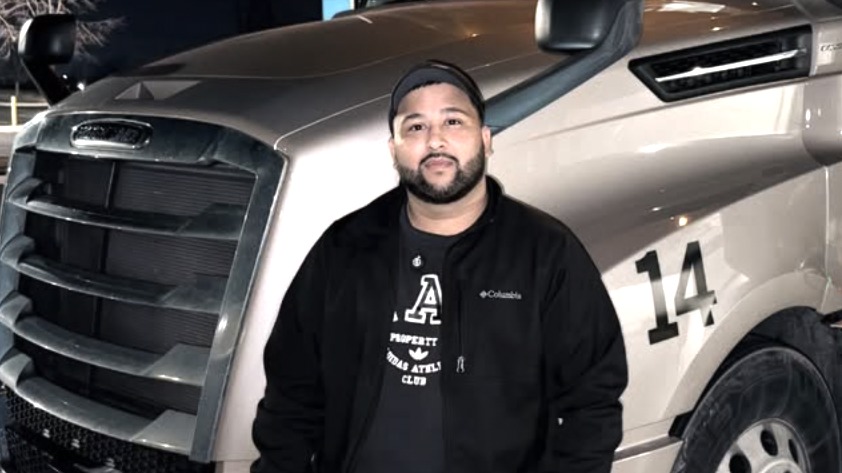
Alex Nino is a 26-year-old refrigerated produce hauler from Dinuba, California, a small town near Fresno. He got his CDL in early 2020, drove six years for his uncle's Dinuba-based operation, and became a leased-on owner-operator in February 2026 running a 2023 Peterbilt 579. Along the way he became one of the most-watched truckers on the internet: 2.08 million YouTube subscribers, roughly 2.8 million on TikTok, and coverage in Commercial Carrier Journal and Overdrive as one of the trucking creators "watched by millions every single day."
This story draws on Alex's own YouTube channel (yes we watched all 260 of his videos), an interview he gave on the A Toast To Life Podcast in March 2023, a 2022 Tubefilter profile, and FMCSA registration records. Every quote below is his own words.
In 2017, a warehouse worker in Dinuba, California took a blank piece of paper and wrote himself a fake check. From: the CEO of YouTube. To: Alex Nino. Amount: $10,000. He put it under his bed and went back to loading trailers for $700 every two weeks.
The first real check from YouTube arrived five years later. It was just short of the number he wrote.
Today Alex Nino has 2.08 million YouTube subscribers, around 2.8 million followers on TikTok, and nearly a billion total views, all built on videos of one job: hauling goods. And in February 2026, after six years of driving for his uncle's small fleet, he finally put his own name on the business and became an owner-operator.
Here's the part worth studying. The audience was never the exit plan. It was the funding plan. Alex spent four years openly telling his viewers he would take the money social media paid him and put it into a truck, then waited until the market, his savings, and his family situation all lined up before he did it. This is how a produce hauler used two million subscribers to buy his way into the hardest freight market in years, on purpose.
Alex grew up in Dinuba, one of two kids. His dad was not a trucker. The trucking in the family came from his uncle Miguel, who went from company driver to owning nine trucks, and whose rigs Alex remembers climbing into at family parties as a kid, thinking, in his words, "I would never drive this thing."
Through high school, Alex worked at McDonald's. At 18, two months after graduation, his girlfriend Layla (now his wife) had their first son. The morning his son was born, Alex got a call offering him a warehouse job shipping medical and dental products. He took it and stayed nearly three years.
In April 2019, he was fired. Twice he had forgotten to pack ice into temperature-sensitive shipments, and each mistake cost the company over $4,000. He was 21, with a second child on the way. "I couldn't save anything to save my life," he said of that stretch. He cashed out his small 401(k) to cover rent, then sold his Infiniti G35 for $7,000 to keep covering it. He remembers looking in the fridge and seeing not much in it.
His uncle had been making the same offer for years: "Quit your job, I'll help you go to school... and then I'll give you a job." Alex had always said no. He was intimidated by the trucks. This time his dad pushed him to say yes, and his uncle paid for CDL school without hesitating. One condition came with it: stop smoking weed, because truck drivers get drug tested.
While in school, Alex washed his uncle's six trucks, from seven in the morning to five in the afternoon, for $200 to $300 a day. The day he got his license in early 2020, he started driving.
He was not planning to film any of it.
Alex hauls refrigerated produce, and only in California. His days are built around a repeatable loop: pick up pallets at packing houses around the Central Valley (Reedley, Dinuba, Visalia, Selma), build toward a full trailer, then run it up to the Bay Area produce markets at night. He sleeps in the truck, delivers in the early morning, and often picks up return freight on the way home. His target is to leave for the Bay with 22 to 24 pallets, "because that's going to pay the best."
The freight comes through family. His uncle Miguel's company, M Nino Trucking Inc of Dinuba, dispatches the loads, and Alex is paid a percentage of each one. As an owner-operator his percentage went up. A full 24-pallet load to the Bay pays him roughly $2,300 to $2,400.
His truck is a 2023 Peterbilt 579 with a Cummins X-15, bought used off a dealer lot in Fort Smith, Arkansas in December 2025. Alex currently runs under his uncle's authority as a leased-on owner-operator while his own paperwork processes; in February 2026 he registered Vamonos Trucking as his business name and filed for his own MC and DOT numbers.
One thing you will not find in his operation: a factoring company. Because his freight comes through a family carrier that pays him a direct percentage, there are no broker invoices to wait on. That makes Alex unusual. Most new owner-operators leave a family-style arrangement or a company seat and walk straight into 30-to-45-day broker payment terms, which is exactly where cash flow tools like freight factoring enter the picture. If that is the situation you are walking into, the OTR Solutions review shows what the company at the top of our rankings charges to close that gap, and our factoring calculator turns your monthly invoice volume into an actual fee. We'll come back to that in the lessons.
And then there's the second paycheck. Alex's YouTube channel, TikTok, sponsorships, and a merch brand called Vamonos Clothing form an income stream that, by his own telling, once out-earned his driving. He kept driving anyway.

What his uncle's six-truck fleet pays in diesel, tags, and fees before hauling a single load, as Alex reports it.
The chart below tells two stories at once. The line is his audience. The markers are his trucking career, and the interesting part is how deliberately the second followed the first.
The line was flat for two years while Alex drove and posted comedy skits that went nowhere. It bent in late 2021 when he pivoted to trucking content, went vertical after a December 2021 video of his son went viral overnight, and crossed 300,000 subscribers within months. First YouTube paycheck: March 2022. One million subscribers: spring 2023. Then, with the audience compounding in the background, came the purchases in order: house in February 2024, truck in December 2025, owner-operator status in February 2026.
Four decisions drove that sequence. We'll work through each of them.
2019: The warehouse firing
Fired at 21 with a second child on the way; his uncle offers to pay for CDL school.
2020: CDL in hand
Starts hauling produce for his uncle the same day he gets his license.
2021: The viral video
A late-night clip of his son passes a million views overnight; trucking content becomes the channel.
2022: First YouTube paycheck
Five years after writing himself a fake $10,000 check, the real one arrives.
2023: One million subscribers
Keeps hauling produce anyway.
2024: The house comes first
Buys the house in February, and publicly passes on buying a truck in the down market.
2025: The truck
Buys a used 2023 Peterbilt 579 in Arkansas in December, at recession pricing.
2026: Owner-operator
Registers Vamonos Trucking in February and runs his first loads on his own dime.
Today.

Growth went vertical after the December 2021 viral video; the house, the truck, and the owner-operator jump followed in that order.
Four things drove Alex's path from fired warehouse worker to owner-operator. The first was a second income stream that made the truck purchase survivable. The second was a family on-ramp that removed the three biggest startup risks: training cost, freight, and authority. The third was timing: he publicly refused to buy during the 2024 freight recession, then bought when used trucks got cheap. The fourth was freight mastery: six years on the same produce loop before his name was on the risk. Each one made the next one safer.
| Growth Lever | |
|---|---|
| 1 | The Second Paycheck Came First: A second income stream became the capital cushion that made the truck purchase survivable |
| 2 | The Family On-Ramp: Paid CDL school, guaranteed freight, and leased-on authority removed the three biggest startup risks |
| 3 | Saying No in 2024: He publicly passed on buying during the freight recession, then bought when trucks were cheap |
| 4 | One Lane, Mastered: Six years on the same produce loop meant he became an owner-operator on freight he already knew cold |
Alex's first trucking TikTok flopped. Five to ten views in a couple of hours. He screenshotted it and sent it to the friend who had told him to try trucking content, as proof it wouldn't work.
Then one morning at 5 a.m. he filmed himself filling out his logbook, posted it, and woke up to 40,000 views. "Okay," he remembers thinking, "maybe people are interested in this." He leaned in: point-of-view driving videos with voiceover, truck-stop food reviews, overnight "truck camping" in the sleeper. No gear. "I literally started with my iPhone strapped to my forehead," he said, held on by a rubber band he took off equipment in the truck.
The numbers moved fast once the format clicked. Under 1,000 YouTube subscribers in early 2021 became roughly 300,000 by mid-2022, with monthly views jumping from under 20,000 to over 30 million, according to a Tubefilter profile published that June. By December 2024 he counted about 2 million on YouTube, 2.5 million on TikTok, and nearly a million on Instagram.
Here's what makes this a business story instead of an influencer story. From the first big checks, Alex framed the money as trucking capital, on camera, over and over:
"Social media isn't forever, so why not take advantage and invest my money into something that I love doing already."
Most creators who blow up quit their day job. Alex kept hauling produce through five years of channel growth, because the channel existed to fund the trucking, not replace it. When the truck finally came, a slow first quarter couldn't sink him; the second paycheck was still landing.
To be clear about the takeaway: it is not "start a channel." Alex's media income took five years of nightly editing to build, and for every creator who breaks through, thousands post into a void. The transferable move is the structure, not the platform. Any durable income that isn't the truck (a working spouse's paycheck, a side business, rental income, even staying part-time on a company seat while your truck earns) changes the risk math of your first year with your own equipment, because the worst months can't starve you out.
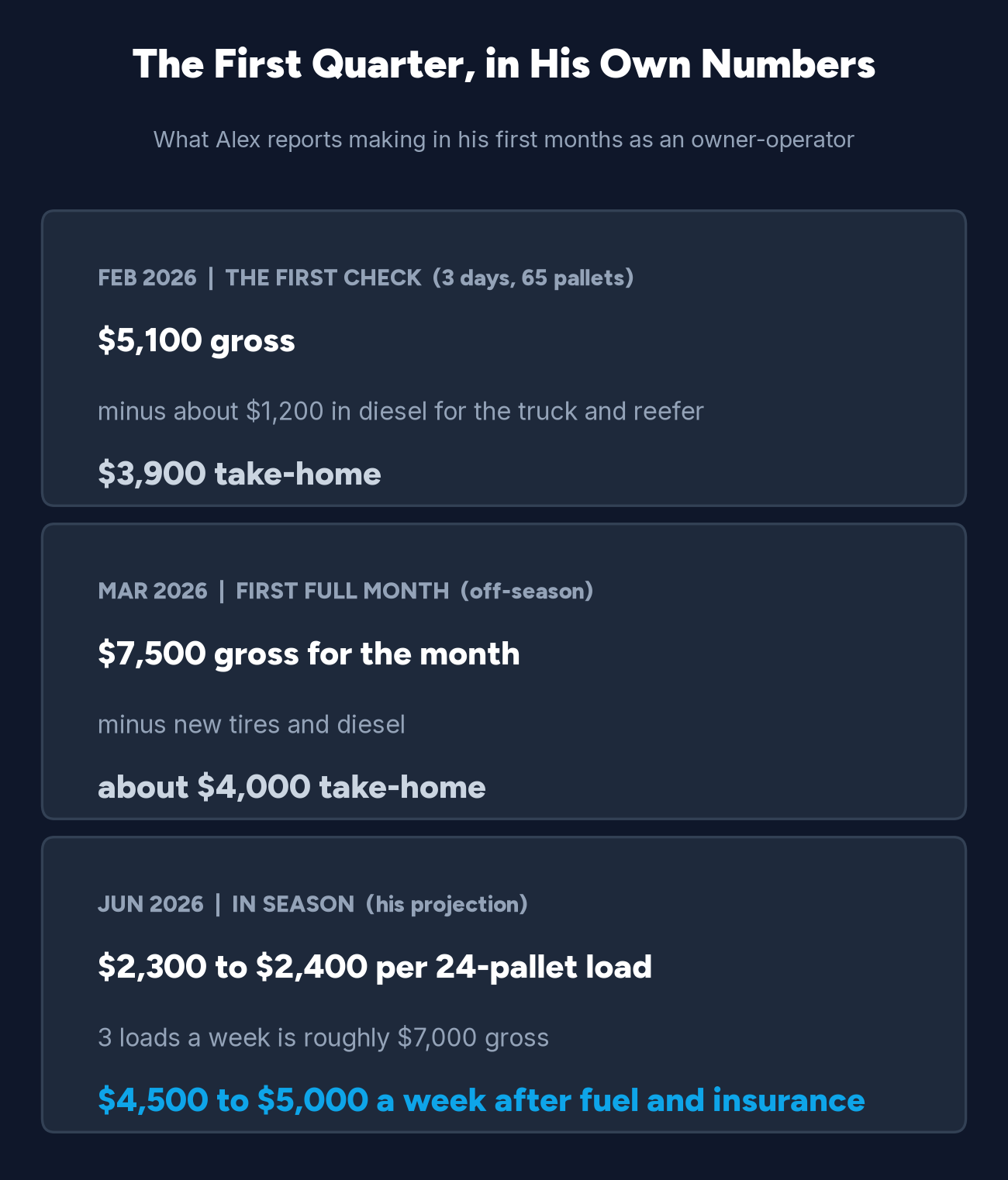
Alex's self-reported first quarter: a $3,900 first check, a $7,500 slow month, then in-season projections near $5,000 a week.
"You can turn nothing into something."
Strip away the subscriber counts and Alex's trucking career is a textbook version of the lowest-risk path into ownership that exists in this industry: come up inside a small family carrier, then lease on with them when you buy.
Look at what the arrangement removed. Startup cost: his uncle paid for CDL school outright. Job risk: he started driving the same day he got his license, with a guaranteed seat. Freight risk: six years later, when he bought his own truck, he kept running the same dispatched loads at a higher percentage instead of hunting load boards with a new MC that no broker wants to touch. Authority risk: he runs under his uncle's DOT while his own MC and DOT applications process, so there was no revenue gap while paperwork cleared.
Even the truck came through the family machine. In December 2025, his uncle bought two used 2023 Peterbilt 579s off a lot in Fort Smith, Arkansas, and gave Alex a choice: take over his old white truck, or run one of the new ones. "I'd be an owner operator but using his equipment," Alex explained to his viewers while weighing it.

None of this was luck he stumbled into. It was a relationship he maintained for a decade, working inside someone else's operation and learning how it ran. His uncle went from company driver to nine trucks; Alex watched the whole climb from the passenger seat and calls him the reason he wanted to own at all. "Once you're an owner operator and your business is doing good, then your bank account's going to be doing good," Alex said, describing what watching his uncle taught him.
If you don't have an uncle with nine trucks, you can still copy the structure: lease on with an established carrier for your first year of ownership instead of getting your own authority on day one. You'll give up a percentage, and in exchange someone else carries the freight relationships, the compliance load, and often the insurance headaches while you learn what your cost per mile actually is. Box Truck Bros lived the version without a family on-ramp: 90 days of brokers refusing a new MC, three Amazon Relay benchings, and a business rebuilt around self-dispatch.
By the end of 2024, Alex had the money, the audience, and four years of experience. Viewers were asking constantly when he would buy a truck. In a December 2024 Q&A, he answered, and the answer was no:
"The rates are down, a lot of people aren't making money, a lot of people are selling their trucks... it's not the right time for me to actually buy a truck and get myself in debt."
Sit with how unusual that is. The classic new owner-operator mistake is buying at the top, when rates are hot and trucks are expensive, then drowning when the market turns. Alex did the inverse: he waited through the down cycle, let other people's repossessed and offloaded equipment flood the used market, and bought a three-year-old Peterbilt in December 2025 at recession pricing. The trucks he walked past on that Arkansas lot, he noted, run "$100,000 to $200,000," and buyers get their money back only if the truck stays working.
The discipline showed in his sequencing, too. In the March 2023 podcast he laid out the order in advance: "I want to get my house first and then buy the truck." He closed on the house in February 2024, then bought the truck 22 months later. Housing costs locked before business debt added.
He knew exactly what he was walking into, and said so before his first slow month, not after. Going in, he expected the winter to be thin, and when March 2026 grossed just $7,500 he told his audience, "I did go into this knowing that this was most likely going to happen. But hey, you got to have the downs to get back up."
The takeaway is not "try to time the market perfectly." It's that the right time to buy a truck is a function of your reserves and the used-truck market, not of your impatience. Alex was ready in 2024 by every emotional measure and still waited 12 more months because the numbers said wait. That takes discipline. Rohit Handa sized his reserves at $35,000 before he bought a truck, and it is why a deadbeat broker and a fuel spike never threatened his company.
Alex became an owner-operator on the exact freight he had hauled for six years: same packing houses, same Highway 99 and I-5 corridors, same Bay Area produce markets, same seasonal rhythm. Day one of ownership, the only thing that changed was whose name was on the risk.
That mattered immediately, because produce is unforgiving freight. Reefer loads wait on cooling: in summer, freshly picked product goes into the cooler and can take four to eight hours to come down to shipping temperature, and, as Alex puts it, "that's why a lot of people lose patience with reefers and they quit." A single pallet can be worth about $4,000, and as an owner-operator, damage now comes out of his side of the ledger. The Bay Area markets even charge entry fees; his uncle spends around $300 a night in gate fees depending on how many trucks go up.
Alex knew all of it before he owned any of it. He knew winter would be slow because he'd driven five slow winters. He knew which packing houses load fast and which leave you sitting (his record wait is about 18 hours). He knew the 22-to-24-pallet math that makes a Bay run worth the diesel. There was no learning curve stacked on top of the debt.
There's a quiet warning in this lever, too. Freight knowledge concentrated in one lane is powerful and fragile at once. Alex once told a story from a driver he met at a truck stop: a produce hauler of 30 years who chatted too freely with a stranger about his pickups and his per-pallet rates, then watched his work dry up as the man poached his account. "Dealing with people in this industry is like dealing with some snakes," Alex concluded. "It's always best not to share everything."
The replicable principle: your first truck should run freight you already understand at the operational level, not freight a YouTube video told you pays well. Every unknown you carry into ownership (lane, shipper behavior, seasonality) is a cost you haven't priced yet.
Alex's story reads smooth in summary. It wasn't lived that way.
The first night he ever slept in the truck, he called his brother-in-law, who also drives for the operation, and cried. "The first night I spent away from them was probably one of the hardest nights I've ever had," he said of leaving his wife and kids at home, even though "home" was rarely more than a few hours up the road. His brother-in-law told him it had happened to him too.
The job has taken people from him. His CDL trainer later died of health problems Alex ties directly to the trucker lifestyle and diet. Alex himself went into trucking weighing 108 pounds from the stress of the broke years, then swung the other way once the money came.
The heaviest stretch came at the peak, not the bottom. In February 2026, in the same video where he announced his owner-operator milestone, Alex told his audience that the previous year and a half had been "a really, really dark path": depression, drinking, weight gain, no motivation, his lowest stretch since 2017. He bought a Bible despite never being religious, quit drinking, and started working out. "I feel alive. I feel happy," he said. He has been posting on a consistent schedule since.
The business side has bitten him, too. In early 2026 he outsourced fulfillment of his Vamonos Clothing merch brand to a Los Angeles warehouse. Orders went unshipped for weeks, restocks stalled, and over 100 hats plus stacks of tees disappeared overnight with no camera footage. He moved fulfillment back in-house with family. "Can't always trust everyone that you get into business with," he told viewers, calling it one of the biggest holes he ever dug himself into.
And ownership itself opened slow: that first March grossed $7,500 against tires and diesel, netting him around $4,000 for a month of being available. He'd planned for it. It still wasn't fun.
Every stage of this story, the truck, the house, the business name on the door, traces back to one video Alex almost didn't post.
It was December 12, 2021. Alex had been grinding out trucking clips for a few weeks, and that night he had a video of his oldest son dancing on the truck's countertop. It wasn't scheduled. He posted it at around 11:30 p.m. mostly because his son wanted him to, and went to sleep.
He woke up to over a million views.
"After that it was kind of just like uphill," he said. The video eventually passed 30 million views. Influencers started following him. Every video after it pulled numbers he wasn't used to. Within three months, the kid who once recorded Modern Warfare clips on his mom's Walmart camera got his first YouTube paycheck, and remembered the fake $10,000 check he'd written himself in 2017 and forgotten under the bed.
What turns this from a lucky break into a lesson is what he did with it. He had yelled goals into the dark on late-night drives, literally: "I remember just yelling out into the... dark sky, just yelling, like, I will hit 1 million subscribers." But when the moment came, he didn't quit driving, didn't move to Los Angeles, didn't pivot to reaction content. He pointed the windfall at a truck and spent four years executing. Luck opened the door. The plan walked through it.
1
Alex's first quarter as an owner-operator (a $3,900 first check, then a $7,500 gross month) would have been terrifying on truck income alone. It wasn't, because his household had money coming in that didn't depend on the truck moving. His source was unusual; the structure isn't. A spouse's steady paycheck, a small side business, rental income, or twelve months of hard reserves all do the same job. Before you buy, ask what pays your household if the truck sits for six weeks. If the answer is nothing, you need bigger reserves than you think.
2
Alex passed on buying in 2024, said why on camera, and bought a used 2023 Peterbilt in December 2025 after two years of rate compression had pushed equipment prices down. Trucks are cheapest exactly when trucking feels worst. If you have the reserves to survive the slow start, a down market is the best entry point you'll get.
3
Alex runs under his uncle's DOT while his own MC and DOT process, getting owner-operator percentage pay without carrying the freight-finding, compliance, and insurance burden alone. If you don't have family to lease on with, established carriers offer the same structure: give up points in year one to buy experience. He also bought his truck onto a produce loop he had hauled for six years, so ownership added zero freight surprises. Don't make your first year of ownership also your first year in a new segment; one learning curve at a time.
4
Alex's cash flow works because a family carrier pays him a direct percentage with no invoice lag. Most owner-operators don't get that; they run for brokers who pay in 30 to 45 days, which is why freight factoring exists: it converts delivered loads into same-day cash for a small percentage fee. If your growth plan involves leaving a padded seat (company job, family operation, dedicated contract) for broker freight, decide how you'll bridge the payment gap before your first invoice ages, not after.

Five things Alex had in place before the truck purchase. The checklist is the part worth copying.
The near-term list is concrete. His Vamonos Trucking MC and DOT paperwork is processing, and he's waiting to put the company sticker on the Peterbilt's door, a moment he has talked about filming since 2022, back when he described the dream as having "that name on the side of the truck." The summer produce season is his first real earnings test as an owner: 22-to-24-pallet loads to the Bay at $2,300 to $2,400 each, aiming at the $4,500-to-$5,000 net weeks he projected in June.
He's rebuilding Vamonos Clothing with fulfillment run by family. And the channel goal is posted publicly in his bio: 3 million subscribers.
Whether the audience keeps growing or not, the structure he spent six years building doesn't depend on it anymore. That was always the point.
Alex Nino is an owner-operator based in Dinuba, California. He runs a 2023 Peterbilt 579 hauling refrigerated produce from Central Valley packing houses to Bay Area markets, leased on with M Nino Trucking Inc, his uncle's six-truck operation, while his own Vamonos Trucking authority is processed. He drove six years as a company driver before buying in, and documents the whole operation for 2.08 million YouTube subscribers at @alexnino_, plus roughly 2.8 million followers on TikTok. He is married with three sons, and his oldest regularly rides along.
New articles for owner-operators, delivered twice a month.
OTR Solutions: Instant 24/7 funding, no contract, no hidden fees. 4.7/5 across 1,390+ carrier reviews.